Sovi.AI - AI Math Tutor

Scan to solve math questions

QUESTION IMAGE

the cells with the same dna can become different types of cells through…

Question

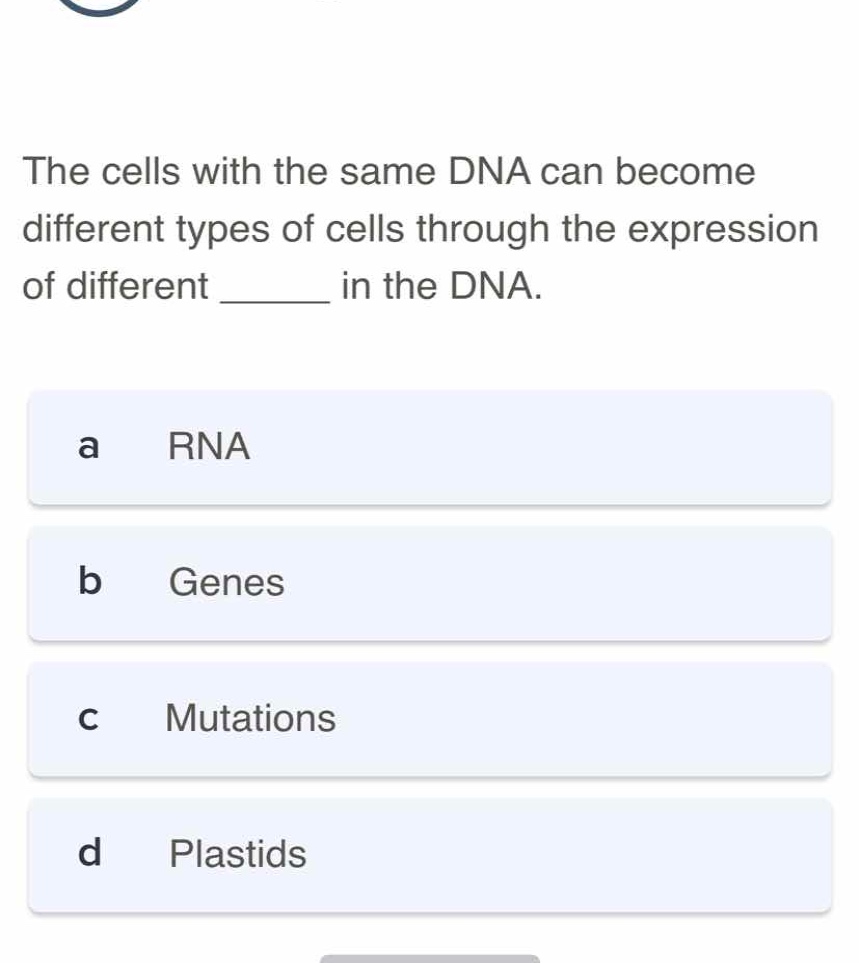
the cells with the same dna can become different types of cells through the expression of different ______ in the dna.

a rna
b genes
c mutations
d plastids

Explanation:

Response

<pre_analysis>
{
"quality": "clear",
"question_count": 1,
"skills_matched": [
"direct_cot",
"multiple_choice_formatter",
"explain_then_answer",
"tutor"
],
"needs_drawing": false,
"concepts_used": [
"Cellular Differentiation",
"Cell Specialization"
],
"new_concepts": [
"Gene Expression"
],
"current_concepts": [
"Cellular Differentiation",
"Cell Specialization",
"Gene Expression"
]
}
</pre_analysis>

<reasoning>

Analyze the core biological process

The question asks how cells with identical DNA can differentiate into distinct cell types. This process is known as Cellular Differentiation and Cell Specialization. Since all somatic cells in an organism share the exact same genome, their unique structures and functions are determined by which specific segments of DNA are turned "on" or "off."

Evaluate the role of DNA segments

The functional units of DNA that code for specific proteins are called genes. During development, different cell types express different subsets of these genes. This selective activation is called differential gene expression, which drives cells to synthesize specific proteins and acquire specialized characteristics.

Assess the given options

  • a) RNA: While RNA is transcribed from DNA, it is not a structural component "in the DNA" whose selective expression defines differentiation in this context.
  • b) Genes: Genes are the specific segments of DNA. The expression of different genes in the DNA allows cells with identical genomes to specialize.
  • c) Mutations: Mutations are permanent changes in the DNA sequence, which is not the mechanism for normal, programmed cellular development.
  • d) Plastids: Plastids are double-membrane organelles found in plants and algae, not segments of DNA.

</reasoning>

<answer>
<mcq-option>a RNA</mcq-option>
<mcq-correct>b Genes</mcq-correct>
<mcq-option>c Mutations</mcq-option>
<mcq-option>d Plastids</mcq-option>
</answer>

<post_analysis>
{
"subject": "Natural Science",
"question_type": "Multiple Choice",
"knowledge_point": [
"Natural Science",
"Biology",
"Gene Expression and Cellular Differentiation"
]
}
</post_analysis>

Answer:

<pre_analysis>
{
"quality": "clear",
"question_count": 1,
"skills_matched": [
"direct_cot",
"multiple_choice_formatter",
"explain_then_answer",
"tutor"
],
"needs_drawing": false,
"concepts_used": [
"Cellular Differentiation",
"Cell Specialization"
],
"new_concepts": [
"Gene Expression"
],
"current_concepts": [
"Cellular Differentiation",
"Cell Specialization",
"Gene Expression"
]
}
</pre_analysis>

<reasoning>

Analyze the core biological process

The question asks how cells with identical DNA can differentiate into distinct cell types. This process is known as Cellular Differentiation and Cell Specialization. Since all somatic cells in an organism share the exact same genome, their unique structures and functions are determined by which specific segments of DNA are turned "on" or "off."

Evaluate the role of DNA segments

The functional units of DNA that code for specific proteins are called genes. During development, different cell types express different subsets of these genes. This selective activation is called differential gene expression, which drives cells to synthesize specific proteins and acquire specialized characteristics.

Assess the given options

  • a) RNA: While RNA is transcribed from DNA, it is not a structural component "in the DNA" whose selective expression defines differentiation in this context.
  • b) Genes: Genes are the specific segments of DNA. The expression of different genes in the DNA allows cells with identical genomes to specialize.
  • c) Mutations: Mutations are permanent changes in the DNA sequence, which is not the mechanism for normal, programmed cellular development.
  • d) Plastids: Plastids are double-membrane organelles found in plants and algae, not segments of DNA.

</reasoning>

<answer>
<mcq-option>a RNA</mcq-option>
<mcq-correct>b Genes</mcq-correct>
<mcq-option>c Mutations</mcq-option>
<mcq-option>d Plastids</mcq-option>
</answer>

<post_analysis>
{
"subject": "Natural Science",
"question_type": "Multiple Choice",
"knowledge_point": [
"Natural Science",
"Biology",
"Gene Expression and Cellular Differentiation"
]
}
</post_analysis>