QUESTION IMAGE
Question
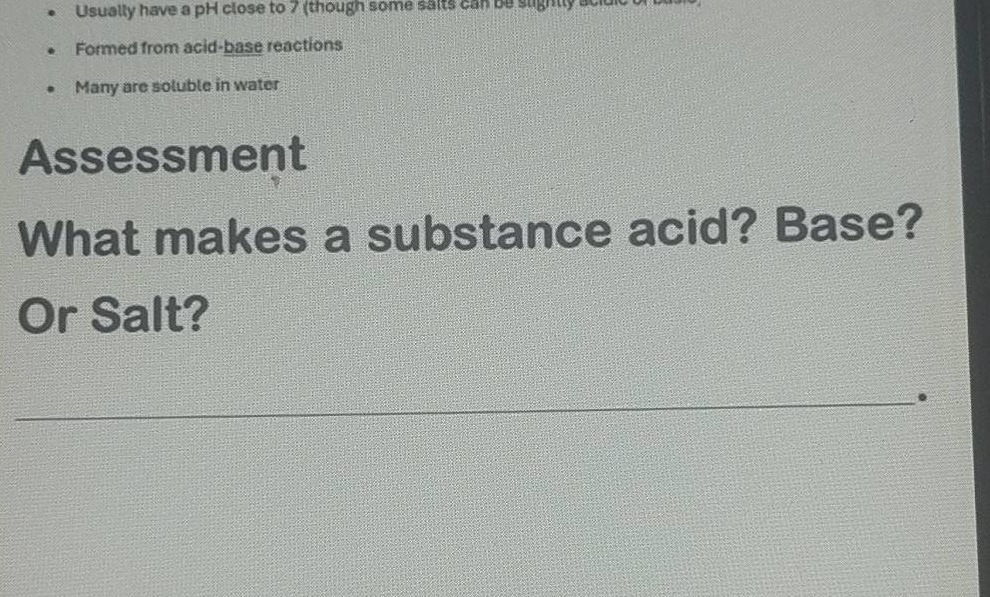
assessment
what makes a substance acid? base? or salt?
🆕 New Concept Discovered: Properties of Acids, Bases, and Salts
How chemical structures define these three classes of compounds
Step 1: Define what makes a substance an acid
An acid is a chemical substance that releases hydrogen ions \( \text{H}^+ \) when dissolved in water.
- Chemical behavior: They act as proton donors.
- Key properties: They have a pH value less than 7, taste sour, and turn blue litmus paper red.
Step 2: Define what makes a substance a base
A base is a chemical substance that can accept hydrogen ions or release hydroxide ions \( \text{OH}^- \) when dissolved in water.
- Chemical behavior: They act as proton acceptors. Water-soluble bases are specifically called alkalis.
- Key properties: They have a pH value greater than 7, taste bitter, feel slippery to the touch, and turn red litmus paper blue.
Step 3: Define what makes a substance a salt
A salt is an ionic compound formed when an acid reacts with a base in a neutralization reaction.
- Chemical behavior: It consists of a positive ion (cation) from a base and a negative ion (anion) from an acid.
- Key properties: They are generally neutral (pH close to 7, though some can be slightly acidic or basic), are typically crystalline solids, and many dissolve easily in water.

Snap & solve any problem in the app
Get step-by-step solutions on Sovi AI
Photo-based solutions with guided steps
Explore more problems and detailed explanations
- Acid: A substance that releases hydrogen ions \( \text{H}^+ \) in water, has a pH less than 7, and tastes sour.
- Base: A substance that accepts hydrogen ions (or releases hydroxide ions \( \text{OH}^- \) in water), has a pH greater than 7, and feels slippery.
- Salt: An ionic compound formed from the neutralization reaction between an acid and a base, typically having a pH close to 7.