QUESTION IMAGE
Question
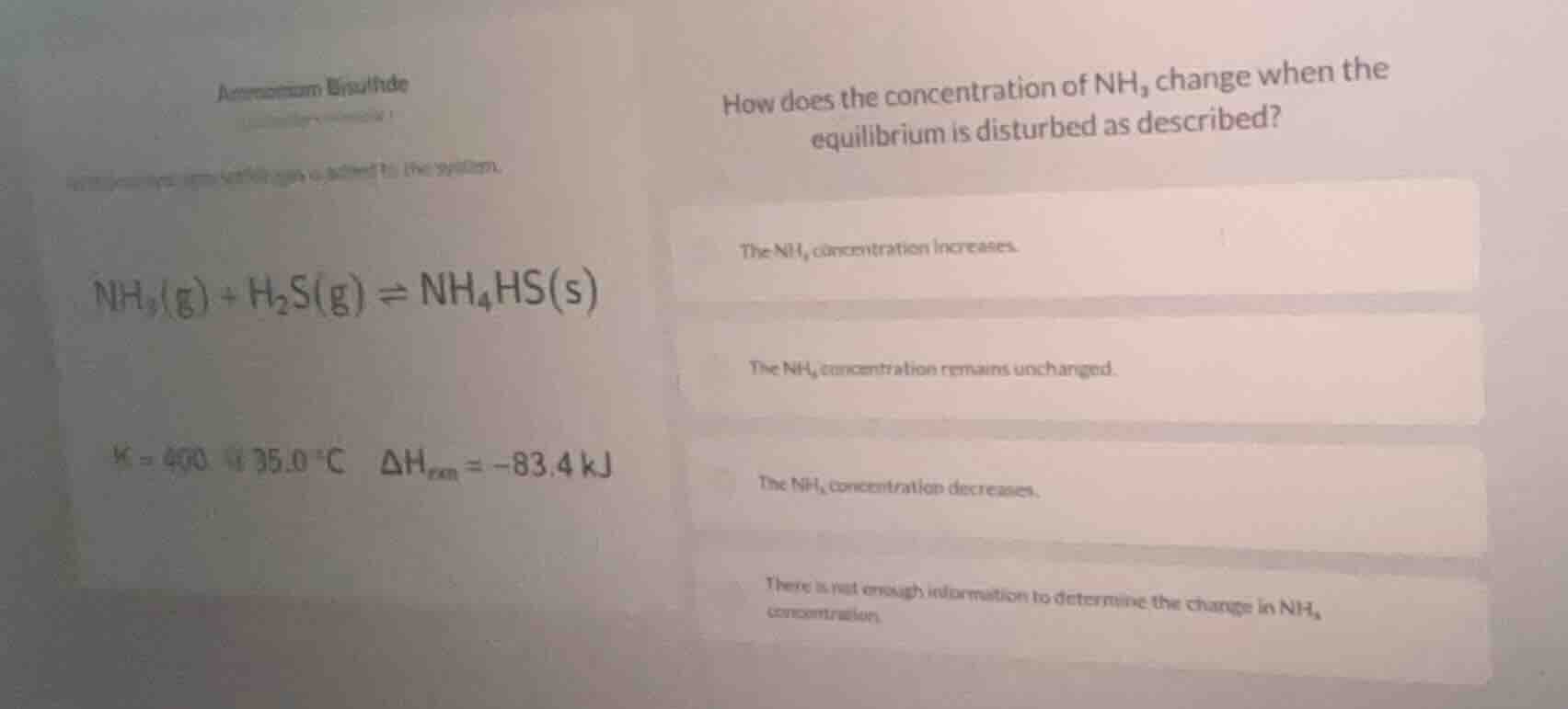
ammonium bisulfide
unreadable text describing the disturbance to the system
\\(\text{nh}_3(g) + \text{h}_2\text{s}(g) \
ightleftharpoons \text{nh}_4\text{hs}(s)\\)
\\(k = 400\\) at \\(35.0\\,^{\circ}\text{c}\\) \\(\delta h_{\text{rxn}} = -83.4\text{ kj}\\)
how does the concentration of \\(\text{nh}_3\\) change when the equilibrium is disturbed as described?
- the \\(\text{nh}_3\\) concentration increases.
- the \\(\text{nh}_3\\) concentration remains unchanged.
- the \\(\text{nh}_3\\) concentration decreases.
- there is not enough information to determine the change in \\(\text{nh}_3\\) concentration.
Identify the chemical system and disturbance
Using the Chemical Equilibrium knowledge point
The disturbance is: "Additional hydrogen sulfide gas is added to the system."
Apply Le Chatelier's principle
We analyze the effect of adding a reactant gas to the equilibrium mixture.
- Adding \(\text{H}_2\text{S}(g)\) increases its concentration.
- The system shifts to consume the added reactant.
- The forward reaction is favored to reduce \(\text{H}_2\text{S}\).
Determine the change in ammonia concentration
We determine how the shift affects the other reactant, \(\text{NH}_3\).
- The forward reaction consumes both \(\text{NH}_3(g)\) and \(\text{H}_2\text{S}(g)\).
- Therefore, the concentration of \(\text{NH}_3\) must decrease.

Snap & solve any problem in the app
Get step-by-step solutions on Sovi AI
Photo-based solutions with guided steps
Explore more problems and detailed explanations
- The \(\text{NH}_3\) concentration increases.
- The \(\text{NH}_3\) concentration remains unchanged.
- The \(\text{NH}_3\) concentration decreases. (Correct answer)
- There is not enough information to determine the change in \(\text{NH}_3\) concentration.