QUESTION IMAGE
Question
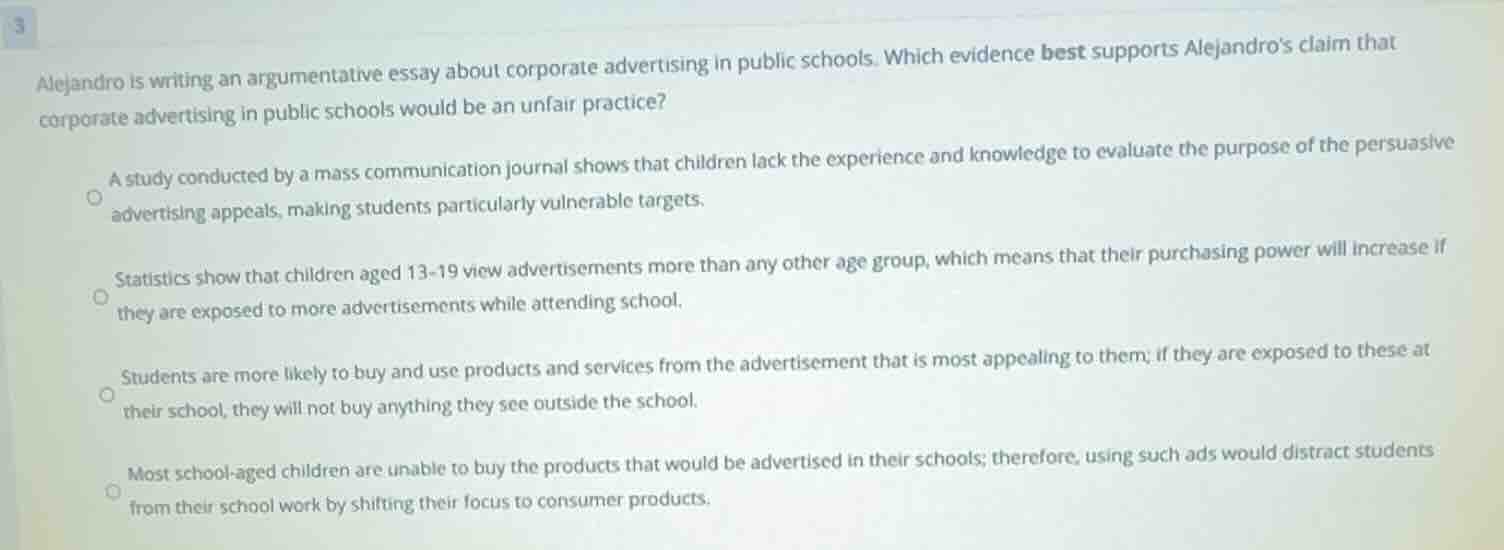
alejandro is writing an argumentative essay about corporate advertising in public schools. which evidence best supports alejandros claim that corporate advertising in public schools would be an unfair practice?
a study conducted by a mass communication journal shows that children lack the experience and knowledge to evaluate the purpose of the persuasive advertising appeals, making students particularly vulnerable targets.
statistics show that children aged 13-19 view advertisements more than any other age group, which means that their purchasing power will increase if they are exposed to more advertisements while attending school.
students are more likely to buy and use products and services from the advertisement that is most appealing to them; if they are exposed to these at their school, they will not buy anything they see outside the school.
most school-aged children are unable to buy the products that would be advertised in their schools; therefore, using such ads would distract students from their school work by shifting their focus to consumer products.
<pre_analysis>
{
"quality": "clear",
"question_count": 1,
"skills_matched": [
"direct_cot",
"multiple_choice_formatter",
"explain_then_answer",
"tutor"
],
"needs_drawing": false,
"concepts_used": [],
"new_concepts": [
"Argumentative Evidence",
"Evaluating Claims"
],
"current_concepts": [
"Argumentative Evidence",
"Evaluating Claims"
]
}
</pre_analysis>
<reasoning>
Analyze the core claim
The prompt states Alejandro is arguing that corporate advertising in public schools is an "unfair practice." We must find the evidence that directly supports why this practice is unfair.
Evaluate the first option
The first option states that children lack the experience and knowledge to evaluate persuasive advertising, making them "vulnerable targets." Targeting a vulnerable population that cannot defend itself or make informed choices is a classic definition of an unfair practice. This strongly supports the claim.
Evaluate the second option
The second option discusses viewing statistics and purchasing power. Increased purchasing power does not inherently make the practice of advertising "unfair"; it merely describes an economic effect.
Evaluate the third option
The third option claims students will not buy anything outside of school if exposed to ads inside school. This is a speculative behavioral claim and does not address the ethical unfairness of the advertising itself.
Evaluate the fourth option
The fourth option suggests ads are distracting because children cannot buy the products. While distraction is a negative outcome, it does not directly support the specific claim of the practice being "unfair" as strongly as the developmental vulnerability of the target audience.
</reasoning>
<answer>
<mcq-correct>(A) A study conducted by a mass communication journal shows that children lack the experience and knowledge to evaluate the purpose of the persuasive advertising appeals, making students particularly vulnerable targets.</mcq-correct>
<mcq-option>(B) Statistics show that children aged 13-19 view advertisements more than any other age group, which means that their purchasing power will increase if they are exposed to more advertisements while attending school.</mcq-option>
<mcq-option>(C) Students are more likely to buy and use products and services from the advertisement that is most appealing to them; if they are exposed to these at their school, they will not buy anything they see outside the school.</mcq-option>
<mcq-option>(D) Most school-aged children are unable to buy the products that would be advertised in their schools; therefore, using such ads would distract students from their school work by shifting their focus to consumer products.</mcq-option>
</answer>
<post_analysis>
{
"subject": "Others",
"question_type": "Multiple Choice",
"knowledge_point": [
"Others",
"English Language Arts",
"Argumentative Writing"
]
}
</post_analysis>
Snap & solve any problem in the app
Get step-by-step solutions on Sovi AI
Photo-based solutions with guided steps
Explore more problems and detailed explanations
<pre_analysis>
{
"quality": "clear",
"question_count": 1,
"skills_matched": [
"direct_cot",
"multiple_choice_formatter",
"explain_then_answer",
"tutor"
],
"needs_drawing": false,
"concepts_used": [],
"new_concepts": [
"Argumentative Evidence",
"Evaluating Claims"
],
"current_concepts": [
"Argumentative Evidence",
"Evaluating Claims"
]
}
</pre_analysis>
<reasoning>
Analyze the core claim
The prompt states Alejandro is arguing that corporate advertising in public schools is an "unfair practice." We must find the evidence that directly supports why this practice is unfair.
Evaluate the first option
The first option states that children lack the experience and knowledge to evaluate persuasive advertising, making them "vulnerable targets." Targeting a vulnerable population that cannot defend itself or make informed choices is a classic definition of an unfair practice. This strongly supports the claim.
Evaluate the second option
The second option discusses viewing statistics and purchasing power. Increased purchasing power does not inherently make the practice of advertising "unfair"; it merely describes an economic effect.
Evaluate the third option
The third option claims students will not buy anything outside of school if exposed to ads inside school. This is a speculative behavioral claim and does not address the ethical unfairness of the advertising itself.
Evaluate the fourth option
The fourth option suggests ads are distracting because children cannot buy the products. While distraction is a negative outcome, it does not directly support the specific claim of the practice being "unfair" as strongly as the developmental vulnerability of the target audience.
</reasoning>
<answer>
<mcq-correct>(A) A study conducted by a mass communication journal shows that children lack the experience and knowledge to evaluate the purpose of the persuasive advertising appeals, making students particularly vulnerable targets.</mcq-correct>
<mcq-option>(B) Statistics show that children aged 13-19 view advertisements more than any other age group, which means that their purchasing power will increase if they are exposed to more advertisements while attending school.</mcq-option>
<mcq-option>(C) Students are more likely to buy and use products and services from the advertisement that is most appealing to them; if they are exposed to these at their school, they will not buy anything they see outside the school.</mcq-option>
<mcq-option>(D) Most school-aged children are unable to buy the products that would be advertised in their schools; therefore, using such ads would distract students from their school work by shifting their focus to consumer products.</mcq-option>
</answer>
<post_analysis>
{
"subject": "Others",
"question_type": "Multiple Choice",
"knowledge_point": [
"Others",
"English Language Arts",
"Argumentative Writing"
]
}
</post_analysis>