QUESTION IMAGE
Question
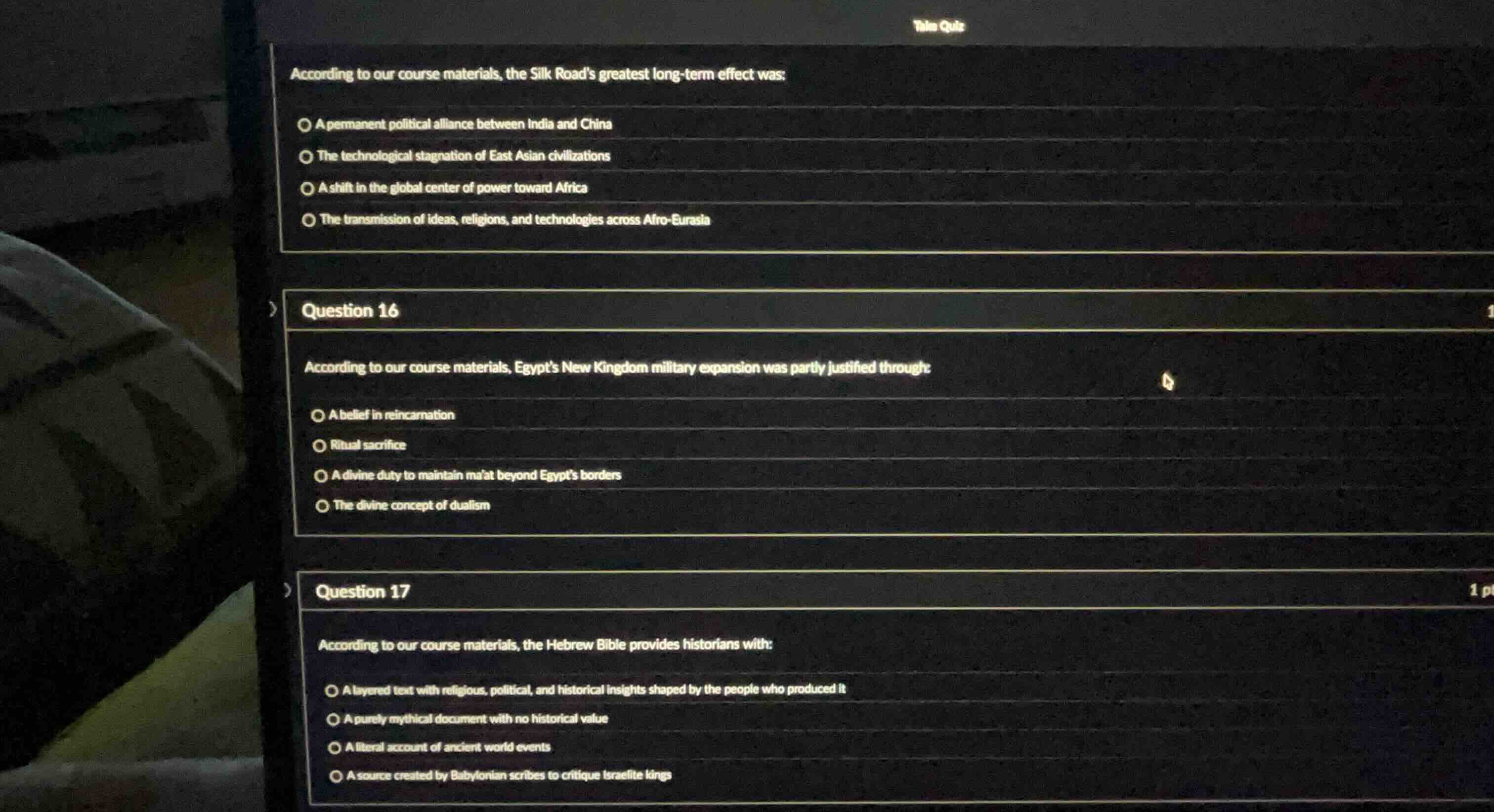
according to our course materials, the silk roads greatest long-term effect was:
a permanent political alliance between india and china
the technological stagnation of east asian civilizations
a shift in the global center of power toward africa
the transmission of ideas, religions, and technologies across afro-eurasia
question 16
according to our course materials, egypts new kingdom military expansion was partly justified through:
a belief in reincarnation
ritual sacrifice
a divine duty to maintain maat beyond egypts borders
the divine concept of dualism
question 17
according to our course materials, the hebrew bible provides historians with:
a layered text with religious, political, and historical insights shaped by the people who produced it
a purely mythical document with no historical value
a literal account of ancient world events
a source created by babylonian scribes to critique israelite kings
<pre_analysis>
{
"quality": "clear",
"question_count": 3,
"skills_matched": [
"direct_cot",
"multiple_choice_formatter",
"explain_then_answer",
"quick"
],
"needs_drawing": false,
"concepts_used": [
"Silk Road Trade",
"New Kingdom Egypt",
"Biblical Historiography"
],
"new_concepts": [],
"current_concepts": [
"Silk Road Trade",
"New Kingdom Egypt",
"Biblical Historiography"
]
}
</pre_analysis>
<reasoning>
Analyze the first question on the Silk Road
The Silk Road was primarily a network of trade routes, but its most significant long-term impact was the cultural, religious, and technological exchange across Afro-Eurasia rather than political alliances or stagnation.
Analyze Question 16 on Egypt's New Kingdom
New Kingdom Egypt's military expansion was ideologically justified by the concept of ma'at (cosmic order, justice, and balance). Pharaohs claimed a divine duty to extend and maintain ma'at beyond Egypt's borders to keep chaos at bay.
Analyze Question 17 on the Hebrew Bible
From a historical methodology perspective, the Hebrew Bible is analyzed as a composite, layered text reflecting the religious, political, and historical perspectives of the various societies and authors who compiled it over centuries.
</reasoning>
<answer>
Question 15
<mcq-option>(A) A permanent political alliance between India and China</mcq-option>
<mcq-option>(B) The technological stagnation of East Asian civilizations</mcq-option>
<mcq-option>(C) A shift in the global center of power toward Africa</mcq-option>
<mcq-correct>(D) The transmission of ideas, religions, and technologies across Afro-Eurasia</mcq-correct>
Question 16
<mcq-option>(A) A belief in reincarnation</mcq-option>
<mcq-option>(B) Ritual sacrifice</mcq-option>
<mcq-correct>(C) A divine duty to maintain ma'at beyond Egypt's borders</mcq-correct>
<mcq-option>(D) The divine concept of dualism</mcq-option>
Question 17
<mcq-correct>(A) A layered text with religious, political, and historical insights shaped by the people who produced it</mcq-correct>
<mcq-option>(B) A purely mythical document with no historical value</mcq-option>
<mcq-option>(C) A literal account of ancient world events</mcq-option>
<mcq-option>(D) A source created by Babylonian scribes to critique Israelite kings</mcq-option>
</answer>
<post_analysis>
{
"subject": "Social Science",
"question_type": "Multiple Choice",
"knowledge_point": [
"Social Science",
"History",
"Ancient World History"
]
}
</post_analysis>
Snap & solve any problem in the app
Get step-by-step solutions on Sovi AI
Photo-based solutions with guided steps
Explore more problems and detailed explanations
<pre_analysis>
{
"quality": "clear",
"question_count": 3,
"skills_matched": [
"direct_cot",
"multiple_choice_formatter",
"explain_then_answer",
"quick"
],
"needs_drawing": false,
"concepts_used": [
"Silk Road Trade",
"New Kingdom Egypt",
"Biblical Historiography"
],
"new_concepts": [],
"current_concepts": [
"Silk Road Trade",
"New Kingdom Egypt",
"Biblical Historiography"
]
}
</pre_analysis>
<reasoning>
Analyze the first question on the Silk Road
The Silk Road was primarily a network of trade routes, but its most significant long-term impact was the cultural, religious, and technological exchange across Afro-Eurasia rather than political alliances or stagnation.
Analyze Question 16 on Egypt's New Kingdom
New Kingdom Egypt's military expansion was ideologically justified by the concept of ma'at (cosmic order, justice, and balance). Pharaohs claimed a divine duty to extend and maintain ma'at beyond Egypt's borders to keep chaos at bay.
Analyze Question 17 on the Hebrew Bible
From a historical methodology perspective, the Hebrew Bible is analyzed as a composite, layered text reflecting the religious, political, and historical perspectives of the various societies and authors who compiled it over centuries.
</reasoning>
<answer>
Question 15
<mcq-option>(A) A permanent political alliance between India and China</mcq-option>
<mcq-option>(B) The technological stagnation of East Asian civilizations</mcq-option>
<mcq-option>(C) A shift in the global center of power toward Africa</mcq-option>
<mcq-correct>(D) The transmission of ideas, religions, and technologies across Afro-Eurasia</mcq-correct>
Question 16
<mcq-option>(A) A belief in reincarnation</mcq-option>
<mcq-option>(B) Ritual sacrifice</mcq-option>
<mcq-correct>(C) A divine duty to maintain ma'at beyond Egypt's borders</mcq-correct>
<mcq-option>(D) The divine concept of dualism</mcq-option>
Question 17
<mcq-correct>(A) A layered text with religious, political, and historical insights shaped by the people who produced it</mcq-correct>
<mcq-option>(B) A purely mythical document with no historical value</mcq-option>
<mcq-option>(C) A literal account of ancient world events</mcq-option>
<mcq-option>(D) A source created by Babylonian scribes to critique Israelite kings</mcq-option>
</answer>
<post_analysis>
{
"subject": "Social Science",
"question_type": "Multiple Choice",
"knowledge_point": [
"Social Science",
"History",
"Ancient World History"
]
}
</post_analysis>