QUESTION IMAGE
Question
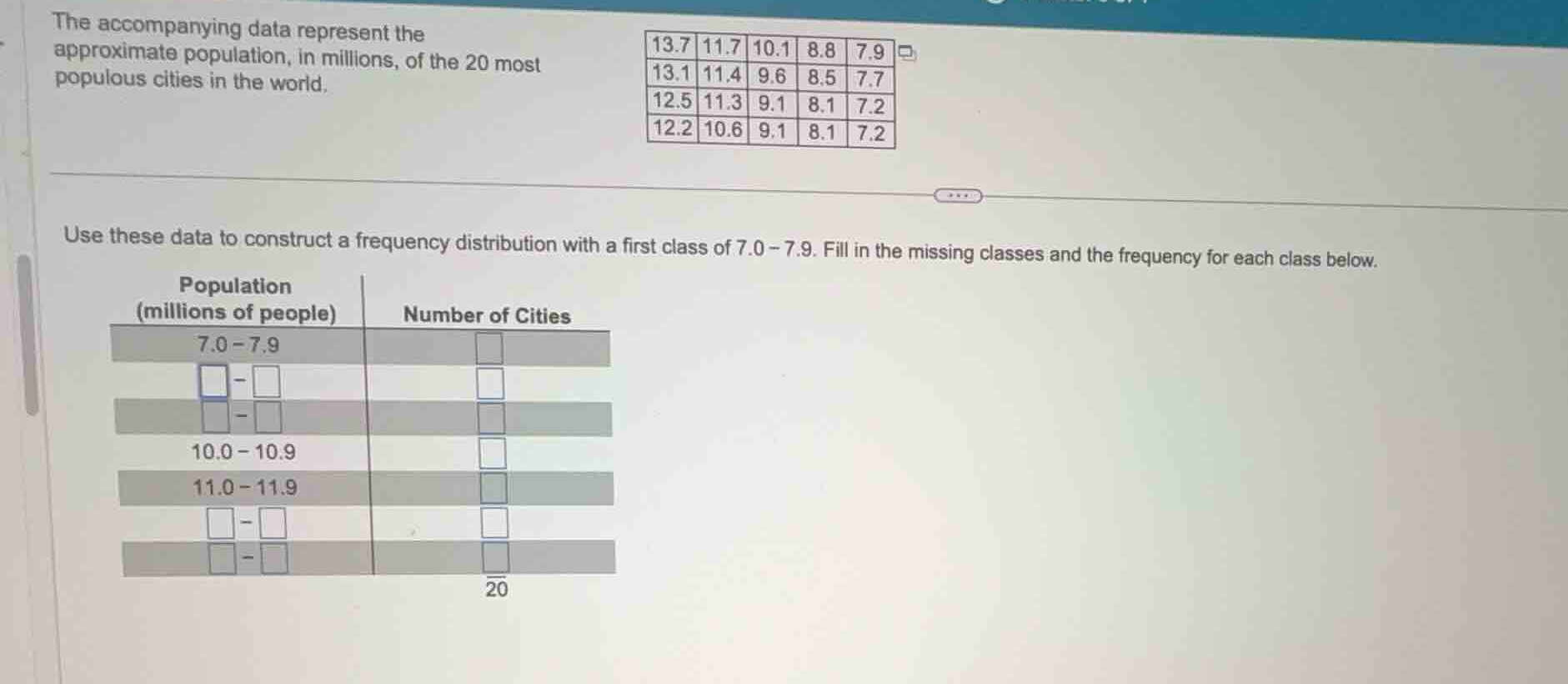
the accompanying data represent the approximate population, in millions, of the 20 most populous cities in the world.
\
use these data to construct a frequency distribution with a first class of 7.0 - 7.9. fill in the missing classes and the frequency for each class below.
\
Determine class width and limits
Using the Class Limits and Class Width knowledge points
The first class is given as \(7.0 - 7.9\).
The lower class limit of the first class is \(7.0\), and the upper class limit is \(7.9\).
The class width is the difference between consecutive lower class limits:
Using this width, we construct the consecutive classes:
- Class 1: \(7.0 - 7.9\)
- Class 2: \(8.0 - 8.9\)
- Class 3: \(9.0 - 9.9\)
- Class 4: \(10.0 - 10.9\)
- Class 5: \(11.0 - 11.9\)
- Class 6: \(12.0 - 12.9\)
- Class 7: \(13.0 - 13.9\)
Sort the data values
Using the Frequency Distribution knowledge point
We sort the 20 given data points in ascending order:
Count frequencies for each class
Using the Frequency Distribution knowledge point
We count how many data points fall into each class interval:
- For \(7.0 - 7.9\): \(7.2, 7.2, 7.7, 7.9\) \(
ightarrow 4\) cities
- For \(8.0 - 8.9\): \(8.1, 8.1, 8.5, 8.8\) \(
ightarrow 4\) cities
- For \(9.0 - 9.9\): \(9.1, 9.1, 9.6\) \(
ightarrow 3\) cities
- For \(10.0 - 10.9\): \(10.1, 10.6\) \(
ightarrow 2\) cities
- For \(11.0 - 11.9\): \(11.3, 11.4, 11.7\) \(
ightarrow 3\) cities
- For \(12.0 - 12.9\): \(12.2, 12.5\) \(
ightarrow 2\) cities
- For \(13.0 - 13.9\): \(13.1, 13.7\) \(
ightarrow 2\) cities
Total sum check: \(4 + 4 + 3 + 2 + 3 + 2 + 2 = 20\).

Snap & solve any problem in the app
Get step-by-step solutions on Sovi AI
Photo-based solutions with guided steps
Explore more problems and detailed explanations
| Population (millions of people) | Number of Cities |
|---|---|
| \(8.0 - 8.9\) | \(4\) |
| \(9.0 - 9.9\) | \(3\) |
| \(10.0 - 10.9\) | \(2\) |
| \(11.0 - 11.9\) | \(3\) |
| \(12.0 - 12.9\) | \(2\) |
| \(13.0 - 13.9\) | \(2\) |