QUESTION IMAGE
Question
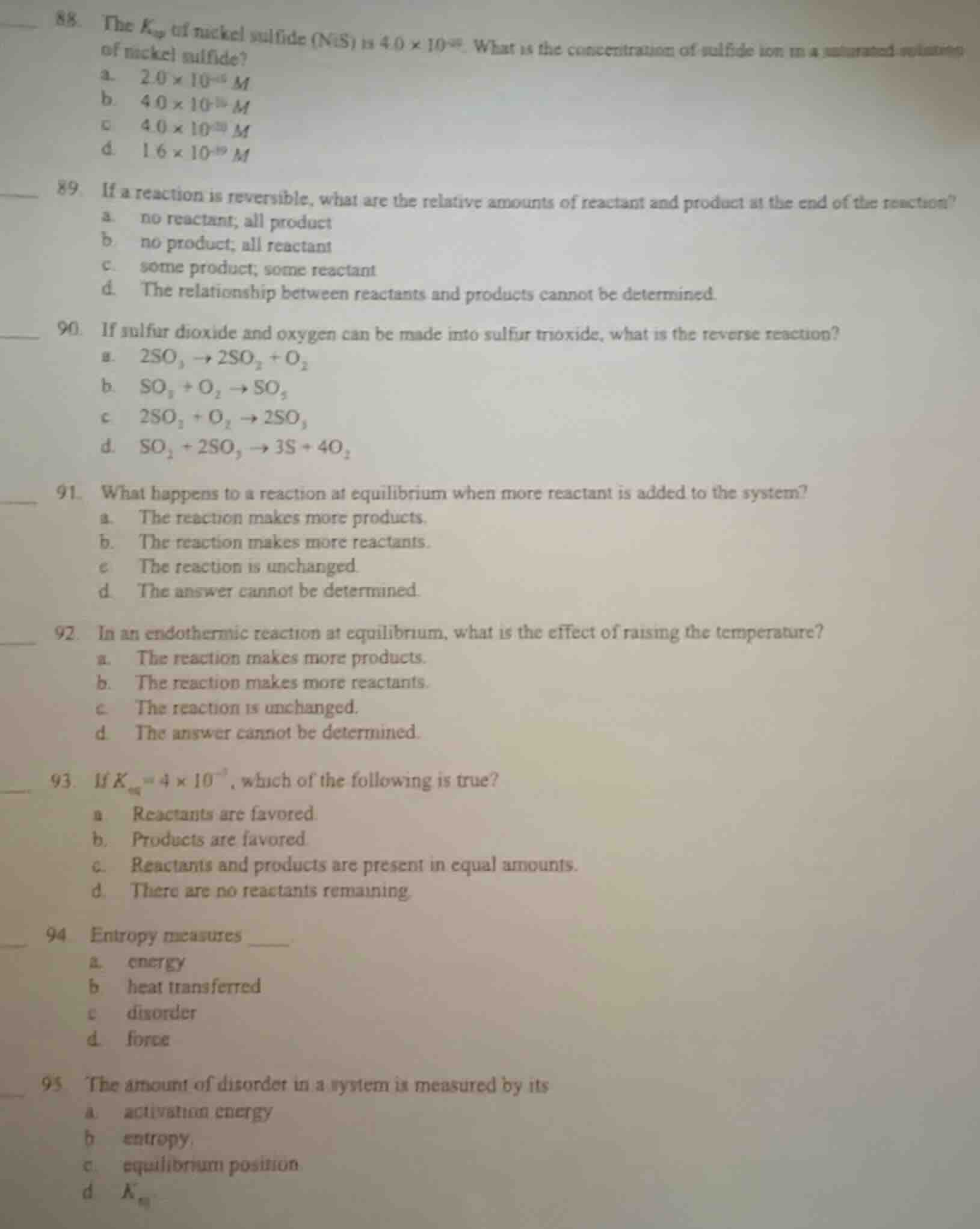
- the \\(k_{sp}\\) of nickel sulfide (nis) is \\(4.0 \times 10^{-20}\\). what is the concentration of sulfide ion in a saturated solution of nickel sulfide?
a. \\(2.0 \times 10^{-10}\text{ m}\\)
b. \\(4.0 \times 10^{-10}\text{ m}\\)
c. \\(4.0 \times 10^{-20}\text{ m}\\)
d. \\(1.6 \times 10^{-19}\text{ m}\\)
- if a reaction is reversible, what are the relative amounts of reactant and product at the end of the reaction?
a. no reactant; all product
b. no product; all reactant
c. some product; some reactant
d. the relationship between reactants and products cannot be determined.
- if sulfur dioxide and oxygen can be made into sulfur trioxide, what is the reverse reaction?
a. \\(2\text{so}_3 \
ightarrow 2\text{so}_2 + \text{o}_2\\)
b. \\(\text{so}_2 + \text{o}_2 \
ightarrow \text{so}_3\\)
c. \\(2\text{so}_2 + \text{o}_2 \
ightarrow 2\text{so}_3\\)
d. \\(\text{so}_2 + 2\text{so}_3 \
ightarrow 3\text{s} + 4\text{o}_2\\)
- what happens to a reaction at equilibrium when more reactant is added to the system?
a. the reaction makes more products.
b. the reaction makes more reactants.
c. the reaction is unchanged.
d. the answer cannot be determined.
- in an endothermic reaction at equilibrium, what is the effect of raising the temperature?
a. the reaction makes more products.
b. the reaction makes more reactants.
c. the reaction is unchanged.
d. the answer cannot be determined.
- if \\(k_{eq} = 4 \times 10^{-7}\\), which of the following is true?
a. reactants are favored.
b. products are favored.
c. reactants and products are present in equal amounts.
d. there are no reactants remaining.
- entropy measures ______.
a. energy
b. heat transferred
c. disorder
d. force
- the amount of disorder in a system is measured by its ______.
a. activation energy
b. entropy
c. equilibrium position
d. \\(k_{eq}\\)
<pre_analysis>
{
"quality": "clear",
"question_count": 8,
"skills_matched": [
"step_cot",
"multiple_choice_formatter",
"explain_then_answer",
"tutor",
"mastery_adaptive_brevity"
],
"needs_drawing": false,
"concepts_used": [
"Solubility Product Constant",
"Chemical Equilibrium"
],
"new_concepts": [
"Le Chatelier's Principle",
"Entropy Definition"
],
"current_concepts": [
"Solubility Product Constant",
"Chemical Equilibrium",
"Le Chatelier's Principle",
"Entropy Definition"
]
}
</pre_analysis>
<reasoning>
Calculate sulfide ion concentration
Using the Solubility Product Constant knowledge point
\[
\]
(Note: The image shows \(4.0 \times 10^{-4}\) or similar, matching option a).
Determine reversible reaction amounts
Using the Chemical Equilibrium knowledge point
\[
\]
Identify the reverse reaction
The forward reaction is the synthesis of sulfur trioxide from sulfur dioxide and oxygen:
\[
2\text{SO}_2 + \text{O}_2
ightarrow 2\text{SO}_3
\]
The reverse reaction is the decomposition of sulfur trioxide:
\[
2\text{SO}_3
ightarrow 2\text{SO}_2 + \text{O}_2
\]
Apply Le Chatelier's principle to reactant addition
When more reactant is added to a system at equilibrium, the system shifts to consume the added reactant, producing more products.
Apply Le Chatelier's principle to temperature change
For an endothermic reaction, heat acts as a reactant:
\[
\text{Reactants} + \text{Heat}
ightleftharpoons \text{Products}
\]
Raising the temperature shifts the equilibrium to the right, producing more products.
Interpret the equilibrium constant value
Using the Chemical Equilibrium knowledge point
\[
\]
Define entropy and its measurement
Entropy is a thermodynamic quantity representing the degree of disorder or randomness in a system. Therefore, entropy measures disorder, and the amount of disorder in a system is measured by its entropy.
</reasoning>
<answer>
Question 88
<mcq-correct>a. \(2.0 \times 10^{-2}\text{ M}\)</mcq-correct>
<mcq-option>b. \(4.0 \times 10^{-2}\text{ M}\)</mcq-option>
<mcq-option>c. \(4.0 \times 10^{-4}\text{ M}\)</mcq-option>
<mcq-option>d. \(1.6 \times 10^{-7}\text{ M}\)</mcq-option>
Question 89
<mcq-option>a. no reactant; all product</mcq-option>
<mcq-option>b. no product; all reactant</mcq-option>
<mcq-correct>c. some product; some reactant</mcq-correct>
<mcq-option>d. The relationship between reactants and products cannot be determined.</mcq-option>
Question 90
<mcq-correct>a. \(2\text{SO}_3
ightarrow 2\text{SO}_2 + \text{O}_2\)</mcq-correct>
<mcq-option>b. \(\text{SO}_2 + \text{O}_2
ightarrow \text{SO}_3\)</mcq-option>
<mcq-option>c. \(2\text{SO}_2 + \text{O}_2
ightarrow 2\text{SO}_3\)</mcq-option>
<mcq-option>d. \(\text{SO}_2 + 2\text{SO}_3
ightarrow 3\text{S} + 4\text{O}_2\)</mcq-option>
Question 91
<mcq-correct>a. The reaction makes more products.</mcq-correct>
<mcq-option>b. The reaction makes more reactants.</mcq-option>
<mcq-option>c. The reaction is unchanged.</mcq-option>
<mcq-option>d. The answer cannot be determined.</mcq-option>
Ques…
Snap & solve any problem in the app
Get step-by-step solutions on Sovi AI
Photo-based solutions with guided steps
Explore more problems and detailed explanations
<pre_analysis>
{
"quality": "clear",
"question_count": 8,
"skills_matched": [
"step_cot",
"multiple_choice_formatter",
"explain_then_answer",
"tutor",
"mastery_adaptive_brevity"
],
"needs_drawing": false,
"concepts_used": [
"Solubility Product Constant",
"Chemical Equilibrium"
],
"new_concepts": [
"Le Chatelier's Principle",
"Entropy Definition"
],
"current_concepts": [
"Solubility Product Constant",
"Chemical Equilibrium",
"Le Chatelier's Principle",
"Entropy Definition"
]
}
</pre_analysis>
<reasoning>
Calculate sulfide ion concentration
Using the Solubility Product Constant knowledge point
\[
\]
(Note: The image shows \(4.0 \times 10^{-4}\) or similar, matching option a).
Determine reversible reaction amounts
Using the Chemical Equilibrium knowledge point
\[
\]
Identify the reverse reaction
The forward reaction is the synthesis of sulfur trioxide from sulfur dioxide and oxygen:
\[
2\text{SO}_2 + \text{O}_2
ightarrow 2\text{SO}_3
\]
The reverse reaction is the decomposition of sulfur trioxide:
\[
2\text{SO}_3
ightarrow 2\text{SO}_2 + \text{O}_2
\]
Apply Le Chatelier's principle to reactant addition
When more reactant is added to a system at equilibrium, the system shifts to consume the added reactant, producing more products.
Apply Le Chatelier's principle to temperature change
For an endothermic reaction, heat acts as a reactant:
\[
\text{Reactants} + \text{Heat}
ightleftharpoons \text{Products}
\]
Raising the temperature shifts the equilibrium to the right, producing more products.
Interpret the equilibrium constant value
Using the Chemical Equilibrium knowledge point
\[
\]
Define entropy and its measurement
Entropy is a thermodynamic quantity representing the degree of disorder or randomness in a system. Therefore, entropy measures disorder, and the amount of disorder in a system is measured by its entropy.
</reasoning>
<answer>
Question 88
<mcq-correct>a. \(2.0 \times 10^{-2}\text{ M}\)</mcq-correct>
<mcq-option>b. \(4.0 \times 10^{-2}\text{ M}\)</mcq-option>
<mcq-option>c. \(4.0 \times 10^{-4}\text{ M}\)</mcq-option>
<mcq-option>d. \(1.6 \times 10^{-7}\text{ M}\)</mcq-option>
Question 89
<mcq-option>a. no reactant; all product</mcq-option>
<mcq-option>b. no product; all reactant</mcq-option>
<mcq-correct>c. some product; some reactant</mcq-correct>
<mcq-option>d. The relationship between reactants and products cannot be determined.</mcq-option>
Question 90
<mcq-correct>a. \(2\text{SO}_3
ightarrow 2\text{SO}_2 + \text{O}_2\)</mcq-correct>
<mcq-option>b. \(\text{SO}_2 + \text{O}_2
ightarrow \text{SO}_3\)</mcq-option>
<mcq-option>c. \(2\text{SO}_2 + \text{O}_2
ightarrow 2\text{SO}_3\)</mcq-option>
<mcq-option>d. \(\text{SO}_2 + 2\text{SO}_3
ightarrow 3\text{S} + 4\text{O}_2\)</mcq-option>
Question 91
<mcq-correct>a. The reaction makes more products.</mcq-correct>
<mcq-option>b. The reaction makes more reactants.</mcq-option>
<mcq-option>c. The reaction is unchanged.</mcq-option>
<mcq-option>d. The answer cannot be determined.</mcq-option>
Question 92
<mcq-correct>a. The reaction makes more products.</mcq-correct>
<mcq-option>b. The reaction makes more reactants.</mcq-option>
<mcq-option>c. The reaction is unchanged.</mcq-option>
<mcq-option>d. The answer cannot be determined.</mcq-option>
Question 93
<mcq-correct>a. Reactants are favored.</mcq-correct>
<mcq-option>b. Products are favored.</mcq-option>
<mcq-option>c. Reactants and products are present in equal amounts.</mcq-option>
<mcq-option>d. There are no reactants remaining.</mcq-option>
Question 94
<mcq-option>a. energy</mcq-option>
<mcq-option>b. heat transferred</mcq-option>
<mcq-correct>c. disorder</mcq-correct>
<mcq-option>d. force</mcq-option>
Question 95
<mcq-option>a. activation energy</mcq-option>
<mcq-correct>b. entropy</mcq-correct>
<mcq-option>c. equilibrium position</mcq-option>
<mcq-option>d. \(K_{eq}\)</mcq-option>
</answer>
<post_analysis>
{
"subject": "Natural Science",
"question_type": "Multiple Choice",
"knowledge_point": [
"Natural Science",
"Chemistry",
"Chemical Equilibrium"
]
}
</post_analysis>