Sovi.AI - AI Math Tutor

Scan to solve math questions

QUESTION IMAGE

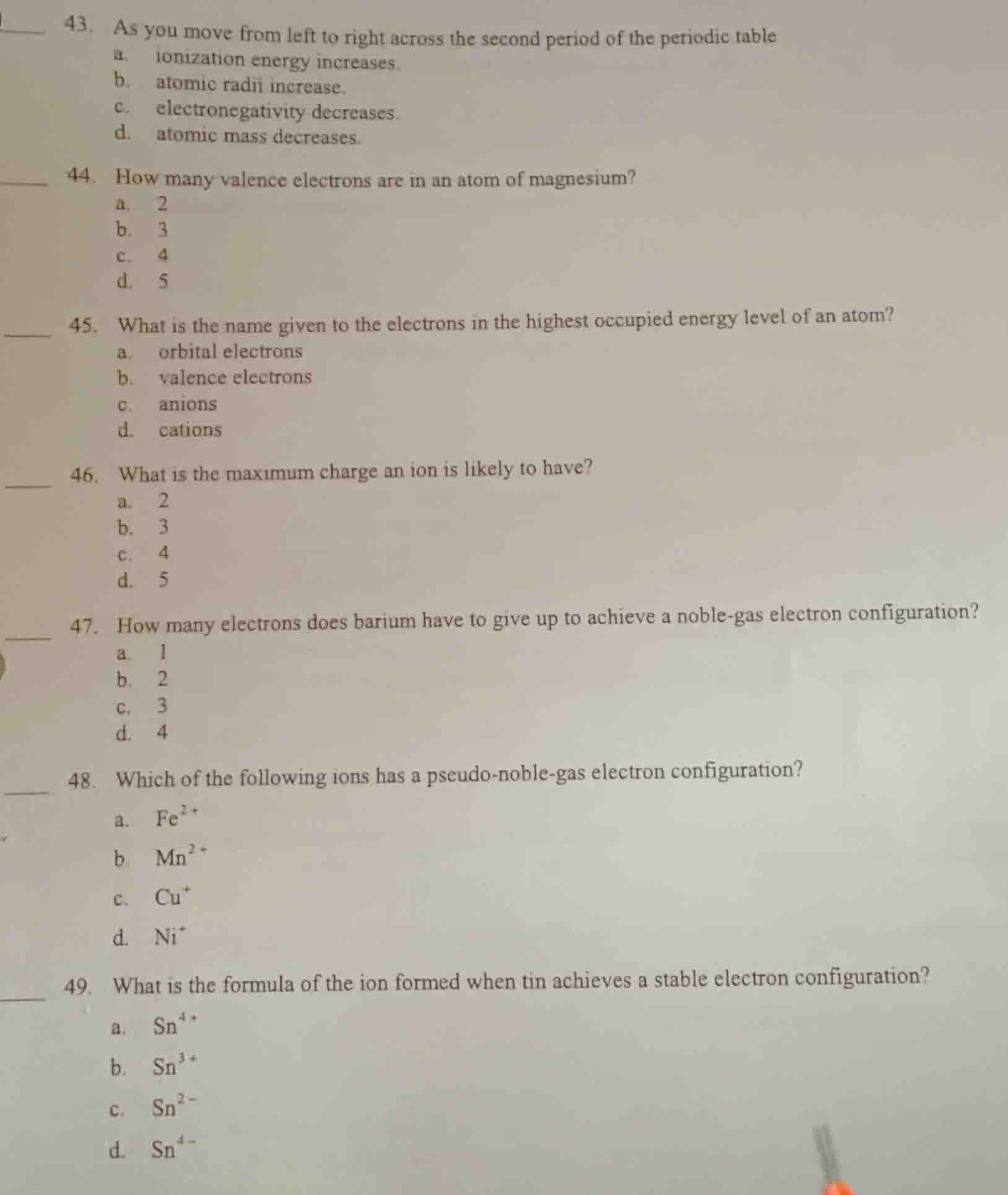
43. as you move from left to right across the second period of the peri…

Question

  1. as you move from left to right across the second period of the periodic table

a. ionization energy increases.
b. atomic radii increase.
c. electronegativity decreases.
d. atomic mass decreases.

  1. how many valence electrons are in an atom of magnesium?

a. 2
b. 3
c. 4
d. 5

  1. what is the name given to the electrons in the highest occupied energy level of an atom?

a. orbital electrons
b. valence electrons
c. anions
d. cations

  1. what is the maximum charge an ion is likely to have?

a. 2
b. 3
c. 4
d. 5

  1. how many electrons does barium have to give up to achieve a noble-gas electron configuration?

a. 1
b. 2
c. 3
d. 4

  1. which of the following ions has a pseudo-noble-gas electron configuration?

a. \\(\text{fe}^{2+}\\)
b. \\(\text{mn}^{2+}\\)
c. \\(\text{cu}^{+}\\)
d. \\(\text{ni}^{+}\\)

  1. what is the formula of the ion formed when tin achieves a stable electron configuration?

a. \\(\text{sn}^{4+}\\)
b. \\(\text{sn}^{3+}\\)
c. \\(\text{sn}^{2-}\\)
d. \\(\text{sn}^{4-}\\)

Explanation:

Response

<pre_analysis>
{
"quality": "clear",
"question_count": 7,
"skills_matched": [
"direct_cot",
"explain_then_answer",
"tutor"
],
"needs_drawing": false,
"concepts_used": [
"Periodic Table Trends",
"Chemical Bonding",
"Atomic Structure Basics"
],
"new_concepts": [
"Pseudo-Noble-Gas Configuration",
"Valence Electron Shells",
"Ionic Charge Limits"
],
"current_concepts": [
"Periodic Table Trends",
"Chemical Bonding",
"Atomic Structure Basics",
"Pseudo-Noble-Gas Configuration",
"Valence Electron Shells",
"Ionic Charge Limits"
]
}
</pre_analysis>

<reasoning>

Analyze periodic trends across a period

Using the Periodic Table Trends knowledge point, we examine how properties change from left to right across the second period. As we move across a period, the nuclear charge increases while the shielding effect remains relatively constant. This stronger nuclear pull holds electrons more tightly, which means that the energy required to remove an electron increases. Therefore, ionization energy increases, atomic radii decrease, and electronegativity increases.

Determine magnesium valence electrons

Using the Atomic Structure Basics knowledge point, we find magnesium (\(\text{Mg}\)) in Group 2 (alkaline earth metals) of the periodic table. Its atomic number is 12, giving it an electron configuration of \(1s^2 2s^2 2p^6 3s^2\). The highest energy level is \(n=3\), which contains 2 electrons. These outermost electrons are the valence electrons.

Identify highest occupied energy level electrons

Using the Chemical Bonding knowledge point, we define the terms for electrons in different shells. The electrons residing in the outermost, highest occupied principal energy level of an atom are responsible for chemical bonding and reactions. These are universally defined as valence electrons.

Determine maximum common ionic charge

Using the Chemical Bonding knowledge point, we look at the limits of electron loss or gain. Atoms typically lose or gain electrons to achieve a stable octet. Transition metals and main-group elements rarely form stable simple ions with charges exceeding \(\pm 3\) under normal chemical conditions because the electrostatic energy required to remove a fourth electron (or add a fourth electron to a highly charged negative ion) is extremely high. Thus, the maximum common charge an ion is likely to have is 3.

Determine barium electron loss

Using the Atomic Structure Basics knowledge point, we locate barium (\(\text{Ba}\)) in Group 2 of the periodic table. To achieve the stable electron configuration of the nearest noble gas (xenon), alkaline earth metals must lose their two outermost s-orbital valence electrons, forming a \(\text{Ba}^{2+}\) cation.

Identify pseudo-noble-gas configuration

Using the Atomic Structure Basics knowledge point, we analyze transition metal ions. A pseudo-noble-gas configuration occurs when an atom or ion has a stable outer shell containing 18 electrons (\(ns^2 np^6 nd^{10}\)) instead of the standard 8. Let's look at copper(I), \(\text{Cu}^+\). Neutral copper (\(\text{Cu}\)) has the configuration \([Ar] 3d^{10} 4s^1\). When it loses one electron to form \(\text{Cu}^+\), its configuration becomes \([Ar] 3d^{10}\), which is \(3s^2 3p^6 3d^{10}\). This full \(n=3\) shell with 18 electrons represents a highly stable pseudo-noble-gas configuration.

Determine stable tin ion formula

Using the Chemical Bonding knowledge point, we look at tin (\(\text{Sn}\)), which is in Group 14 with a valence…

Answer:

<pre_analysis>
{
"quality": "clear",
"question_count": 7,
"skills_matched": [
"direct_cot",
"explain_then_answer",
"tutor"
],
"needs_drawing": false,
"concepts_used": [
"Periodic Table Trends",
"Chemical Bonding",
"Atomic Structure Basics"
],
"new_concepts": [
"Pseudo-Noble-Gas Configuration",
"Valence Electron Shells",
"Ionic Charge Limits"
],
"current_concepts": [
"Periodic Table Trends",
"Chemical Bonding",
"Atomic Structure Basics",
"Pseudo-Noble-Gas Configuration",
"Valence Electron Shells",
"Ionic Charge Limits"
]
}
</pre_analysis>

<reasoning>

Analyze periodic trends across a period

Using the Periodic Table Trends knowledge point, we examine how properties change from left to right across the second period. As we move across a period, the nuclear charge increases while the shielding effect remains relatively constant. This stronger nuclear pull holds electrons more tightly, which means that the energy required to remove an electron increases. Therefore, ionization energy increases, atomic radii decrease, and electronegativity increases.

Determine magnesium valence electrons

Using the Atomic Structure Basics knowledge point, we find magnesium (\(\text{Mg}\)) in Group 2 (alkaline earth metals) of the periodic table. Its atomic number is 12, giving it an electron configuration of \(1s^2 2s^2 2p^6 3s^2\). The highest energy level is \(n=3\), which contains 2 electrons. These outermost electrons are the valence electrons.

Identify highest occupied energy level electrons

Using the Chemical Bonding knowledge point, we define the terms for electrons in different shells. The electrons residing in the outermost, highest occupied principal energy level of an atom are responsible for chemical bonding and reactions. These are universally defined as valence electrons.

Determine maximum common ionic charge

Using the Chemical Bonding knowledge point, we look at the limits of electron loss or gain. Atoms typically lose or gain electrons to achieve a stable octet. Transition metals and main-group elements rarely form stable simple ions with charges exceeding \(\pm 3\) under normal chemical conditions because the electrostatic energy required to remove a fourth electron (or add a fourth electron to a highly charged negative ion) is extremely high. Thus, the maximum common charge an ion is likely to have is 3.

Determine barium electron loss

Using the Atomic Structure Basics knowledge point, we locate barium (\(\text{Ba}\)) in Group 2 of the periodic table. To achieve the stable electron configuration of the nearest noble gas (xenon), alkaline earth metals must lose their two outermost s-orbital valence electrons, forming a \(\text{Ba}^{2+}\) cation.

Identify pseudo-noble-gas configuration

Using the Atomic Structure Basics knowledge point, we analyze transition metal ions. A pseudo-noble-gas configuration occurs when an atom or ion has a stable outer shell containing 18 electrons (\(ns^2 np^6 nd^{10}\)) instead of the standard 8. Let's look at copper(I), \(\text{Cu}^+\). Neutral copper (\(\text{Cu}\)) has the configuration \([Ar] 3d^{10} 4s^1\). When it loses one electron to form \(\text{Cu}^+\), its configuration becomes \([Ar] 3d^{10}\), which is \(3s^2 3p^6 3d^{10}\). This full \(n=3\) shell with 18 electrons represents a highly stable pseudo-noble-gas configuration.

Determine stable tin ion formula

Using the Chemical Bonding knowledge point, we look at tin (\(\text{Sn}\)), which is in Group 14 with a valence configuration of \(5s^2 5p^2\). Main-group metals in Group 14 can lose either their two \(p\) electrons to form a \(2+\) ion or all four valence electrons (\(s\) and \(p\)) to achieve a stable pseudo-noble-gas core. Losing 4 electrons yields the highly stable \(\text{Sn}^{4+}\) cation.
</reasoning>

<answer>

Question 43

<mcq-correct>a. ionization energy increases.</mcq-correct>
<mcq-option>b. atomic radii increase.</mcq-option>
<mcq-option>c. electronegativity decreases.</mcq-option>
<mcq-option>d. atomic mass decreases.</mcq-option>

Question 44

<mcq-correct>a. 2</mcq-correct>
<mcq-option>b. 3</mcq-option>
<mcq-option>c. 4</mcq-option>
<mcq-option>d. 5</mcq-option>

Question 45

<mcq-option>a. orbital electrons</mcq-option>
<mcq-correct>b. valence electrons</mcq-correct>
<mcq-option>c. anions</mcq-option>
<mcq-option>d. cations</mcq-option>

Question 46

<mcq-option>a. 2</mcq-option>
<mcq-correct>b. 3</mcq-correct>
<mcq-option>c. 4</mcq-option>
<mcq-option>d. 5</mcq-option>

Question 47

<mcq-option>a. 1</mcq-option>
<mcq-correct>b. 2</mcq-correct>
<mcq-option>c. 3</mcq-option>
<mcq-option>d. 4</mcq-option>

Question 48

<mcq-option>a. \(Fe^{2+}\)</mcq-option>
<mcq-option>b. \(Mn^{2+}\)</mcq-option>
<mcq-correct>c. \(Cu^+\)</mcq-correct>
<mcq-option>d. \(Ni^+\)</mcq-option>

Question 49

<mcq-correct>a. \(Sn^{4+}\)</mcq-correct>
<mcq-option>b. \(Sn^{3+}\)</mcq-option>
<mcq-option>c. \(Sn^{2-}\)</mcq-option>
<mcq-option>d. \(Sn^{4-}\)</mcq-option>
</answer>

<post_analysis>
{
"subject": "Natural Science",
"question_type": "Multiple Choice",
"knowledge_point": [
"Natural Science",
"Chemistry",
"Atomic Structure and Periodic Trends"
]
}
</post_analysis>