Sovi.AI - AI Math Tutor

Scan to solve math questions

QUESTION IMAGE

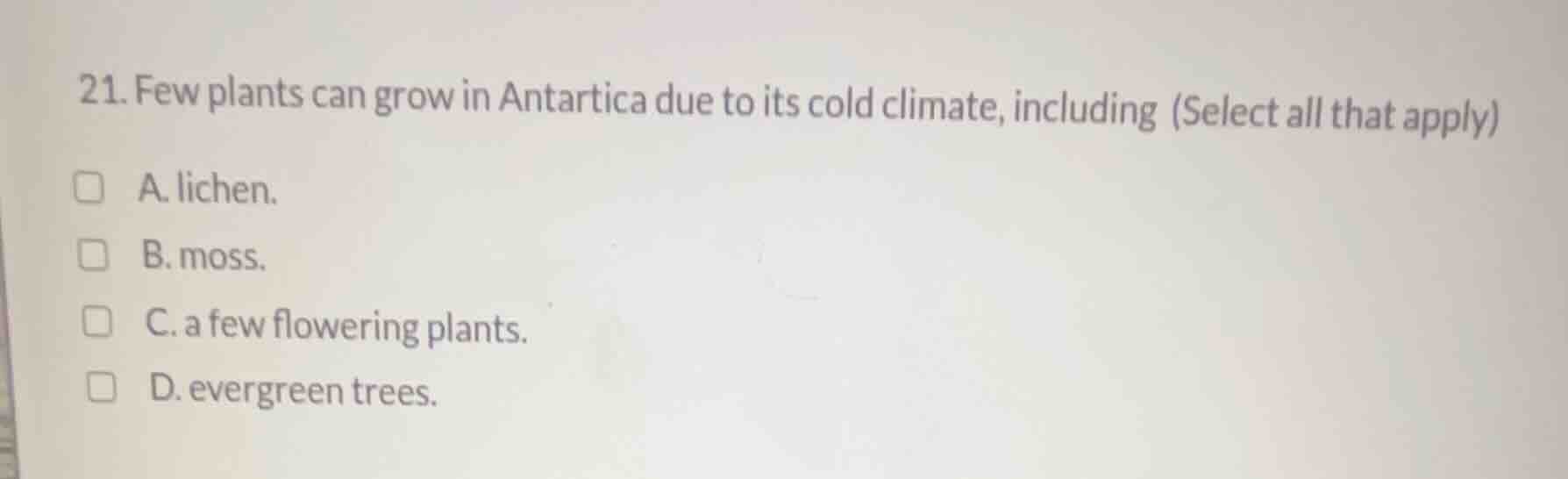
21. few plants can grow in antartica due to its cold climate, including…

Question

  1. few plants can grow in antartica due to its cold climate, including (select all that apply)

a. lichen.
b. moss.
c. a few flowering plants.
d. evergreen trees.

Explanation:

Response

<pre_analysis>
{
"quality": "clear",
"question_count": 1,
"skills_matched": [
"direct_cot",
"multiple_choice_formatter",
"explain_then_answer",
"tutor"
],
"needs_drawing": false,
"concepts_used": [
"Antarctic Climate"
],
"new_concepts": [
"Antarctic Flora",
"Tundra Vegetation"
],
"current_concepts": [
"Antarctic Climate",
"Antarctic Flora",
"Tundra Vegetation"
]
}
</pre_analysis>

<reasoning>

Analyze the environmental conditions of Antarctica

The climate of Antarctica is extremely cold, dry, and windy, which severely limits plant growth. This environment is characterized as a polar desert. We must evaluate which of the given organisms can survive under these harsh conditions.

Evaluate the survival of lichens and mosses

Using the Antarctic Climate knowledge point, we know that non-vascular plants and symbiotic organisms are best suited for ice-free areas.

  • Lichen (Option A): Lichens are highly resilient symbiotic organisms (fungi and algae) that can survive extreme cold and dehydration. They are the most abundant flora in Antarctica.
  • Moss (Option B): Mosses are simple, non-vascular plants that grow in damp, ice-free areas, particularly along the Antarctic Peninsula.

Evaluate the presence of vascular plants

We examine the remaining options regarding vascular plants:

  • A few flowering plants (Option C): Antarctica has only two native species of flowering vascular plants: Antarctic hair grass (Deschampsia antarctica) and Antarctic pearlwort (Colobanthus quitensis). Therefore, "a few flowering plants" is correct.
  • Evergreen trees (Option D): The freezing temperatures, lack of liquid water, and permafrost prevent the growth of any trees, including evergreen trees.

Determine the correct options

Since the question asks to "Select all that apply," we select all organisms that can grow in Antarctica: lichen, moss, and a few flowering plants.
</reasoning>

<answer>
<mcq-correct>A. lichen.</mcq-correct>
<mcq-correct>B. moss.</mcq-correct>
<mcq-correct>C. a few flowering plants.</mcq-correct>
<mcq-option>D. evergreen trees.</mcq-option>
</answer>

<post_analysis>
{
"subject": "Natural Science",
"question_type": "Multiple Choice",
"knowledge_point": [
"Natural Science",
"Geography",
"Antarctic Flora"
]
}
</post_analysis>

Answer:

<pre_analysis>
{
"quality": "clear",
"question_count": 1,
"skills_matched": [
"direct_cot",
"multiple_choice_formatter",
"explain_then_answer",
"tutor"
],
"needs_drawing": false,
"concepts_used": [
"Antarctic Climate"
],
"new_concepts": [
"Antarctic Flora",
"Tundra Vegetation"
],
"current_concepts": [
"Antarctic Climate",
"Antarctic Flora",
"Tundra Vegetation"
]
}
</pre_analysis>

<reasoning>

Analyze the environmental conditions of Antarctica

The climate of Antarctica is extremely cold, dry, and windy, which severely limits plant growth. This environment is characterized as a polar desert. We must evaluate which of the given organisms can survive under these harsh conditions.

Evaluate the survival of lichens and mosses

Using the Antarctic Climate knowledge point, we know that non-vascular plants and symbiotic organisms are best suited for ice-free areas.

  • Lichen (Option A): Lichens are highly resilient symbiotic organisms (fungi and algae) that can survive extreme cold and dehydration. They are the most abundant flora in Antarctica.
  • Moss (Option B): Mosses are simple, non-vascular plants that grow in damp, ice-free areas, particularly along the Antarctic Peninsula.

Evaluate the presence of vascular plants

We examine the remaining options regarding vascular plants:

  • A few flowering plants (Option C): Antarctica has only two native species of flowering vascular plants: Antarctic hair grass (Deschampsia antarctica) and Antarctic pearlwort (Colobanthus quitensis). Therefore, "a few flowering plants" is correct.
  • Evergreen trees (Option D): The freezing temperatures, lack of liquid water, and permafrost prevent the growth of any trees, including evergreen trees.

Determine the correct options

Since the question asks to "Select all that apply," we select all organisms that can grow in Antarctica: lichen, moss, and a few flowering plants.
</reasoning>

<answer>
<mcq-correct>A. lichen.</mcq-correct>
<mcq-correct>B. moss.</mcq-correct>
<mcq-correct>C. a few flowering plants.</mcq-correct>
<mcq-option>D. evergreen trees.</mcq-option>
</answer>

<post_analysis>
{
"subject": "Natural Science",
"question_type": "Multiple Choice",
"knowledge_point": [
"Natural Science",
"Geography",
"Antarctic Flora"
]
}
</post_analysis>