QUESTION IMAGE
Question
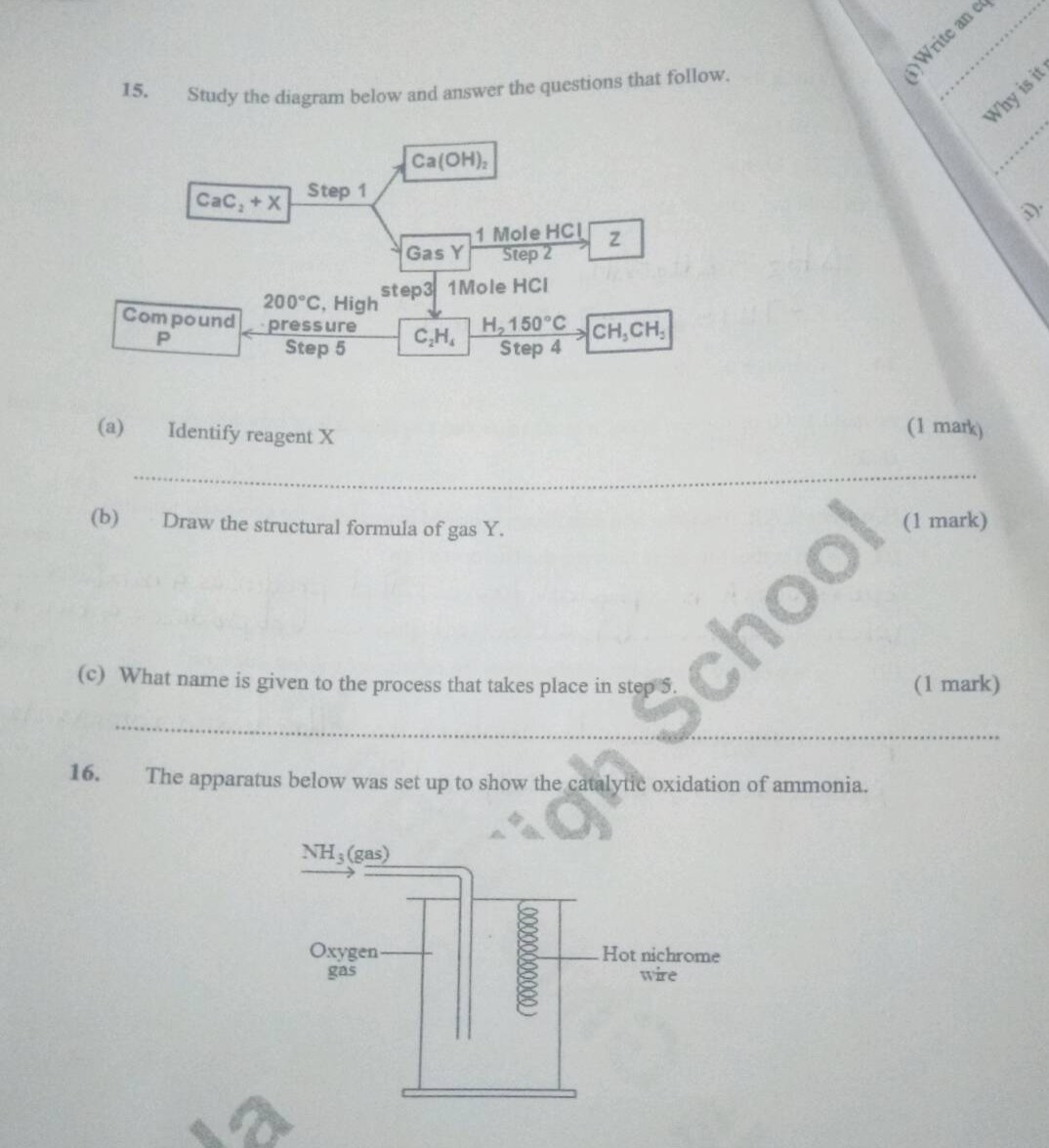
- study the diagram below and answer the questions that follow.
\\(\text{cac}_2 + \text{x} \xrightarrow{\text{step 1}} \text{ca(oh)}_2 + \text{gas y}\\)
\\(\text{gas y} \xrightarrow\text{step 2}{1 \text{ mole hcl}} \text{z}\\)
\\(\text{gas y} \xrightarrow{\text{step 3}} \text{c}_2\text{h}_4 \xrightarrow\text{step 4}{\text{h}_2, 150^\circ\text{c}} \text{ch}_3\text{ch}_3\\)
\\(\text{c}_2\text{h}_4 \xrightarrow\text{step 5}{200^\circ\text{c, high pressure}} \text{compound p}\\)
(a) identify reagent x (1 mark)
(b) draw the structural formula of gas y. (1 mark)
(c) what name is given to the process that takes place in step 5. (1 mark)
- the apparatus below was set up to show the catalytic oxidation of ammonia.
diagram showing a gas delivery tube delivering \\(\text{nh}_3\text{ (gas)}\\) into a jar containing oxygen gas, with a hot nichrome wire suspended inside
🆕 New Concept Discovered: Organic Reaction Pathways
Connecting reactions of alkynes, alkenes, and polymers.
Step 1: Identify Reagent X
In Step 1, calcium carbide (\(\text{CaC}_2\)) reacts with reagent X to produce calcium hydroxide (\(\text{Ca(OH)}_2\)) and Gas Y.
This is the standard laboratory preparation of ethyne (acetylene) gas. Calcium carbide reacts readily with cold water to yield calcium hydroxide and ethyne gas:
Therefore, Reagent X is water (\(\text{H}_2\text{O}\)), and Gas Y is ethyne (\(\text{C}_2\text{H}_2\)).
Step 2: Draw the Structural Formula of Gas Y
Gas Y is ethyne (\(\text{C}_2\text{H}_2\)), which is the simplest alkyne. It contains a carbon-to-carbon triple bond (\(\text{C}\equiv\text{C}\)) with one hydrogen atom bonded to each carbon atom.
The structural formula showing all bonds is:
Step 3: Identify the Process in Step 5
In Step 5, ethene (\(\text{C}_2\text{H}_4\)) is subjected to high temperature (\(200^\circ\text{C}\)) and high pressure to form Compound P.
Under these conditions, many ethene monomer molecules link together to form the polymer polyethene (polythene). This chemical process of linking monomer units together to form a long-chain polymer without the elimination of any small molecules is called addition polymerization.

Snap & solve any problem in the app
Get step-by-step solutions on Sovi AI
Photo-based solutions with guided steps
Explore more problems and detailed explanations
(a) Identify reagent X
Water (or \(\text{H}_2\text{O}\))
---
(b) Draw the structural formula of gas Y
---
(c) What name is given to the process that takes place in step 5
Addition polymerization (or polymerization)