Sovi.AI - AI Math Tutor

Scan to solve math questions

QUESTION IMAGE

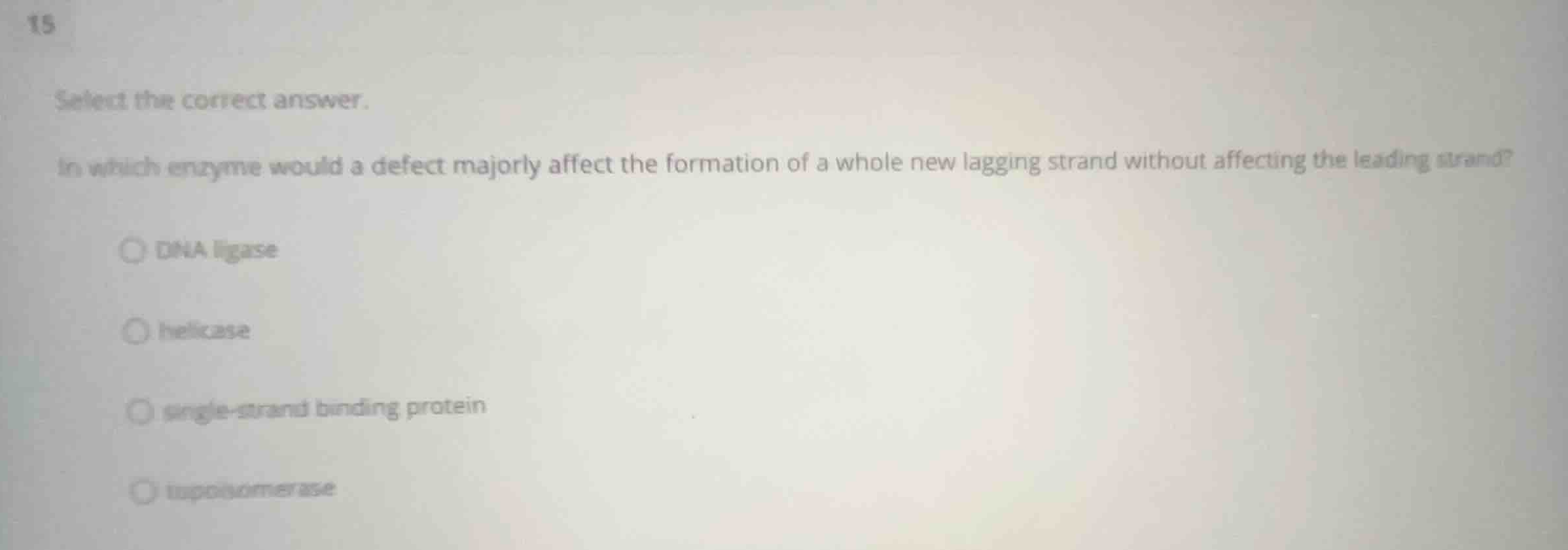
15 select the correct answer. in which enzyme would a defect majorly af…

Question

15
select the correct answer.
in which enzyme would a defect majorly affect the formation of a whole new lagging strand without affecting the leading strand?
dna ligase
helicase
single-strand binding protein
topoisomerase

Explanation:

Response

<pre_analysis>
{
"quality": "clear",
"question_count": 1,
"skills_matched": [
"direct_cot",
"multiple_choice_formatter",
"explain_then_answer",
"tutor"
],
"needs_drawing": false,
"concepts_used": [
"Prokaryotic DNA Replication"
],
"new_concepts": [
"Lagging Strand Synthesis",
"DNA Ligase Function"
],
"current_concepts": [
"Prokaryotic DNA Replication",
"Lagging Strand Synthesis",
"DNA Ligase Function"
]
}
</pre_analysis>

<reasoning>

Analyze the replication process

DNA replication is semi-discontinuous. The leading strand is synthesized continuously, while the lagging strand is synthesized discontinuously as Okazaki fragments.

Evaluate the role of each enzyme

  • DNA ligase: Joins Okazaki fragments on the lagging strand. A defect specifically prevents lagging strand completion.
  • Helicase: Unwinds the double helix. Essential for initiating both leading and lagging strands.
  • Single-strand binding protein: Stabilizes single-stranded DNA. Required for both strands.
  • Topoisomerase: Relieves torsional strain ahead of the replication fork. Affects both strands.

Connect to student knowledge

Using the Prokaryotic DNA Replication knowledge point, we identify that DNA ligase is uniquely required to seal nicks between Okazaki fragments on the lagging strand, making its defect highly specific to lagging strand completion.
</reasoning>

<answer>
<mcq-correct>DNA ligase</mcq-correct>
<mcq-option>helicase</mcq-option>
<mcq-option>single-strand binding protein</mcq-option>
<mcq-option>topoisomerase</mcq-option>
</answer>

<post_analysis>
{
"subject": "Natural Science",
"question_type": "Multiple Choice",
"knowledge_point": [
"Natural Science",
"Biology",
"DNA Replication"
]
}
</post_analysis>

Answer:

<pre_analysis>
{
"quality": "clear",
"question_count": 1,
"skills_matched": [
"direct_cot",
"multiple_choice_formatter",
"explain_then_answer",
"tutor"
],
"needs_drawing": false,
"concepts_used": [
"Prokaryotic DNA Replication"
],
"new_concepts": [
"Lagging Strand Synthesis",
"DNA Ligase Function"
],
"current_concepts": [
"Prokaryotic DNA Replication",
"Lagging Strand Synthesis",
"DNA Ligase Function"
]
}
</pre_analysis>

<reasoning>

Analyze the replication process

DNA replication is semi-discontinuous. The leading strand is synthesized continuously, while the lagging strand is synthesized discontinuously as Okazaki fragments.

Evaluate the role of each enzyme

  • DNA ligase: Joins Okazaki fragments on the lagging strand. A defect specifically prevents lagging strand completion.
  • Helicase: Unwinds the double helix. Essential for initiating both leading and lagging strands.
  • Single-strand binding protein: Stabilizes single-stranded DNA. Required for both strands.
  • Topoisomerase: Relieves torsional strain ahead of the replication fork. Affects both strands.

Connect to student knowledge

Using the Prokaryotic DNA Replication knowledge point, we identify that DNA ligase is uniquely required to seal nicks between Okazaki fragments on the lagging strand, making its defect highly specific to lagging strand completion.
</reasoning>

<answer>
<mcq-correct>DNA ligase</mcq-correct>
<mcq-option>helicase</mcq-option>
<mcq-option>single-strand binding protein</mcq-option>
<mcq-option>topoisomerase</mcq-option>
</answer>

<post_analysis>
{
"subject": "Natural Science",
"question_type": "Multiple Choice",
"knowledge_point": [
"Natural Science",
"Biology",
"DNA Replication"
]
}
</post_analysis>