QUESTION IMAGE
Question
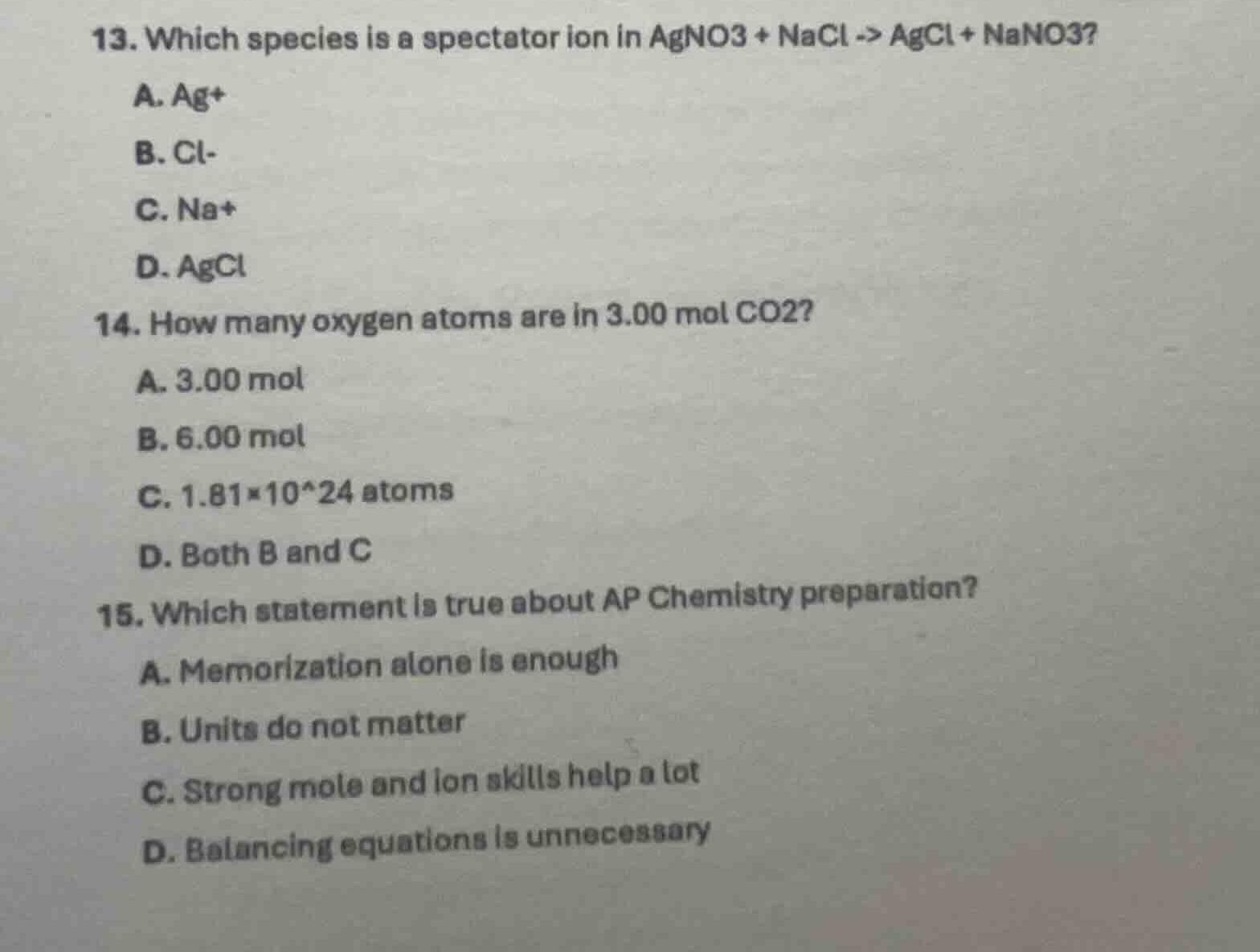
- which species is a spectator ion in \\(\text{agno}_3 + \text{nacl} \
ightarrow \text{agcl} + \text{nano}_3\\)?
a. \\(\text{ag}^+\\)
b. \\(\text{cl}^-\\)
c. \\(\text{na}^+\\)
d. \\(\text{agcl}\\)
- how many oxygen atoms are in \\(3.00\text{ mol co}_2\\)?
a. \\(3.00\text{ mol}\\)
b. \\(6.00\text{ mol}\\)
c. \\(1.81 \times 10^{24}\text{ atoms}\\)
d. both b and c
- which statement is true about ap chemistry preparation?
a. memorization alone is enough
b. units do not matter
c. strong mole and ion skills help a lot
d. balancing equations is unnecessary
Identify spectator ions in the precipitation reaction
To find the spectator ions in the reaction:
We write the complete ionic equation by dissociating soluble strong electrolytes:
Spectator ions appear unchanged on both sides:
- \(\text{Na}^+(aq)\)
- \(\text{NO}_3^-(aq)\)
Comparing with the given options:
- A. \(\text{Ag}^+\) (participates in forming the precipitate)
- B. \(\text{Cl}^-\) (participates in forming the precipitate)
- C. \(\text{Na}^+\) (remains in solution unchanged)
- D. \(\text{AgCl}\) (the precipitate product)
Therefore, \(\text{Na}^+\) is a spectator ion.
Calculate oxygen atoms in carbon dioxide
We are given \(3.00\text{ mol of }\text{CO}_2\).
First, calculate the moles of oxygen atoms:
Next, calculate the absolute number of oxygen atoms using Avogadro's number:
Let's evaluate the options:
- A. \(3.00\text{ mol}\) (incorrect)
- B. \(6.00\text{ mol}\) (correct representation in moles)
- C. \(1.81 \times 10^{24}\text{ atoms}\) (this is the number of \(\text{CO}_2\) molecules: \(3.00 \times 6.022 \times 10^{23} \approx 1.81 \times 10^{24}\))
- D. Both B and C (incorrect, since C is the number of molecules, not oxygen atoms)
Thus, the correct option is B.
Evaluate AP Chemistry preparation statements
Let's analyze each statement regarding AP Chemistry preparation:
- A. "Memorization alone is enough" (False, conceptual understanding and problem-solving are critical)
- B. "Units do not matter" (False, dimensional analysis and units are essential)
- C. "Strong mole and ion skills help a lot" (True, stoichiometry and aqueous chemistry are foundational)
- D. "Balancing equations is unnecessary" (False, balanced equations are required for stoichiometry)
Thus, the correct option is C.

Snap & solve any problem in the app
Get step-by-step solutions on Sovi AI
Photo-based solutions with guided steps
Explore more problems and detailed explanations
Question 13
- (A) Ag+
- (B) Cl-
- (C) Na+ (Correct answer)
- (D) AgCl
Question 14
- (A) 3.00 mol
- (B) 6.00 mol (Correct answer)
- (C) 1.81×10^24 atoms
- (D) Both B and C
Question 15
- (A) Memorization alone is enough
- (B) Units do not matter
- (C) Strong mole and ion skills help a lot (Correct answer)
- (D) Balancing equations is unnecessary