QUESTION IMAGE
Question
the winters tale
by william shakespeare
act 5, scene 3
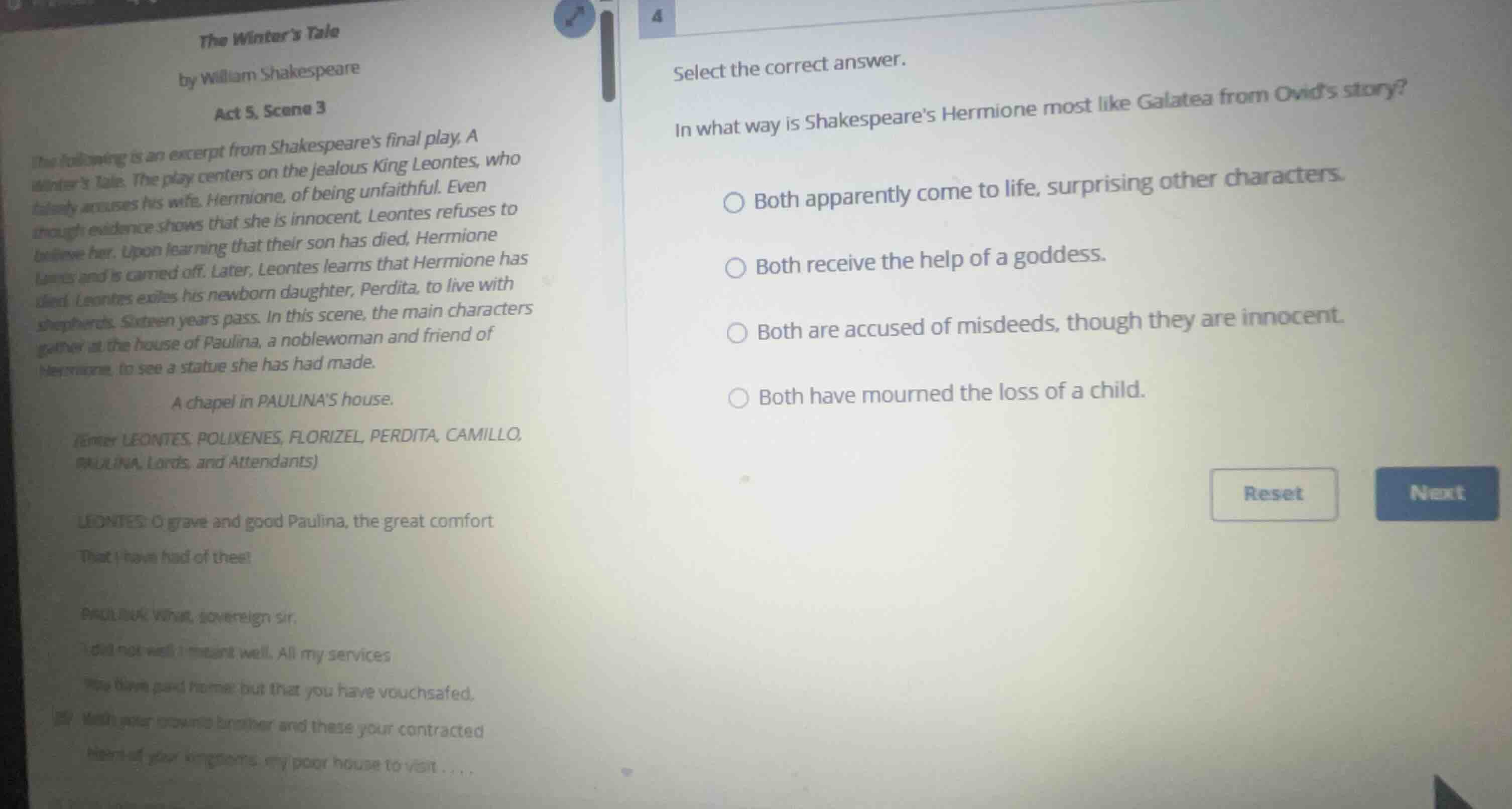
the following is an excerpt from shakespeares final play, a winters tale. the play centers on the jealous king leontes, who falsely accuses his wife, hermione, of being unfaithful. even though evidence shows that she is innocent, leontes refuses to believe her. upon learning that their son has died, hermione faints and is carried off. later, leontes learns that hermione has died. leontes exiles his newborn daughter, perdita, to live with shepherds. sixteen years pass. in this scene, the main characters gather at the house of paulina, a noblewoman and friend of hermione, to see a statue she has had made.
a chapel in paulinas house.
(enter leontes, polixenes, florizel, perdita, camillo, paulina, lords, and attendants)
leontes: o grave and good paulina, the great comfort
that i have had of thee!
paulina: what, sovereign sir,
i did not well i meant well. all my services
you have paid home: but that you have vouchsafed,
with your crowned brother and these your contracted
heirs of your kingdoms, my poor house to visit....
select the correct answer.
in what way is shakespeares hermione most like galatea from ovids story?
both apparently come to life, surprising other characters.
both receive the help of a goddess.
both are accused of misdeeds, though they are innocent.
both have mourned the loss of a child.
Analyze the mythological connection
In Ovid's myth of Pygmalion, a statue of a woman (later named Galatea) is brought to life by the goddess Venus, surprising Pygmalion. In Shakespeare's The Winter's Tale (Act 5, Scene 3), Hermione, who was believed to be dead and is presented as a realistic statue, apparently comes to life, shocking Leontes and the other gathered characters.
Evaluate the options
- Both apparently come to life, surprising other characters: This directly matches the climax of both stories, where a statue (or apparent statue) transforms into a living woman, causing immense surprise.
- Both receive the help of a goddess: While Venus directly intervenes to bring Galatea to life in Ovid's myth, Hermione's revival in Shakespeare's play is orchestrated by Paulina without explicit divine intervention on stage.
- Both are accused of misdeeds, though they are innocent: Galatea is not accused of misdeeds in Ovid's story.
- Both have mourned the loss of a child: Galatea does not mourn the loss of a child in the original myth.

Snap & solve any problem in the app
Get step-by-step solutions on Sovi AI
Photo-based solutions with guided steps
Explore more problems and detailed explanations
- Both apparently come to life, surprising other characters. (Correct answer)
- Both receive the help of a goddess.
- Both are accused of misdeeds, though they are innocent.
- Both have mourned the loss of a child.