QUESTION IMAGE
Question
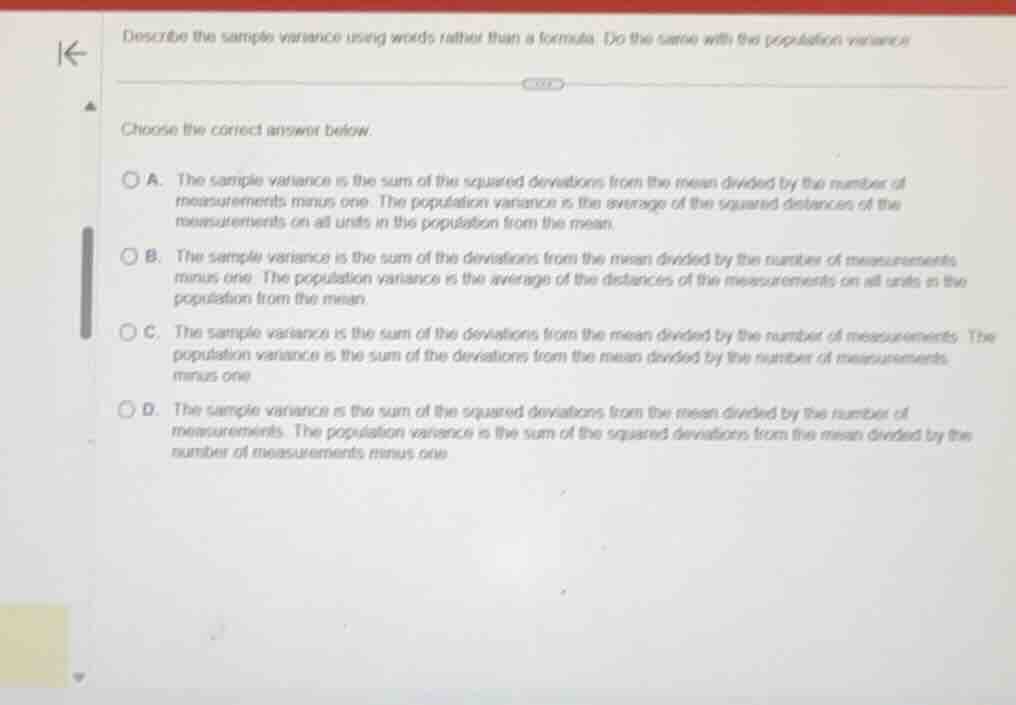
describe the sample variance using words rather than a formula. do the same with the population variance.
choose the correct answer below.
a. the sample variance is the sum of the squared deviations from the mean divided by the number of measurements minus one. the population variance is the average of the squared distances of the measurements on all units in the population from the mean.
b. the sample variance is the sum of the deviations from the mean divided by the number of measurements minus one. the population variance is the average of the distances of the measurements on all units in the population from the mean.
c. the sample variance is the sum of the deviations from the mean divided by the number of measurements. the population variance is the sum of the deviations from the mean divided by the number of measurements minus one.
d. the sample variance is the sum of the squared deviations from the mean divided by the number of measurements. the population variance is the sum of the squared deviations from the mean divided by the number of measurements minus one.
🆕 New Concept Discovered: Measures of Spread (Variance)
How we measure data dispersion using squared differences.
Step 1: Define Sample Variance in Words
To find the variance, we look at how far each data point is from the average (the deviation), square those differences so they do not cancel each other out, and add them up.
For a sample variance (\(s^2\)), we divide this sum of squared deviations by the sample size minus one (\(n - 1\)) to correct for bias in estimating the population:
In words, this is: the sum of the squared deviations from the mean divided by the number of measurements minus one.
Step 2: Define Population Variance in Words
For a population variance (\(\sigma^2\)), we have the complete data set. We calculate the average of these squared differences by dividing the sum of squared deviations by the total population size (\(N\)):
In words, this is: the average of the squared distances of the measurements on all units in the population from the mean.
Step 3: Match with the Options
Let's evaluate the given choices:
- A: Correctly defines sample variance (divided by measurements minus one) and population variance (average of the squared distances).
- B: Incorrectly uses "deviations" and "distances" instead of squared deviations/distances.
- C: Incorrectly omits the squaring of deviations.
- D: Incorrectly states that population variance is divided by the number of measurements minus one.

Snap & solve any problem in the app
Get step-by-step solutions on Sovi AI
Photo-based solutions with guided steps
Explore more problems and detailed explanations
A. The sample variance is the sum of the squared deviations from the mean divided by the number of measurements minus one. The population variance is the average of the squared distances of the measurements on all units in the population from the mean.