QUESTION IMAGE
Question
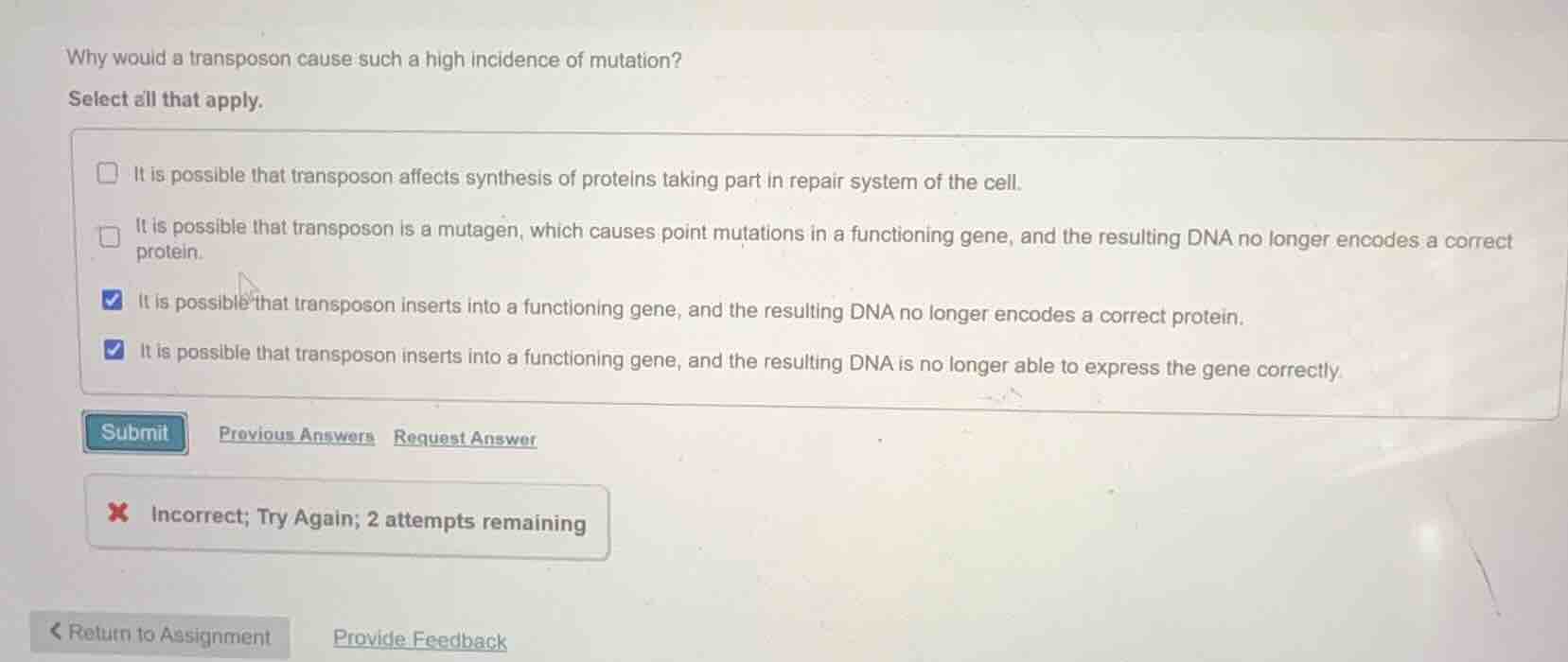
why would a transposon cause such a high incidence of mutation?
select all that apply.
- it is possible that transposon affects synthesis of proteins taking part in repair system of the cell.
- it is possible that transposon is a mutagen, which causes point mutations in a functioning gene, and the resulting dna no longer encodes a correct protein.
- it is possible that transposon inserts into a functioning gene, and the resulting dna no longer encodes a correct protein.
- it is possible that transposon inserts into a functioning gene, and the resulting dna is no longer able to express the gene correctly.
Analyze transposon insertion mechanisms
Using the Transposon Mutagenesis and Insertional Mutation knowledge points, we analyze how transposable elements disrupt genetic sequences. When a transposon physically inserts itself into the coding sequence of a functioning gene, it disrupts the open reading frame. This physical disruption typically leads to a frameshift, premature stop codons, or major structural changes, meaning the resulting DNA no longer encodes a correct, functional protein.
Evaluate gene expression disruption
Using the Gene Expression Regulation knowledge point, we examine the regulatory consequences of transposon insertion. If a transposon inserts into regulatory regions (such as promoters, enhancers, or operators) or within introns/exons of a gene, it can severely disrupt transcription or translation. This prevents the cell from expressing the gene at the correct levels, at the correct times, or in the correct manner.
Assess alternative mutagenic mechanisms
We evaluate the remaining options regarding other potential mutagenic pathways. Transposons are mobile genetic elements that cause mutations primarily through physical insertion (insertional mutagenesis) rather than acting as chemical or physical mutagens that induce single-nucleotide point mutations (like UV light or alkylating agents). Additionally, while a transposon could theoretically insert into a gene encoding a repair protein, this is a highly specific event rather than the general reason why transposons cause a high overall incidence of mutation across the genome. Thus, the primary general mechanisms are direct insertion disrupting protein coding and gene expression.

Snap & solve any problem in the app
Get step-by-step solutions on Sovi AI
Photo-based solutions with guided steps
Explore more problems and detailed explanations
- It is possible that transposon affects synthesis of proteins taking part in repair system of the cell.
- It is possible that transposon is a mutagen, which causes point mutations in a functioning gene, and the resulting DNA no longer encodes a correct protein.
- It is possible that transposon inserts into a functioning gene, and the resulting DNA no longer encodes a correct protein. (Correct answer)
- It is possible that transposon inserts into a functioning gene, and the resulting DNA is no longer able to express the gene correctly. (Correct answer)