QUESTION IMAGE
Question
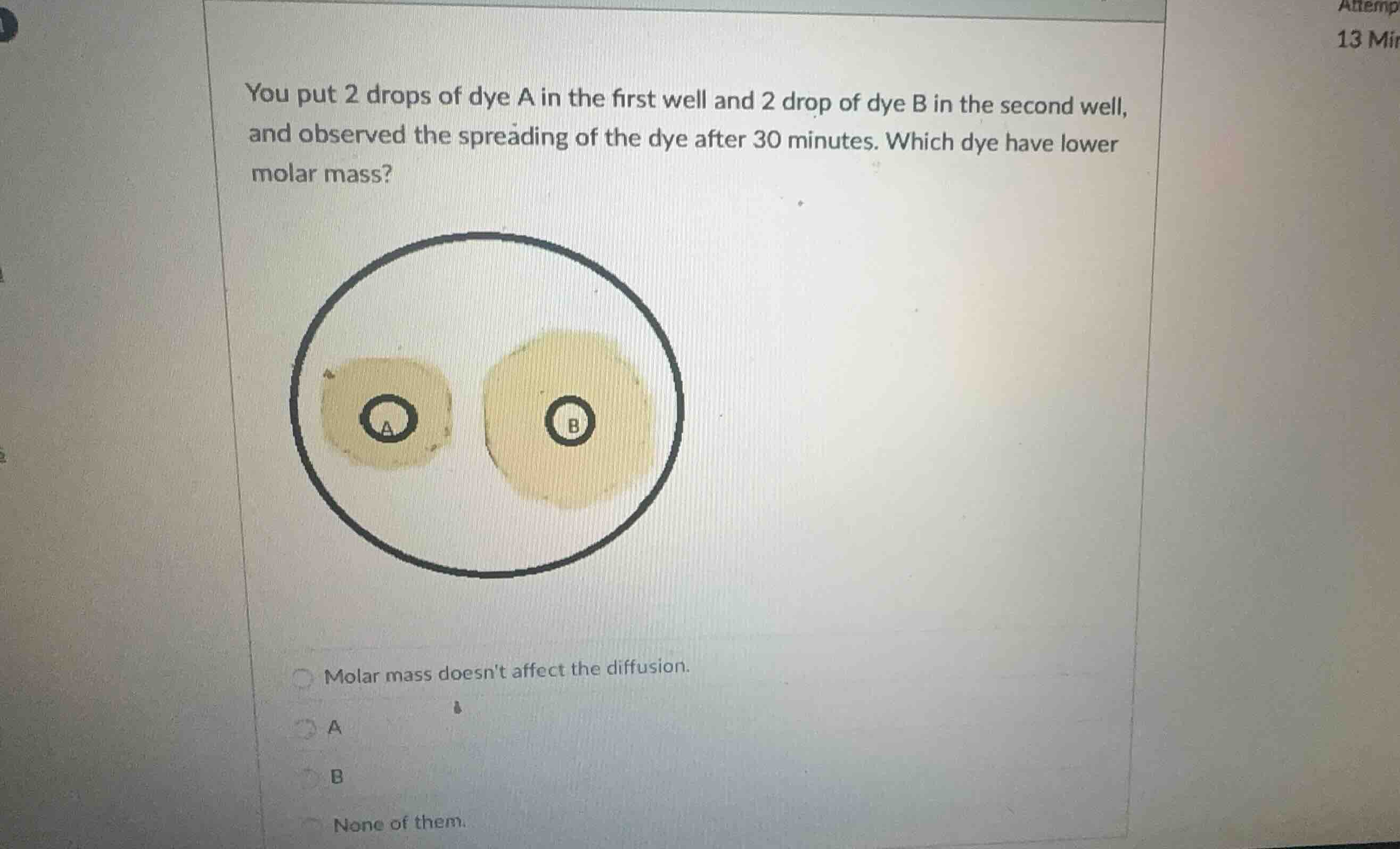
you put 2 drops of dye a in the first well and 2 drop of dye b in the second well, and observed the spreading of the dye after 30 minutes. which dye have lower molar mass?
molar mass doesnt affect the diffusion.
a
b
none of them.
🆕 New Concept Discovered: Diffusion and Molecular Mass
Smaller, lighter molecules move and spread faster.
Step 1: Analyze the experimental observation
By looking at the image, we can compare how far each dye has spread from its starting well after 30 minutes:
- Dye A has spread to form a smaller circle.
- Dye B has spread to form a larger circle.
This means Dye B travels faster through the medium than Dye A.
Step 2: Relate diffusion rate to molar mass
The process of a substance spreading out from an area of high concentration to an area of low concentration is called diffusion.
The rate of diffusion is inversely related to the mass of the particles (described by Graham's Law of Diffusion):
- Lighter molecules (lower molar mass) move faster and therefore diffuse over a larger distance in a given time.
- Heavier molecules (higher molar mass) move slower and diffuse over a shorter distance.
Since Dye B diffused further than Dye A in the same amount of time, Dye B must have a faster rate of diffusion, which means it has a lower molar mass.

Snap & solve any problem in the app
Get step-by-step solutions on Sovi AI
Photo-based solutions with guided steps
Explore more problems and detailed explanations
B