QUESTION IMAGE
Question
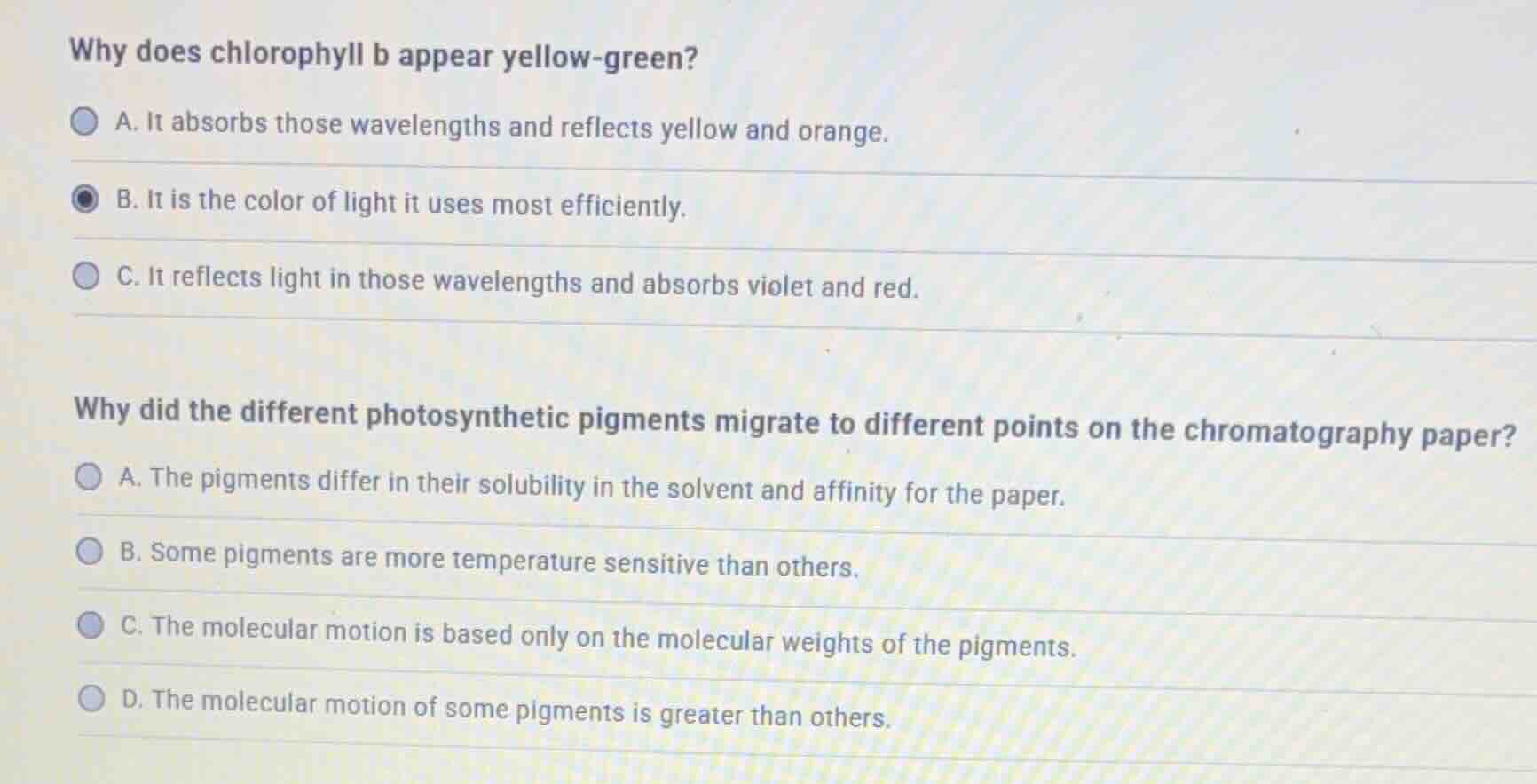
why does chlorophyll b appear yellow-green?
a. it absorbs those wavelengths and reflects yellow and orange.
b. it is the color of light it uses most efficiently.
c. it reflects light in those wavelengths and absorbs violet and red.
why did the different photosynthetic pigments migrate to different points on the chromatography paper?
a. the pigments differ in their solubility in the solvent and affinity for the paper.
b. some pigments are more temperature sensitive than others.
c. the molecular motion is based only on the molecular weights of the pigments.
d. the molecular motion of some pigments is greater than others.
Analyze pigment color perception
The color of any pigment is determined by the wavelengths of light it reflects or transmits, rather than the wavelengths it absorbs. Chlorophyll b appears yellow-green because it reflects light in those yellow-green wavelengths. Conversely, it absorbs other wavelengths of light, particularly in the blue-violet and red regions of the visible spectrum, to drive photosynthesis. Therefore, the correct explanation is that it reflects light in the yellow-green wavelengths and absorbs violet and red.
Analyze paper chromatography separation
Paper chromatography separates photosynthetic pigments based on their physical and chemical properties. As the solvent moves up the paper, pigments migrate at different rates. This migration speed depends on two competing factors: the pigment's solubility in the mobile phase (the solvent) and its affinity for the stationary phase (the chromatography paper). Pigments that are highly soluble in the solvent and have low affinity for the paper travel faster and farther, while those with low solubility or high paper affinity move slower.
Match options for Question 1
- Option A suggests it absorbs yellow-green wavelengths, which is incorrect because absorbed light is not seen.
- Option B suggests it is the color used most efficiently, which is incorrect because absorbed colors (like blue and red) are used for photosynthesis, not reflected ones.
- Option C correctly states that it reflects light in those wavelengths (yellow-green) and absorbs violet and red.
Match options for Question 2
- Option A correctly states that pigments differ in their solubility in the solvent and affinity for the paper.
- Option B is incorrect because temperature sensitivity does not govern chromatography migration.
- Option C is incorrect because separation is not based solely on molecular weight.
- Option D is too vague and does not explain the chemical basis of separation.

Snap & solve any problem in the app
Get step-by-step solutions on Sovi AI
Photo-based solutions with guided steps
Explore more problems and detailed explanations
Question 1
- (A) It absorbs those wavelengths and reflects yellow and orange.
- (B) It is the color of light it uses most efficiently.
- (C) It reflects light in those wavelengths and absorbs violet and red. (Correct answer)
Question 2
- (A) The pigments differ in their solubility in the solvent and affinity for the paper. (Correct answer)
- (B) Some pigments are more temperature sensitive than others.
- (C) The molecular motion is based only on the molecular weights of the pigments.
- (D) The molecular motion of some pigments is greater than others.