QUESTION IMAGE
Question
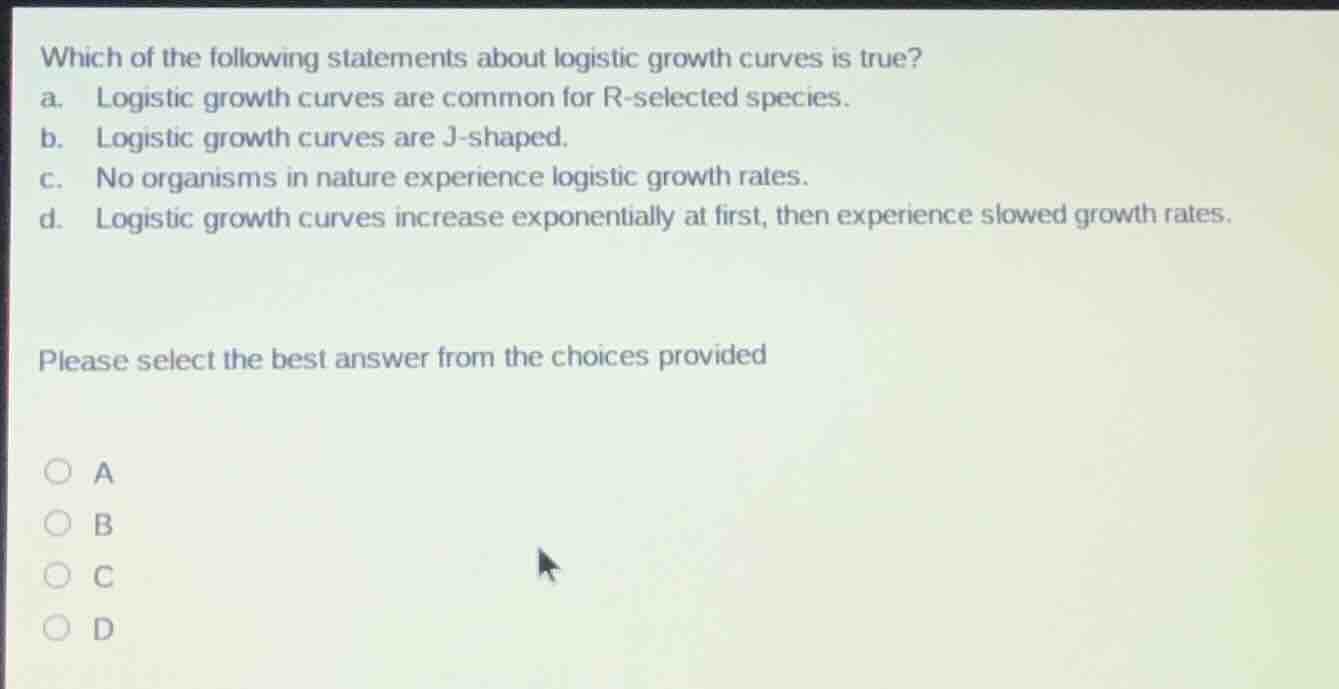
which of the following statements about logistic growth curves is true?
a. logistic growth curves are common for r-selected species.
b. logistic growth curves are j-shaped.
c. no organisms in nature experience logistic growth rates.
d. logistic growth curves increase exponentially at first, then experience slowed growth rates.
please select the best answer from the choices provided
a
b
c
d
🆕 New Concept Discovered: Population Growth Models
How populations grow when resources are limited
Step 1: Define Logistic Growth
Logistic growth describes how a population grows when resources are limited.
- The Shape: It produces an S-shaped curve rather than a J-shaped curve.
- The Process:
- At first, when the population is small and resources are abundant, growth is rapid and looks exponential.
- As the population grows and resources (like food, water, and space) become scarce, the growth rate slows down.
- Eventually, the population size levels off at the environment's carrying capacity.
Step 2: Evaluate the Options
- a. Logistic growth curves are common for R-selected species.
- Incorrect. R-selected species (like bacteria or insects) reproduce rapidly and typically show exponential (J-shaped) growth, often followed by a crash. K-selected species (like humans or elephants) are more associated with logistic growth.
- b. Logistic growth curves are J-shaped.
- Incorrect. Exponential growth curves are J-shaped. Logistic growth curves are S-shaped.
- c. No organisms in nature experience logistic growth rates.
- Incorrect. Many natural populations (such as yeast, seals, and sheep) show logistic growth as they reach the limits of their environment.
- d. Logistic growth curves increase exponentially at first, then experience slowed growth rates.
- Correct. This perfectly describes the transition from the initial abundant-resource phase to the limited-resource phase of an S-curve.

Snap & solve any problem in the app
Get step-by-step solutions on Sovi AI
Photo-based solutions with guided steps
Explore more problems and detailed explanations
D