QUESTION IMAGE
Question
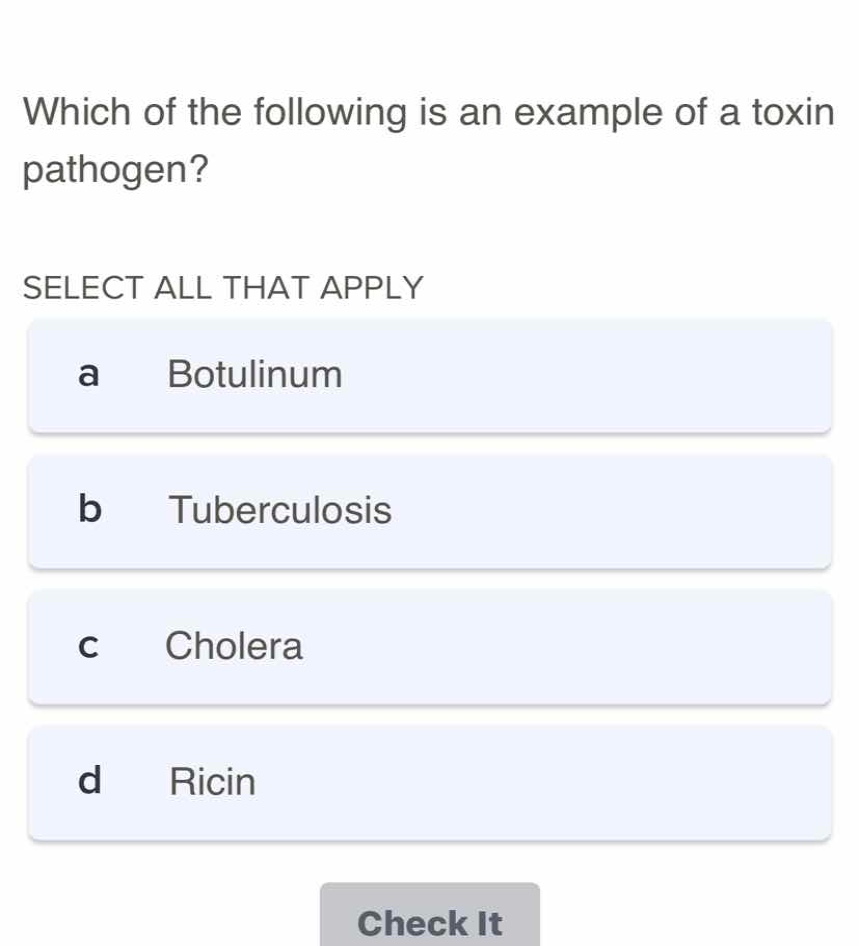
which of the following is an example of a toxin pathogen?
select all that apply
a botulinum
b tuberculosis
c cholera
d ricin
<pre_analysis>
{
"quality": "clear",
"question_count": 1,
"skills_matched": [
"direct_cot",
"multiple_choice_formatter",
"explain_then_answer",
"tutor"
],
"needs_drawing": false,
"concepts_used": [],
"new_concepts": [
"Toxin Pathogens",
"Bacterial Toxins",
"Biological Agents"
],
"current_concepts": [
"Toxin Pathogens",
"Bacterial Toxins",
"Biological Agents"
]
}
</pre_analysis>
<reasoning>
Define toxin pathogens
A toxin pathogen is a biological agent, typically a bacterium, that causes disease primarily through the production of specific toxins rather than by direct tissue invasion or cellular destruction by the replicating organism itself.
Analyze Botulinum
Clostridium botulinum produces botulinum toxin, one of the most lethal neurotoxins known. The disease botulism is entirely mediated by this toxin, making it a classic example of a toxin pathogen.
Analyze Tuberculosis
Mycobacterium tuberculosis causes tuberculosis. It is an intracellular pathogen that causes disease through chronic infection, cellular invasion, and the host's immune response, rather than relying on a primary exotoxin to cause disease. Thus, it is not classified as a toxin pathogen.
Analyze Cholera
Vibrio cholerae causes cholera by secreting cholera toxin (an enterotoxin) in the small intestine. This toxin disrupts cellular signaling, leading to massive watery diarrhea. Because its pathogenicity is driven by this toxin, it is a toxin pathogen.
Analyze Ricin
Ricin is a highly potent toxin, but it is a chemical/protein substance extracted from castor beans (Ricinus communis). It is a biological toxin, but it is not a living pathogen (microorganism) itself. Therefore, it does not qualify as a toxin pathogen.
</reasoning>
<answer>
<mcq-correct>a Botulinum</mcq-correct>
<mcq-option>b Tuberculosis</mcq-option>
<mcq-correct>c Cholera</mcq-correct>
<mcq-option>d Ricin</mcq-option>
</answer>
<post_analysis>
{
"subject": "Natural Science",
"question_type": "Multiple Choice",
"knowledge_point": [
"Natural Science",
"Biology",
"Microbiology and Pathogens"
]
}
</post_analysis>
Snap & solve any problem in the app
Get step-by-step solutions on Sovi AI
Photo-based solutions with guided steps
Explore more problems and detailed explanations
<pre_analysis>
{
"quality": "clear",
"question_count": 1,
"skills_matched": [
"direct_cot",
"multiple_choice_formatter",
"explain_then_answer",
"tutor"
],
"needs_drawing": false,
"concepts_used": [],
"new_concepts": [
"Toxin Pathogens",
"Bacterial Toxins",
"Biological Agents"
],
"current_concepts": [
"Toxin Pathogens",
"Bacterial Toxins",
"Biological Agents"
]
}
</pre_analysis>
<reasoning>
Define toxin pathogens
A toxin pathogen is a biological agent, typically a bacterium, that causes disease primarily through the production of specific toxins rather than by direct tissue invasion or cellular destruction by the replicating organism itself.
Analyze Botulinum
Clostridium botulinum produces botulinum toxin, one of the most lethal neurotoxins known. The disease botulism is entirely mediated by this toxin, making it a classic example of a toxin pathogen.
Analyze Tuberculosis
Mycobacterium tuberculosis causes tuberculosis. It is an intracellular pathogen that causes disease through chronic infection, cellular invasion, and the host's immune response, rather than relying on a primary exotoxin to cause disease. Thus, it is not classified as a toxin pathogen.
Analyze Cholera
Vibrio cholerae causes cholera by secreting cholera toxin (an enterotoxin) in the small intestine. This toxin disrupts cellular signaling, leading to massive watery diarrhea. Because its pathogenicity is driven by this toxin, it is a toxin pathogen.
Analyze Ricin
Ricin is a highly potent toxin, but it is a chemical/protein substance extracted from castor beans (Ricinus communis). It is a biological toxin, but it is not a living pathogen (microorganism) itself. Therefore, it does not qualify as a toxin pathogen.
</reasoning>
<answer>
<mcq-correct>a Botulinum</mcq-correct>
<mcq-option>b Tuberculosis</mcq-option>
<mcq-correct>c Cholera</mcq-correct>
<mcq-option>d Ricin</mcq-option>
</answer>
<post_analysis>
{
"subject": "Natural Science",
"question_type": "Multiple Choice",
"knowledge_point": [
"Natural Science",
"Biology",
"Microbiology and Pathogens"
]
}
</post_analysis>