QUESTION IMAGE
Question
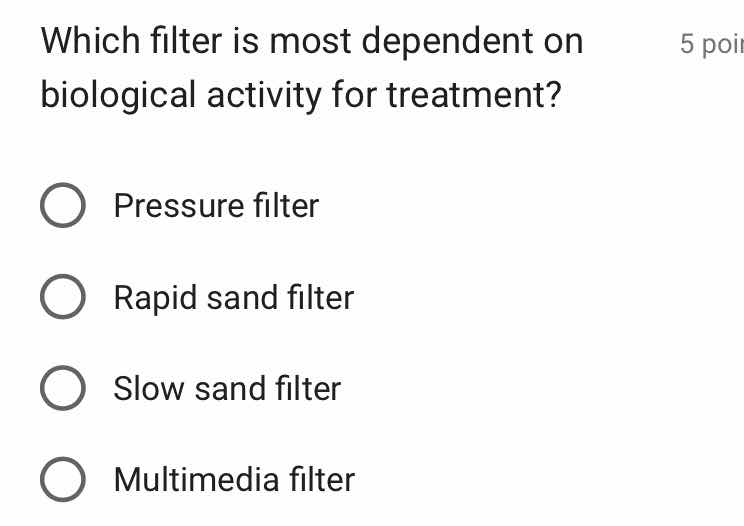
which filter is most dependent on biological activity for treatment?
pressure filter
rapid sand filter
slow sand filter
multimedia filter
🆕 New Concept Discovered: Biological Water Filtration
Microbes cleaning water naturally
Step 1: Analyze the role of biology in filtration
In water treatment, some filters rely purely on physical mechanisms (like straining, adsorption, and sedimentation) to remove particles. Other filters rely heavily on a living biofilm layer—composed of bacteria, algae, and protozoa—to biologically degrade organic matter, consume pathogens, and remove dissolved impurities.
Step 2: Evaluate the options
- Pressure filter: Uses applied pressure to force water through a filter medium. It relies almost entirely on physical straining and operates at high rates, which prevents a stable biological layer from forming.
- Rapid sand filter: Uses relatively coarse sand and operates at high filtration rates. Because it is backwashed frequently to clear physical clogging, a stable biological layer does not have time or stability to develop.
- Slow sand filter: Operates at very low filtration rates. This slow flow allows a highly active biological layer called the Schmutzdecke (dirty layer) to develop on the top surface of the sand. This biofilm is responsible for the majority of the pathogen and organic matter removal.
- Multimedia filter: Uses multiple layers of different media (e.g., anthracite, sand, garnet) to physically trap particles of varying sizes throughout the depth of the filter. It does not rely on biological action.

Snap & solve any problem in the app
Get step-by-step solutions on Sovi AI
Photo-based solutions with guided steps
Explore more problems and detailed explanations
Slow sand filter