QUESTION IMAGE
Question
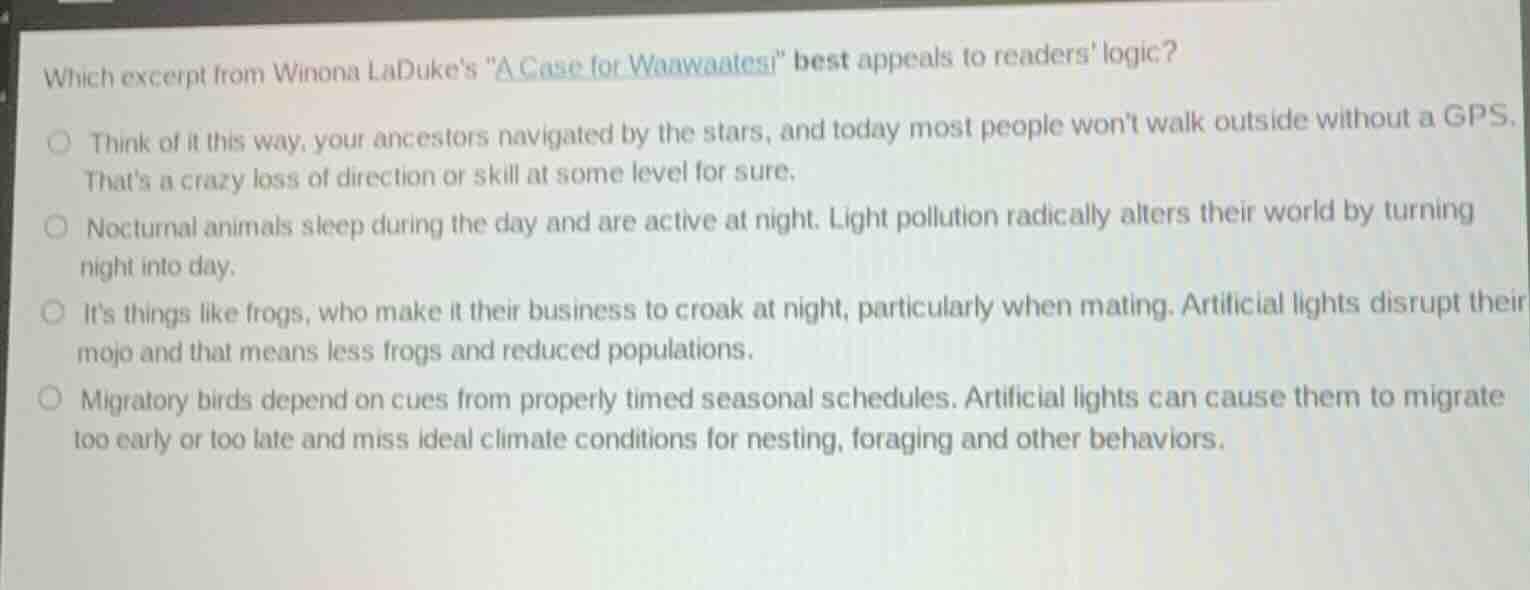
which excerpt from winona ladukes \a case for waawaatesi\ best appeals to readers logic?
think of it this way, your ancestors navigated by the stars, and today most people wont walk outside without a gps. thats a crazy loss of direction or skill at some level for sure.
nocturnal animals sleep during the day and are active at night. light pollution radically alters their world by turning night into day.
its things like frogs, who make it their business to croak at night, particularly when mating. artificial lights disrupt their mojo and that means less frogs and reduced populations.
migratory birds depend on cues from properly timed seasonal schedules. artificial lights can cause them to migrate too early or too late and miss ideal climate conditions for nesting, foraging and other behaviors.
Identify the core objective
The question asks which excerpt from Winona LaDuke's "A Case for Waawaatesi" best appeals to the readers' logic. An appeal to logic, or Logos Appeal, relies on clear reasoning, cause-and-effect relationships, and factual evidence rather than emotional language or informal anecdotes.
Analyze the rhetorical appeals in each option
- Option 1: "Think of it this way, your ancestors navigated by the stars, and today most people won't walk outside without a GPS. That's a crazy loss of direction or skill at some level for sure."
- Analysis: This option uses informal, conversational language ("crazy loss," "for sure") and makes a broad generalization. It is more of an anecdotal observation than a structured logical argument.
- Option 2: "Nocturnal animals sleep during the day and are active at night. Light pollution radically alters their world by turning night into day."
- Analysis: This statement presents a basic biological fact and a general consequence, but it is relatively brief and less developed in terms of a complete cause-and-effect logical chain compared to other options.
- Option 3: "It's things like frogs, who make it their business to croak at night, particularly when mating. Artificial lights disrupt their mojo and that means less frogs and reduced populations."
- Analysis: This option uses highly informal, colloquial language ("make it their business," "disrupt their mojo") which detracts from a formal appeal to logic.
- Option 4: "Migratory birds depend on cues from properly timed seasonal schedules. Artificial lights can cause them to migrate too early or too late and miss ideal climate conditions for nesting, foraging and other behaviors."
- Analysis: This option utilizes Rhetorical Appeals by constructing a clear, objective, and scientific cause-and-effect explanation. It explains why artificial lights are harmful: they disrupt seasonal cues, leading to mistimed migration, which in turn causes birds to miss critical conditions for survival behaviors (nesting, foraging). The tone is formal, objective, and logically structured.
Determine the best logical appeal
Option 4 provides the most complete, objective, and structured cause-and-effect argument, making it the best example of a Logos Appeal.

Snap & solve any problem in the app
Get step-by-step solutions on Sovi AI
Photo-based solutions with guided steps
Explore more problems and detailed explanations
- (A) Think of it this way, your ancestors navigated by the stars, and today most people won't walk outside without a GPS. That's a crazy loss of direction or skill at some level for sure.
- (B) Nocturnal animals sleep during the day and are active at night. Light pollution radically alters their world by turning night into day.
- (C) It's things like frogs, who make it their business to croak at night, particularly when mating. Artificial lights disrupt their mojo and that means less frogs and reduced populations.
- (D) Migratory birds depend on cues from properly timed seasonal schedules. Artificial lights can cause them to migrate too early or too late and miss ideal climate conditions for nesting, foraging and other behaviors. (Correct answer)