QUESTION IMAGE
Question
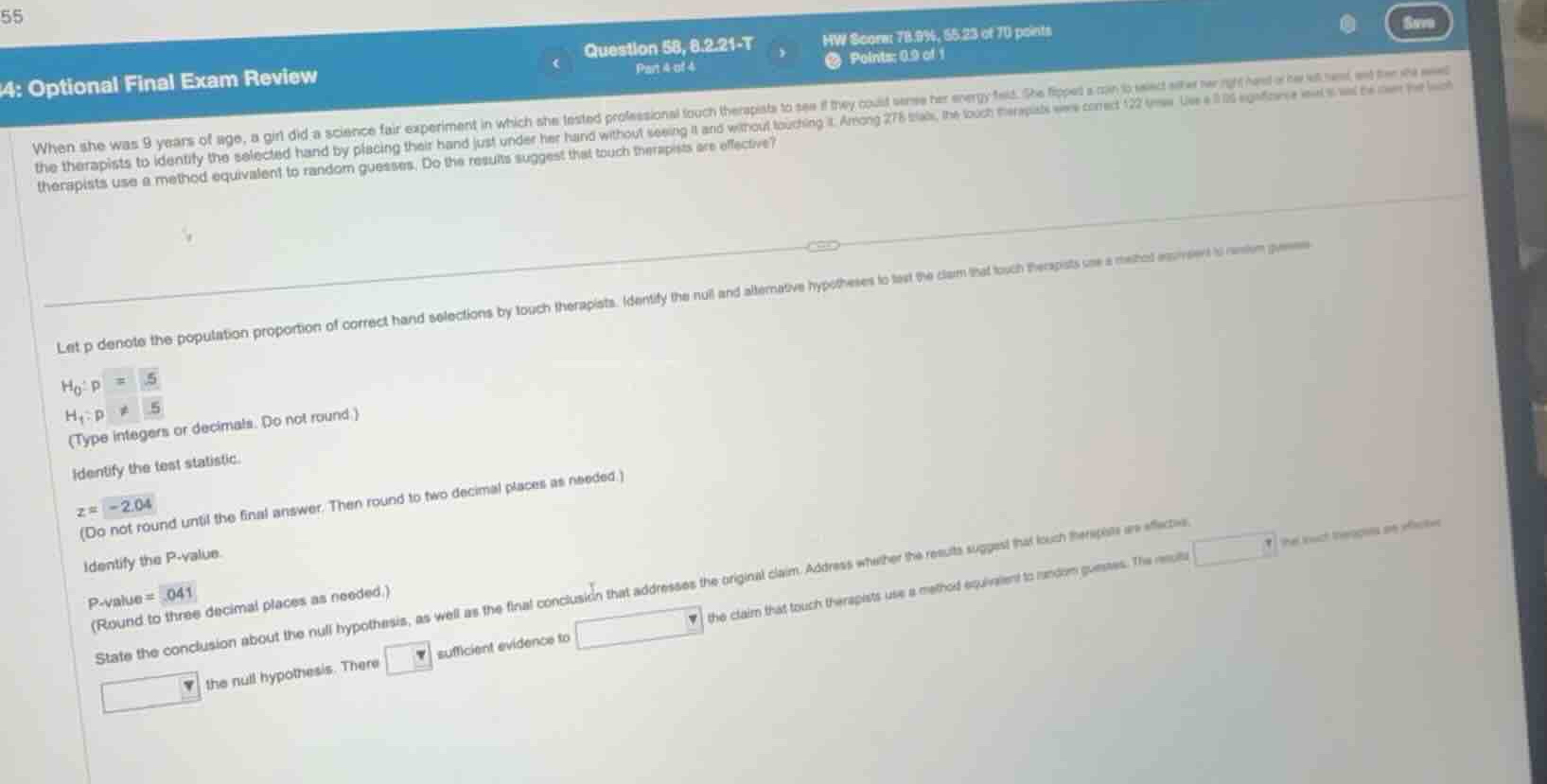
when she was 9 years of age, a girl did a science fair experiment in which she tested professional touch therapists to see if they could sense her energy field. she flipped a coin to select either her right hand or her left hand, and then she asked the therapists to identify the selected hand by placing their hand just under her hand without seeing it and without touching it. among 278 trials, the touch therapists were correct 122 times. use a 0.05 significance level to test the claim that touch therapists use a method equivalent to random guesses. do the results suggest that touch therapists are effective?
let p denote the population proportion of correct hand selections by touch therapists. identify the null and alternative hypotheses to test the claim that touch therapists use a method equivalent to random guesses.
\\(h_0: p = 0.5\\)
\\(h_1: p \
eq 0.5\\)
(type integers or decimals. do not round.)
identify the test statistic.
\\(z = -2.04\\)
(do not round until the final answer. then round to two decimal places as needed.)
identify the p-value.
p-value = .041
(round to three decimal places as needed.)
state the conclusion about the null hypothesis, as well as the final conclusion that addresses the original claim. address whether the results suggest that touch therapists are effective.
Determine the decision for the null hypothesis
Determine the conclusion regarding the claim
Evaluate the effectiveness of the therapists

Snap & solve any problem in the app
Get step-by-step solutions on Sovi AI
Photo-based solutions with guided steps
Explore more problems and detailed explanations
State the conclusion about the null hypothesis, as well as the final conclusion that addresses the original claim. Address whether the results suggest that touch therapists are effective.
Reject the null hypothesis. There is sufficient evidence to warrant rejection of the claim that touch therapists use a method equivalent to random guesses. The results do not suggest that touch therapists are effective.