QUESTION IMAGE
Question
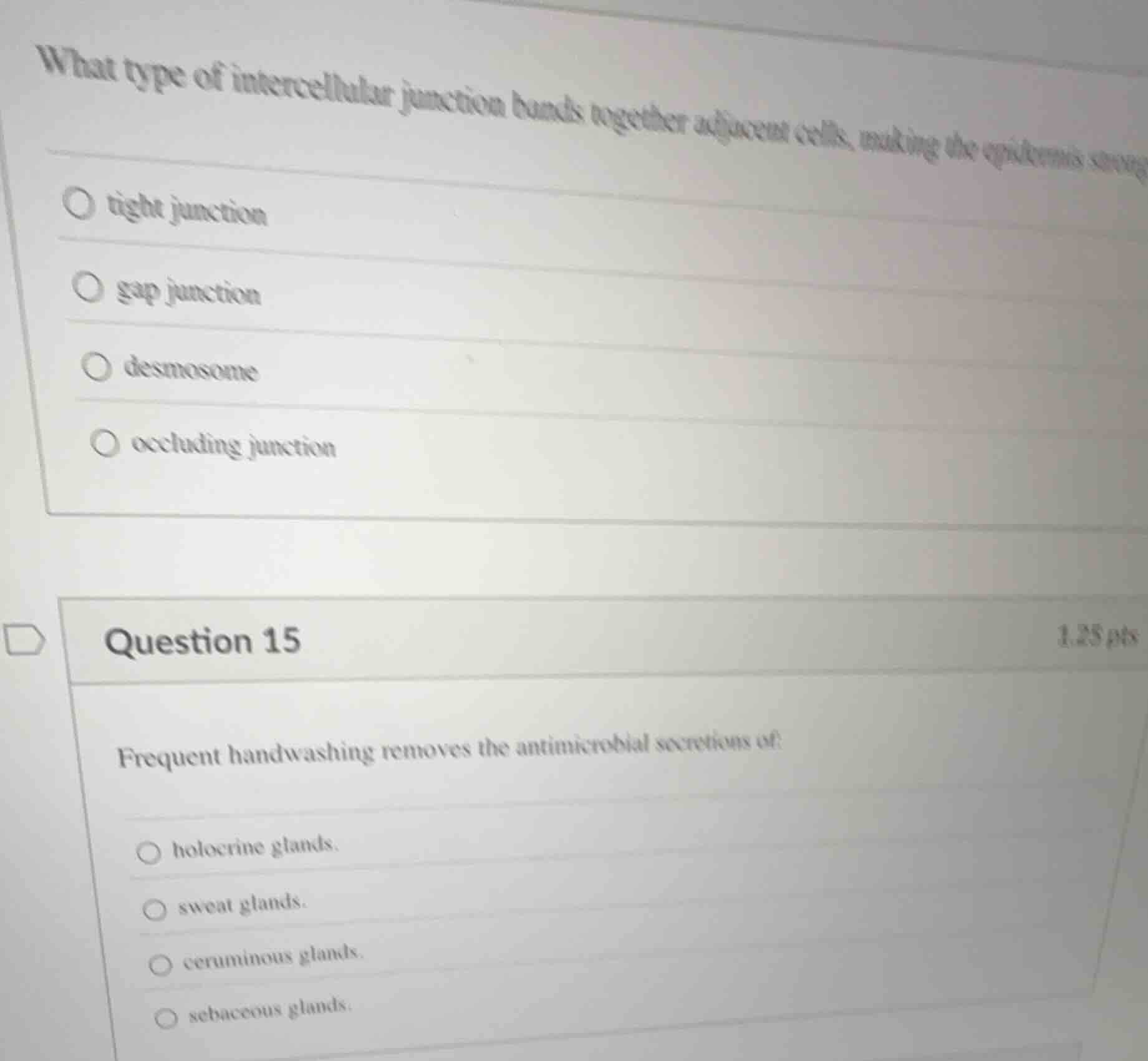
what type of intercellular junction bands together adjacent cells, making the epidermis strong
tight junction
gap junction
desmosome
occluding junction
question 15
1.25 pts
frequent handwashing removes the antimicrobial secretions of:
holocrine glands.
sweat glands.
ceruminous glands.
sebaceous glands.
Analyze the first question
The first question asks: "What type of intercellular junction bands together adjacent cells, making the epidermis strong?"
- Tight junctions (and occluding junctions) seal cells together to prevent leakage of water and solutes.
- Gap junctions allow direct chemical communication between adjacent cells.
- Desmosomes (anchoring junctions) mechanically attach cells to each other and to the cytoskeleton, providing mechanical strength to tissues like the epidermis.
Therefore, desmosomes are responsible for banding adjacent cells together to make the epidermis strong.
Analyze the second question
The second question (labeled Question 15) asks: "Frequent handwashing removes the antimicrobial secretions of:"
- Holocrine glands release secretions by cell rupture (sebaceous glands are a type of holocrine gland, but "sebaceous glands" is a more specific and standard answer for skin surface antimicrobial lipids).
- Sweat glands produce sweat, which contains water, salts, and some antimicrobial peptides (dermcidin), but the primary lipid-based antimicrobial barrier on the hands is sebum.
- Ceruminous glands are modified sweat glands in the external ear canal that produce earwax.
- Sebaceous glands secrete sebum, an oily substance containing lipids that coat the skin surface, providing a crucial antimicrobial and moisturizing barrier. Frequent washing with soap emulsifies and removes these lipids.
Therefore, sebaceous glands is the most accurate choice.

Snap & solve any problem in the app
Get step-by-step solutions on Sovi AI
Photo-based solutions with guided steps
Explore more problems and detailed explanations
Question 1
- tight junction
- gap junction
- desmosome (Correct answer)
- occluding junction
Question 2
- holocrine glands.
- sweat glands.
- ceruminous glands.
- sebaceous glands. (Correct answer)