QUESTION IMAGE
Question
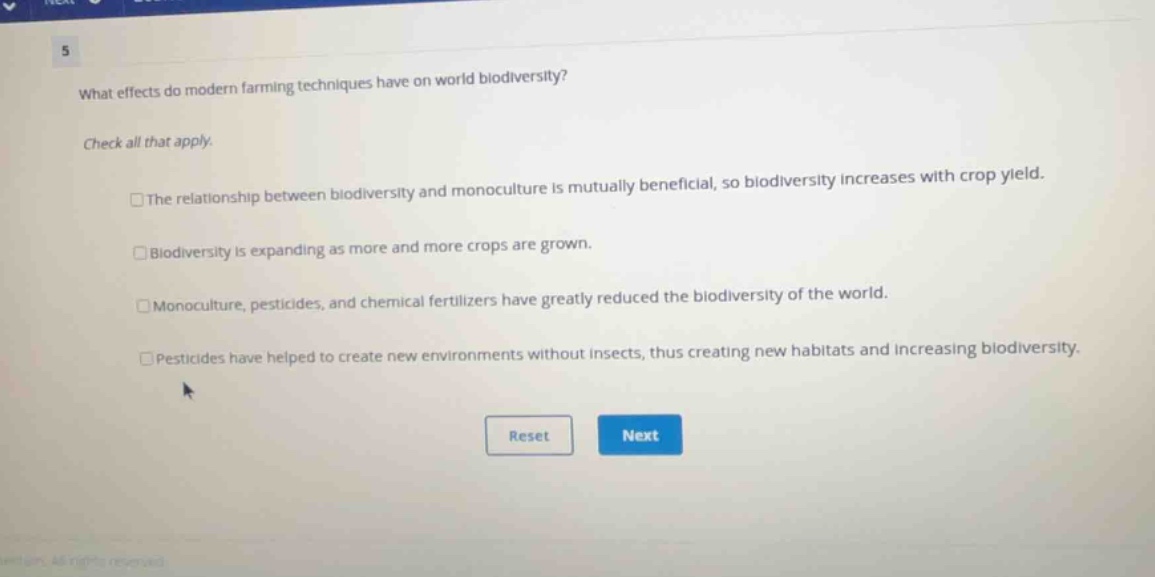
what effects do modern farming techniques have on world biodiversity?
check all that apply.
- the relationship between biodiversity and monoculture is mutually beneficial, so biodiversity increases with crop yield.
- biodiversity is expanding as more and more crops are grown.
- monoculture, pesticides, and chemical fertilizers have greatly reduced the biodiversity of the world.
- pesticides have helped to create new environments without insects, thus creating new habitats and increasing biodiversity.
<pre_analysis>
{
"quality": "clear",
"question_count": 1,
"skills_matched": [
"direct_cot",
"multiple_choice_formatter",
"explain_then_answer",
"quick"
],
"needs_drawing": false,
"concepts_used": [
"Farming Practices"
],
"new_concepts": [
"Agricultural Biodiversity",
"Monoculture Impact"
],
"current_concepts": [
"Farming Practices",
"Agricultural Biodiversity",
"Monoculture Impact"
]
}
</pre_analysis>
<reasoning>
Analyze the impact of modern farming on biodiversity
Modern agricultural practices such as monoculture (growing a single crop over a wide area), heavy pesticide use, and chemical fertilizers simplify ecosystems, eliminate native plant and insect species, and disrupt local food webs, leading to a significant reduction in global biodiversity.
Evaluate the given statements
- Statement 1 claims monoculture and biodiversity are mutually beneficial, which is false because monoculture reduces genetic and species diversity.
- Statement 2 claims biodiversity is expanding, which is false as modern intensive farming is a primary driver of biodiversity loss.
- Statement 3 correctly identifies that monoculture, pesticides, and chemical fertilizers have greatly reduced global biodiversity.
- Statement 4 claims pesticides increase biodiversity by creating insect-free environments, which is false because removing insects reduces biodiversity and disrupts ecosystems.
</reasoning>
<answer>
<mcq-option>The relationship between biodiversity and monoculture is mutually beneficial, so biodiversity increases with crop yield.</mcq-option>
<mcq-option>Biodiversity is expanding as more and more crops are grown.</mcq-option>
<mcq-correct>Monoculture, pesticides, and chemical fertilizers have greatly reduced the biodiversity of the world.</mcq-correct>
<mcq-option>Pesticides have helped to create new environments without insects, thus creating new habitats and increasing biodiversity.</mcq-option>
</answer>
<post_analysis>
{
"subject": "Natural Science",
"question_type": "Multiple Choice",
"knowledge_point": [
"Natural Science",
"Environmental Science",
"Agricultural Biodiversity"
]
}
</post_analysis>
Snap & solve any problem in the app
Get step-by-step solutions on Sovi AI
Photo-based solutions with guided steps
Explore more problems and detailed explanations
<pre_analysis>
{
"quality": "clear",
"question_count": 1,
"skills_matched": [
"direct_cot",
"multiple_choice_formatter",
"explain_then_answer",
"quick"
],
"needs_drawing": false,
"concepts_used": [
"Farming Practices"
],
"new_concepts": [
"Agricultural Biodiversity",
"Monoculture Impact"
],
"current_concepts": [
"Farming Practices",
"Agricultural Biodiversity",
"Monoculture Impact"
]
}
</pre_analysis>
<reasoning>
Analyze the impact of modern farming on biodiversity
Modern agricultural practices such as monoculture (growing a single crop over a wide area), heavy pesticide use, and chemical fertilizers simplify ecosystems, eliminate native plant and insect species, and disrupt local food webs, leading to a significant reduction in global biodiversity.
Evaluate the given statements
- Statement 1 claims monoculture and biodiversity are mutually beneficial, which is false because monoculture reduces genetic and species diversity.
- Statement 2 claims biodiversity is expanding, which is false as modern intensive farming is a primary driver of biodiversity loss.
- Statement 3 correctly identifies that monoculture, pesticides, and chemical fertilizers have greatly reduced global biodiversity.
- Statement 4 claims pesticides increase biodiversity by creating insect-free environments, which is false because removing insects reduces biodiversity and disrupts ecosystems.
</reasoning>
<answer>
<mcq-option>The relationship between biodiversity and monoculture is mutually beneficial, so biodiversity increases with crop yield.</mcq-option>
<mcq-option>Biodiversity is expanding as more and more crops are grown.</mcq-option>
<mcq-correct>Monoculture, pesticides, and chemical fertilizers have greatly reduced the biodiversity of the world.</mcq-correct>
<mcq-option>Pesticides have helped to create new environments without insects, thus creating new habitats and increasing biodiversity.</mcq-option>
</answer>
<post_analysis>
{
"subject": "Natural Science",
"question_type": "Multiple Choice",
"knowledge_point": [
"Natural Science",
"Environmental Science",
"Agricultural Biodiversity"
]
}
</post_analysis>