QUESTION IMAGE
Question
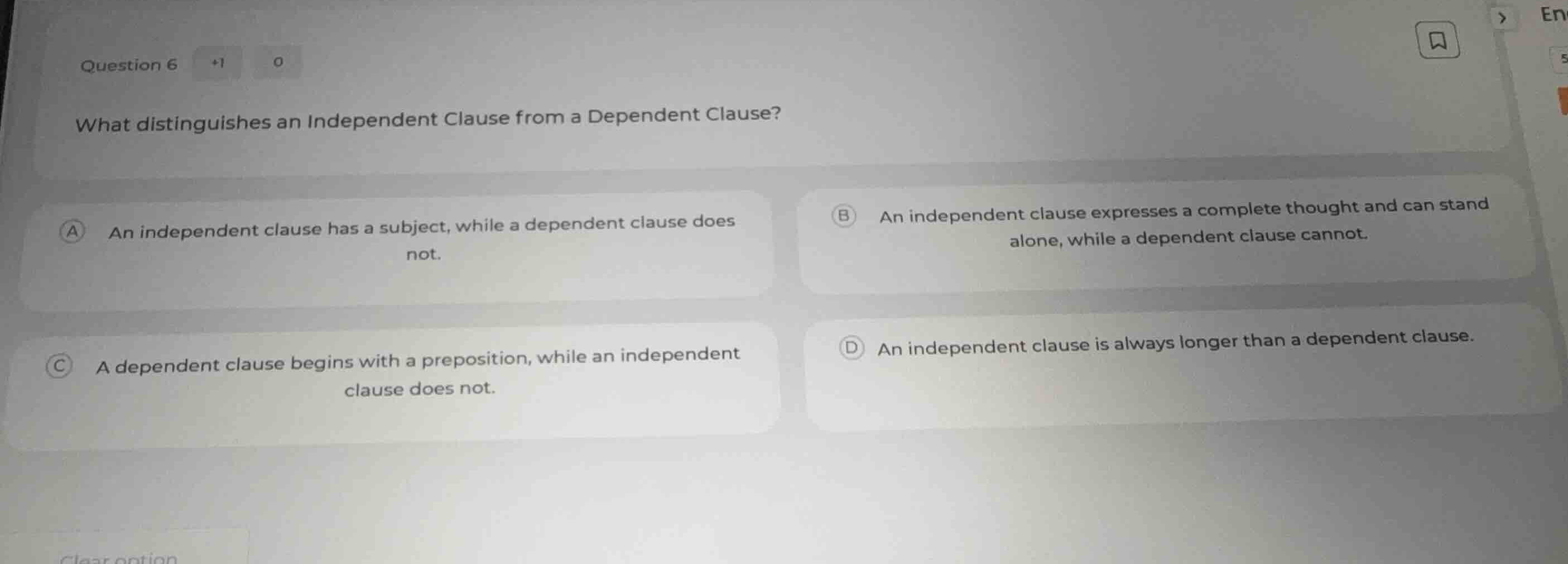
what distinguishes an independent clause from a dependent clause?
a. an independent clause has a subject, while a dependent clause does not.
b. an independent clause expresses a complete thought and can stand alone, while a dependent clause cannot.
c. a dependent clause begins with a preposition, while an independent clause does not.
d. an independent clause is always longer than a dependent clause.
Analyze the definition of clauses
Both independent and dependent clauses contain a subject and a verb. However, an independent clause expresses a complete thought and can stand alone as a sentence, whereas a dependent clause does not express a complete thought and cannot stand alone.
Evaluate the given options
- Option A is incorrect because both types of clauses contain a subject.
- Option B is correct because it accurately describes the defining difference in completeness and ability to stand alone.
- Option C is incorrect because dependent clauses typically begin with subordinating conjunctions or relative pronouns, not prepositions.
- Option D is incorrect because length does not determine the type of clause.

Snap & solve any problem in the app
Get step-by-step solutions on Sovi AI
Photo-based solutions with guided steps
Explore more problems and detailed explanations
- (A) An independent clause has a subject, while a dependent clause does not.
- (B) An independent clause expresses a complete thought and can stand alone, while a dependent clause cannot. (Correct answer)
- (C) A dependent clause begins with a preposition, while an independent clause does not.
- (D) An independent clause is always longer than a dependent clause.