QUESTION IMAGE
Question
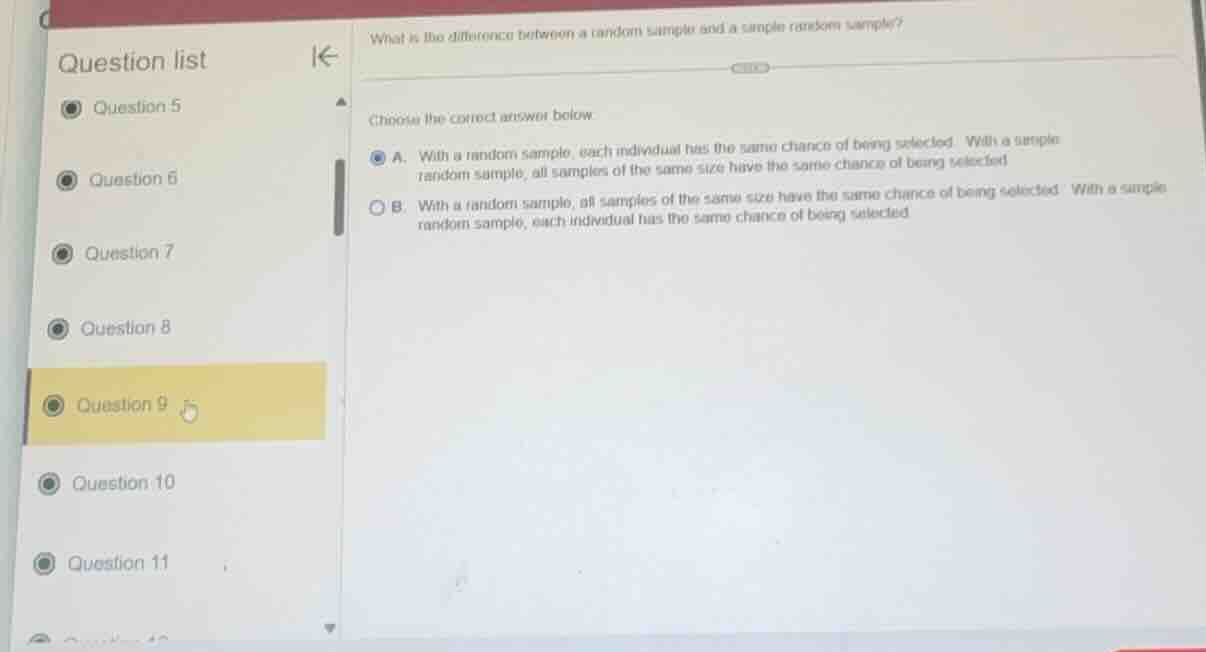
what is the difference between a random sample and a simple random sample?
choose the correct answer below.
a. with a random sample, each individual has the same chance of being selected. with a simple random sample, all samples of the same size have the same chance of being selected.
b. with a random sample, all samples of the same size have the same chance of being selected. with a simple random sample, each individual has the same chance of being selected.
⚡ Using what you learned: Sampling Methods
Step 1: Define a Random Sample
A random sample is a sampling method where every individual member of the population has an equal (or known) chance of being selected. This focuses on the probability of selecting individual members.
Step 2: Define a Simple Random Sample (SRS)
A simple random sample of size \( n \) is a more restrictive type of sample. It requires not only that every individual has the same chance of being chosen, but also that every possible group/sample of size \( n \) has the exact same chance of being selected.
For example, if you select a sample by choosing entire pre-determined clusters (like classrooms), every individual student might have an equal chance of being selected, but certain combinations of students (samples) are impossible to form. In a simple random sample, every possible combination must be equally likely.
Step 3: Compare the Options
- Option A states: "With a random sample, each individual has the same chance of being selected. With a simple random sample, all samples of the same size have the same chance of being selected." This matches our definitions.
- Option B reverses these definitions incorrectly.

Snap & solve any problem in the app
Get step-by-step solutions on Sovi AI
Photo-based solutions with guided steps
Explore more problems and detailed explanations
A. With a random sample, each individual has the same chance of being selected. With a simple random sample, all samples of the same size have the same chance of being selected.