QUESTION IMAGE
Question
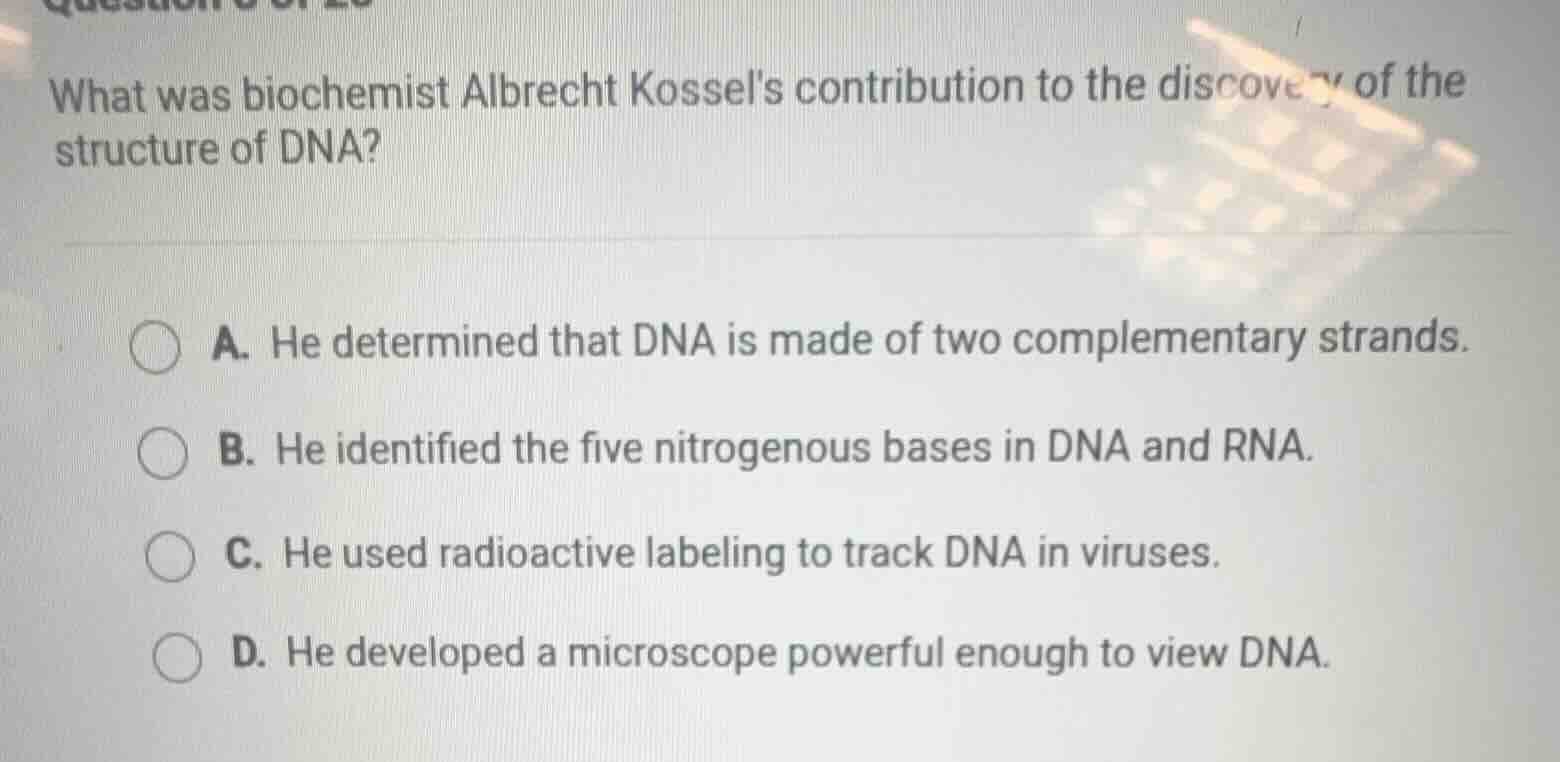
what was biochemist albrecht kossels contribution to the discovery of the structure of dna?
a. he determined that dna is made of two complementary strands.
b. he identified the five nitrogenous bases in dna and rna.
c. he used radioactive labeling to track dna in viruses.
d. he developed a microscope powerful enough to view dna.
<pre_analysis>
{
"quality": "clear",
"question_count": 1,
"skills_matched": [
"direct_cot",
"multiple_choice_formatter",
"explain_then_answer",
"tutor",
"mastery_adaptive_brevity"
],
"needs_drawing": false,
"concepts_used": [
"History of DNA Discovery"
],
"new_concepts": [],
"current_concepts": [
"History of DNA Discovery",
"DNA Structure"
]
}
</pre_analysis>
<reasoning>
Identify the historical contribution of Albrecht Kossel
Using the History of DNA Discovery knowledge point, we recall that Albrecht Kossel isolated and described the five primary nitrogenous bases: adenine, cytosine, guanine, thymine, and uracil.
Evaluate the given multiple-choice options
- Option A refers to Watson and Crick's double helix model.
- Option B correctly identifies Kossel's discovery of the five nitrogenous bases.
- Option C refers to the Hershey-Chase experiment.
- Option D is historically inaccurate regarding DNA's structural discovery.
</reasoning>
<answer>
<mcq-option>(A) He determined that DNA is made of two complementary strands.</mcq-option>
<mcq-correct>(B) He identified the five nitrogenous bases in DNA and RNA.</mcq-correct>
<mcq-option>(C) He used radioactive labeling to track DNA in viruses.</mcq-option>
<mcq-option>(D) He developed a microscope powerful enough to view DNA.</mcq-option>
</answer>
<post_analysis>
{
"subject": "Natural Science",
"question_type": "Multiple Choice",
"knowledge_point": [
"Natural Science",
"Biology",
"History of DNA Discovery"
]
}
</post_analysis>
Snap & solve any problem in the app
Get step-by-step solutions on Sovi AI
Photo-based solutions with guided steps
Explore more problems and detailed explanations
<pre_analysis>
{
"quality": "clear",
"question_count": 1,
"skills_matched": [
"direct_cot",
"multiple_choice_formatter",
"explain_then_answer",
"tutor",
"mastery_adaptive_brevity"
],
"needs_drawing": false,
"concepts_used": [
"History of DNA Discovery"
],
"new_concepts": [],
"current_concepts": [
"History of DNA Discovery",
"DNA Structure"
]
}
</pre_analysis>
<reasoning>
Identify the historical contribution of Albrecht Kossel
Using the History of DNA Discovery knowledge point, we recall that Albrecht Kossel isolated and described the five primary nitrogenous bases: adenine, cytosine, guanine, thymine, and uracil.
Evaluate the given multiple-choice options
- Option A refers to Watson and Crick's double helix model.
- Option B correctly identifies Kossel's discovery of the five nitrogenous bases.
- Option C refers to the Hershey-Chase experiment.
- Option D is historically inaccurate regarding DNA's structural discovery.
</reasoning>
<answer>
<mcq-option>(A) He determined that DNA is made of two complementary strands.</mcq-option>
<mcq-correct>(B) He identified the five nitrogenous bases in DNA and RNA.</mcq-correct>
<mcq-option>(C) He used radioactive labeling to track DNA in viruses.</mcq-option>
<mcq-option>(D) He developed a microscope powerful enough to view DNA.</mcq-option>
</answer>
<post_analysis>
{
"subject": "Natural Science",
"question_type": "Multiple Choice",
"knowledge_point": [
"Natural Science",
"Biology",
"History of DNA Discovery"
]
}
</post_analysis>