QUESTION IMAGE
Question
use a table to find the indicated area under the standard normal curve. include an appropriately labeled sketch of the normal curve and shade the appropriate region.
a. find the area to the left of a z-score of \\(-0.21\\).
b. find the area to the right of a z-score of \\(-0.21\\).
click here to view page 1 of the standard normal table.
click here to view page 2 of the standard normal table.
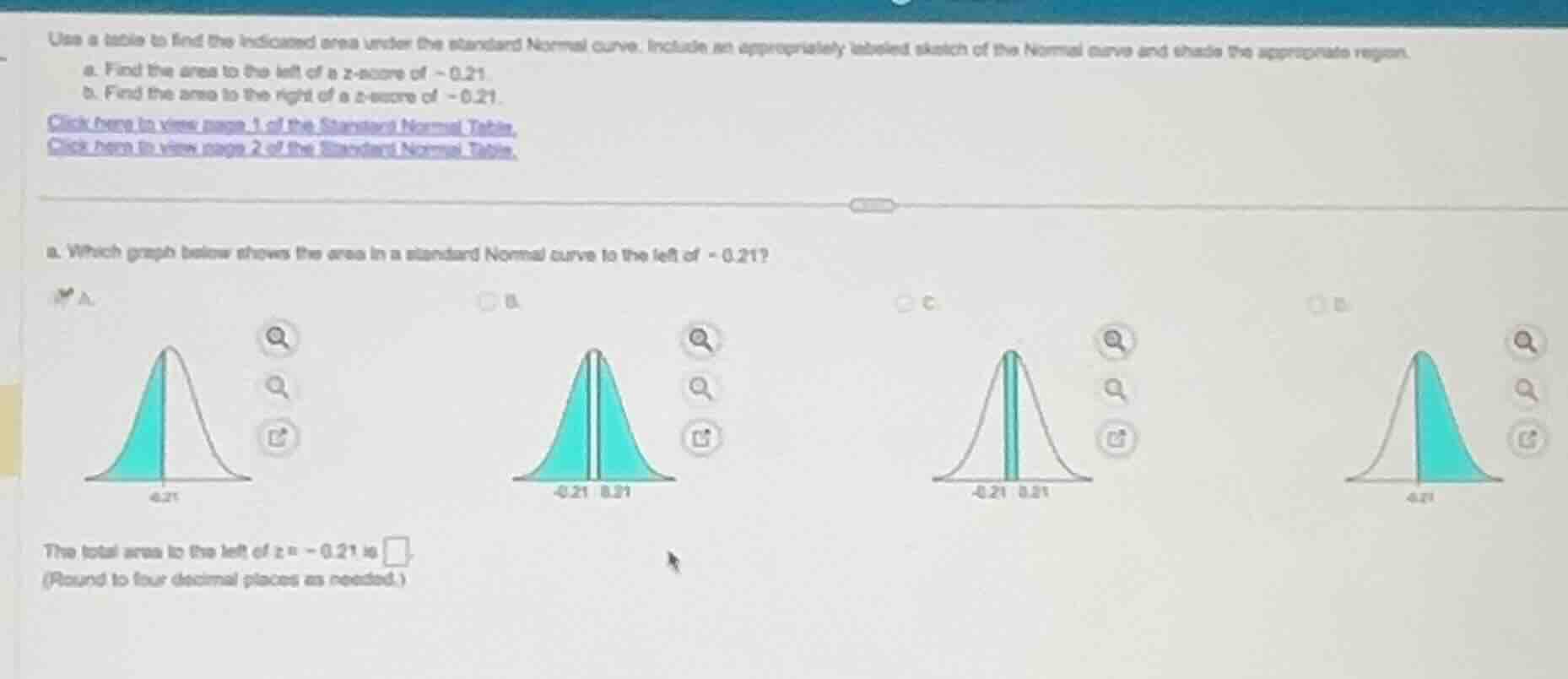
a. which graph below shows the area in a standard normal curve to the left of \\(-0.21\\)?
the total area to the left of \\(z = -0.21\\) is
(round to four decimal places as needed.)
⚡ Using what you learned: normal distribution
Step 1: Identify the correct graph
To represent the area to the left of \( z = -0.21 \):
- The value \( z = -0.21 \) lies slightly to the left of the center (where \( z = 0 \)).
- The region "to the left" means we shade the tail starting from \( -0.21 \) extending to the far left.
Looking at the options:
- A: Shaded to the left of \( -0.21 \).
- B: Shaded between \( -0.21 \) and \( 0.21 \).
- C: Shaded in the tails outside of \( -0.21 \) and \( 0.21 \).
- D: Shaded to the right of \( -0.21 \).
Thus, the correct graph is A.
Step 2: Find the area to the left of \( z = -0.21 \)
Using a standard Normal table (z-table) for \( z = -0.21 \):
- Look up the row for \( -0.2 \) and the column for \( 0.01 \).
- The cumulative area to the left is:
Step 3: Find the area to the right of \( z = -0.21 \)
The total area under the standard Normal curve is \( 1 \).
- Subtract the area to the left from \( 1 \):

Snap & solve any problem in the app
Get step-by-step solutions on Sovi AI
Photo-based solutions with guided steps
Explore more problems and detailed explanations
- Graph selection: A
- a. The total area to the left of \( z = -0.21 \): \( 0.4168 \)
- b. The total area to the right of \( z = -0.21 \): \( 0.5832 \)