Sovi.AI - AI Math Tutor

Scan to solve math questions

QUESTION IMAGE

if two parents are each heterozygous, the probability of their child be…

Question

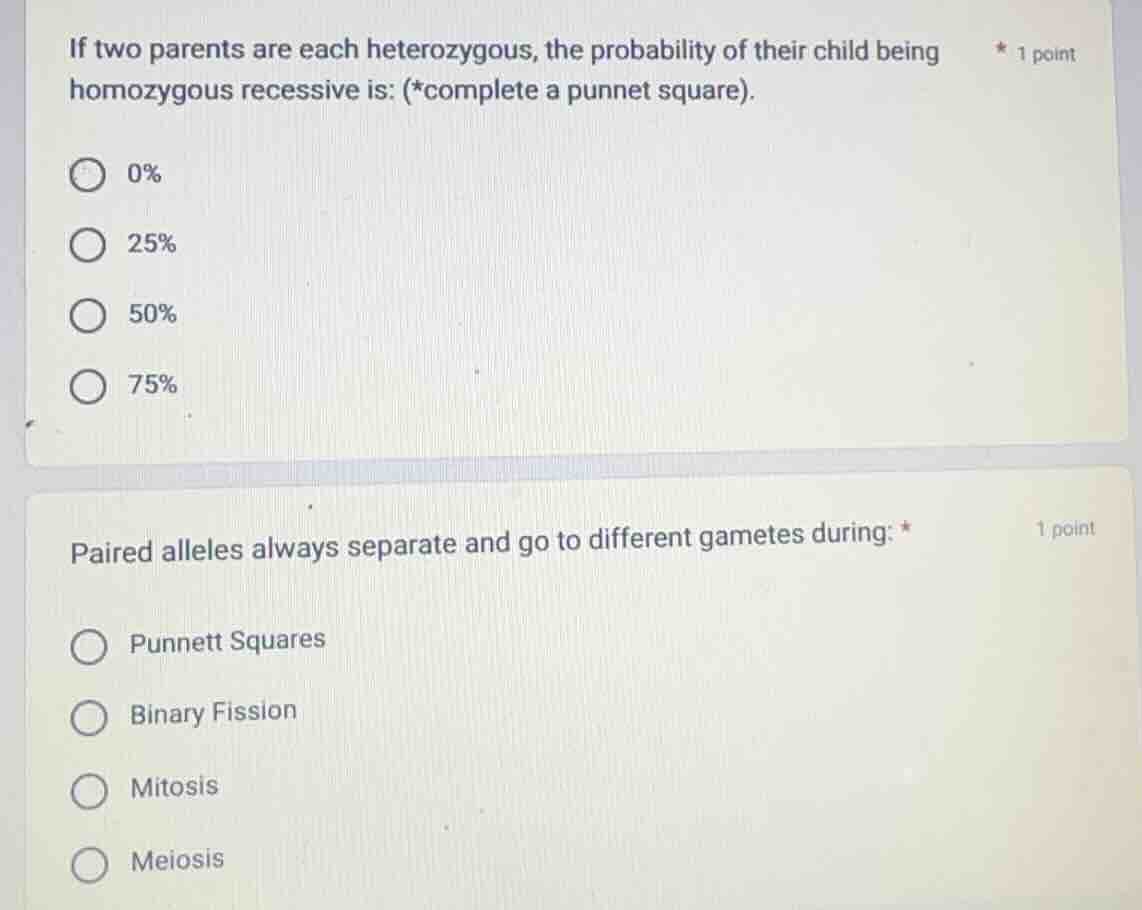
if two parents are each heterozygous, the probability of their child being homozygous recessive is: (*complete a punnet square).

0%
25%
50%
75%

paired alleles always separate and go to different gametes during:

punnett squares
binary fission
mitosis
meiosis

Explanation:

Response

<pre_analysis>
{
"quality": "clear",
"question_count": 2,
"skills_matched": [
"step_cot",
"multiple_choice_formatter",
"explain_then_answer",
"tutor"
],
"needs_drawing": false,
"concepts_used": [
"Punnett Square",
"Meiosis"
],
"new_concepts": [],
"current_concepts": [
"Punnett Square",
"Meiosis",
"Mendelian Inheritance"
]
}
</pre_analysis>

<reasoning>

Analyze the first question

The first question asks for the probability of a child being homozygous recessive when both parents are heterozygous.

Using the Punnett Square concept, we represent the heterozygous parents with alleles \(Aa\) and \(Aa\). Crossing these parents yields:

  • \(AA\) (homozygous dominant): 1 out of 4 (\(25\%\))
  • \(Aa\) (heterozygous): 2 out of 4 (\(50\%\))
  • \(aa\) (homozygous recessive): 1 out of 4 (\(25\%\))

Thus, the probability of a homozygous recessive child is \(25\%\).

Analyze the second question

The second question asks when paired alleles separate and go to different gametes.

Using the Meiosis concept, homologous chromosomes (and thus paired alleles) segregate during the formation of gametes. This physical separation of alleles is the biological basis of Mendel's Law of Segregation, which occurs specifically during the cell division process of meiosis.
</reasoning>

<answer>

Question 1

<mcq-option>0%</mcq-option>
<mcq-correct>25%</mcq-correct>
<mcq-option>50%</mcq-option>
<mcq-option>75%</mcq-option>

Question 2

<mcq-option>Punnett Squares</mcq-option>
<mcq-option>Binary Fission</mcq-option>
<mcq-option>Mitosis</mcq-option>
<mcq-correct>Meiosis</mcq-correct>
</answer>

<post_analysis>
{
"subject": "Natural Science",
"question_type": "Multiple Choice",
"knowledge_point": [
"Natural Science",
"Biology",
"Mendelian Genetics"
]
}
</post_analysis>

Answer:

<pre_analysis>
{
"quality": "clear",
"question_count": 2,
"skills_matched": [
"step_cot",
"multiple_choice_formatter",
"explain_then_answer",
"tutor"
],
"needs_drawing": false,
"concepts_used": [
"Punnett Square",
"Meiosis"
],
"new_concepts": [],
"current_concepts": [
"Punnett Square",
"Meiosis",
"Mendelian Inheritance"
]
}
</pre_analysis>

<reasoning>

Analyze the first question

The first question asks for the probability of a child being homozygous recessive when both parents are heterozygous.

Using the Punnett Square concept, we represent the heterozygous parents with alleles \(Aa\) and \(Aa\). Crossing these parents yields:

  • \(AA\) (homozygous dominant): 1 out of 4 (\(25\%\))
  • \(Aa\) (heterozygous): 2 out of 4 (\(50\%\))
  • \(aa\) (homozygous recessive): 1 out of 4 (\(25\%\))

Thus, the probability of a homozygous recessive child is \(25\%\).

Analyze the second question

The second question asks when paired alleles separate and go to different gametes.

Using the Meiosis concept, homologous chromosomes (and thus paired alleles) segregate during the formation of gametes. This physical separation of alleles is the biological basis of Mendel's Law of Segregation, which occurs specifically during the cell division process of meiosis.
</reasoning>

<answer>

Question 1

<mcq-option>0%</mcq-option>
<mcq-correct>25%</mcq-correct>
<mcq-option>50%</mcq-option>
<mcq-option>75%</mcq-option>

Question 2

<mcq-option>Punnett Squares</mcq-option>
<mcq-option>Binary Fission</mcq-option>
<mcq-option>Mitosis</mcq-option>
<mcq-correct>Meiosis</mcq-correct>
</answer>

<post_analysis>
{
"subject": "Natural Science",
"question_type": "Multiple Choice",
"knowledge_point": [
"Natural Science",
"Biology",
"Mendelian Genetics"
]
}
</post_analysis>