QUESTION IMAGE
Question
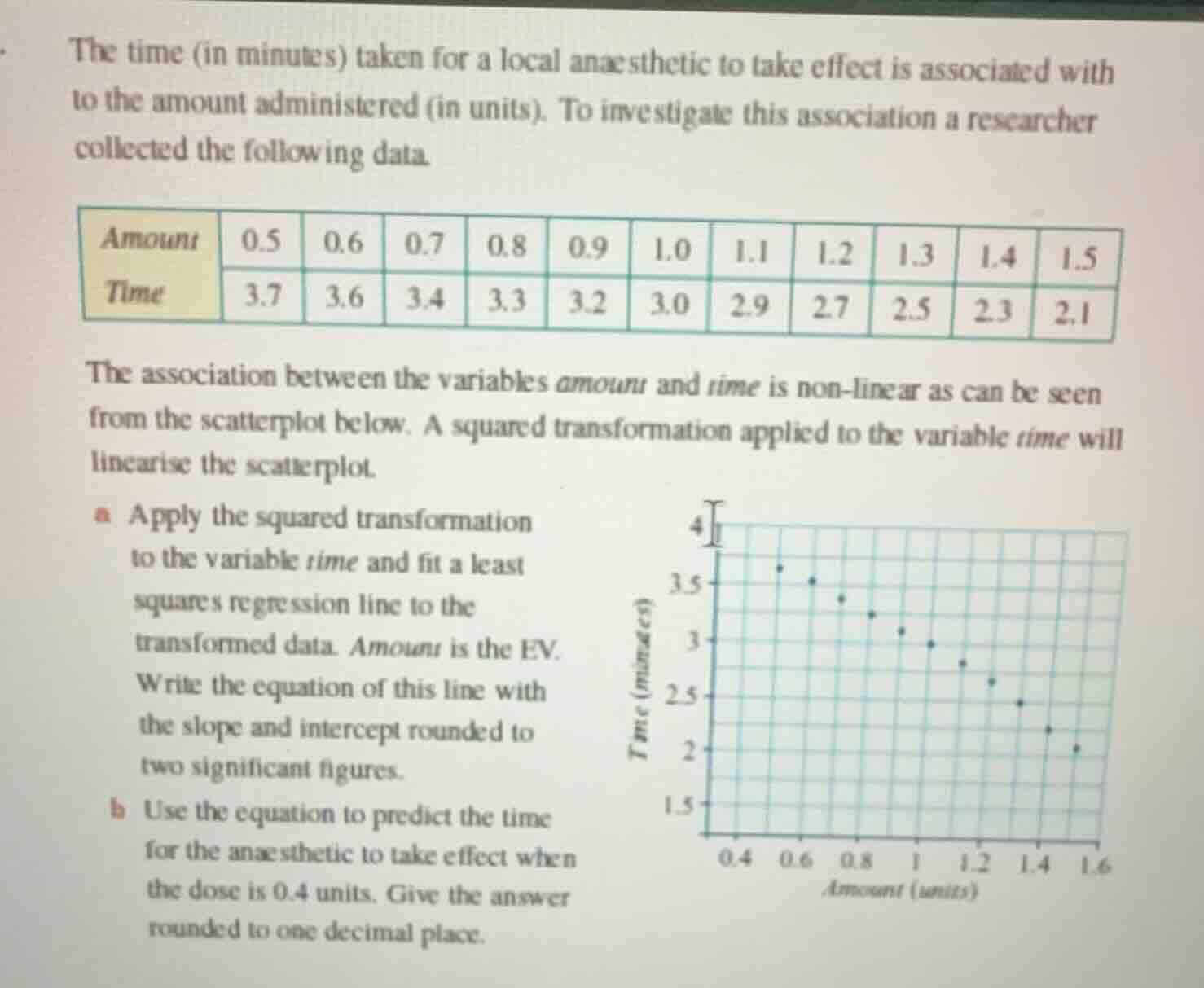
the time (in minutes) taken for a local anaesthetic to take effect is associated with to the amount administered (in units). to investigate this association a researcher collected the following data.
\
the association between the variables amount and time is non-linear as can be seen from the scatterplot below. a squared transformation applied to the variable time will linearise the scatterplot.
a apply the squared transformation to the variable time and fit a least squares regression line to the transformed data. amount is the ev. write the equation of this line with the slope and intercept rounded to two significant figures.
b use the equation to predict the time for the anaesthetic to take effect when the dose is 0.4 units. give the answer rounded to one decimal place.
Transform the response variable
We apply a squared transformation to the variable \(y = \text{time}\). Let \(y^* = \text{time}^2\).
The explanatory variable is \(x = \text{amount}\).
We calculate \(y^*\) for each data point:
- For \(x = 0.5\), \(y^* = 3.7^2 = 13.69\)
- For \(x = 0.6\), \(y^* = 3.6^2 = 12.96\)
- For \(x = 0.7\), \(y^* = 3.4^2 = 11.56\)
- For \(x = 0.8\), \(y^* = 3.3^2 = 10.89\)
- For \(x = 0.9\), \(y^* = 3.2^2 = 10.24\)
- For \(x = 1.0\), \(y^* = 3.0^2 = 9.00\)
- For \(x = 1.1\), \(y^* = 2.9^2 = 8.41\)
- For \(x = 1.2\), \(y^* = 2.7^2 = 7.29\)
- For \(x = 1.3\), \(y^* = 2.5^2 = 6.25\)
- For \(x = 1.4\), \(y^* = 2.3^2 = 5.29\)
- For \(x = 1.5\), \(y^* = 2.1^2 = 4.41\)
Fit least squares regression line
We calculate the linear regression of \(y^*\) on \(x\):
- Number of data points \(n = 11\)
- Sum of \(x\): \(\sum x = 11.0\)
- Mean of \(x\): \(\bar{x} = 1.0\)
- Sum of \(y^*\): \(\sum y^* = 100.0\)
- Mean of \(y^*\): \(\bar{y}^* \approx 9.0909\)
- Sum of \(x^2\): \(\sum x^2 = 12.1\)
- Sum of \(x y^*\): \(\sum x y^* = 90.7\)
We compute the slope \(b\):
We compute the intercept \(a\):
Rounding the slope and intercept to two significant figures:
- Slope: \(-8.5\)
- Intercept: \(18\)
The equation is:
Predict time for amount of 0.4
We substitute \(\text{amount} = 0.4\) into our regression equation:
We solve for \(\text{time}\):
Rounding to one decimal place gives \(3.8\) minutes.

Snap & solve any problem in the app
Get step-by-step solutions on Sovi AI
Photo-based solutions with guided steps
Explore more problems and detailed explanations
Question a
Question b
\(3.8\) minutes