QUESTION IMAGE
Question
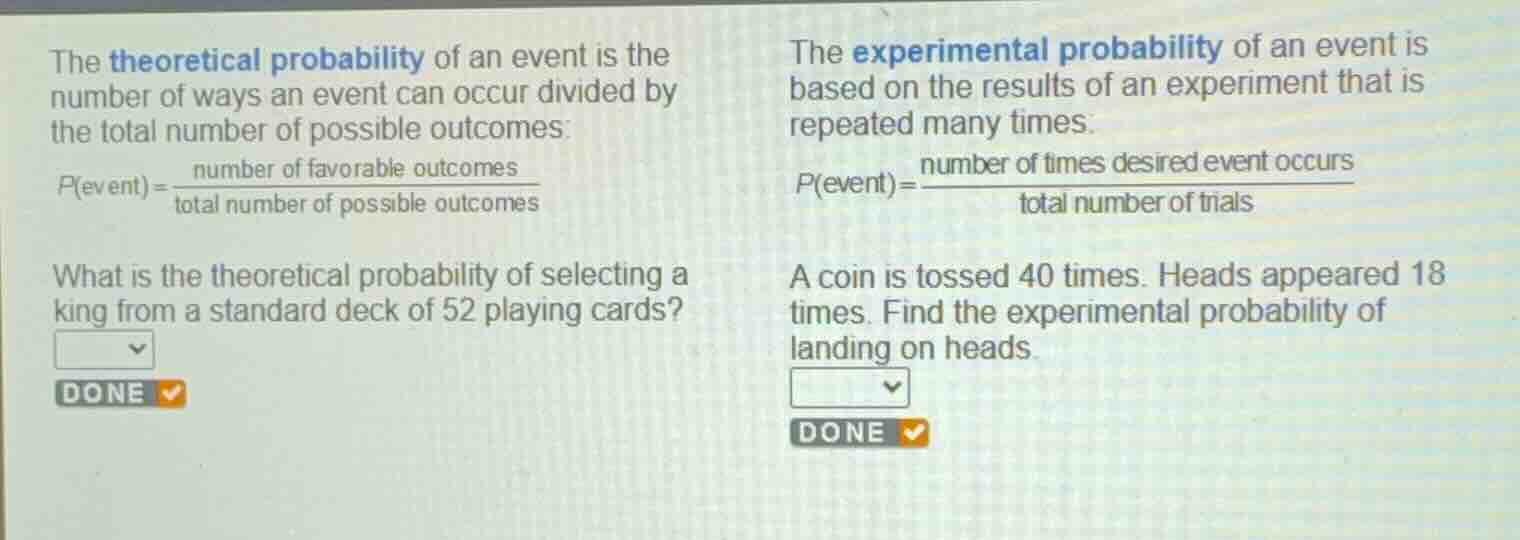
the theoretical probability of an event is the number of ways an event can occur divided by the total number of possible outcomes:
\\p(\text{event}) = \frac{\text{number of favorable outcomes}}{\text{total number of possible outcomes}}\\
what is the theoretical probability of selecting a king from a standard deck of 52 playing cards?
the experimental probability of an event is based on the results of an experiment that is repeated many times:
\\p(\text{event}) = \frac{\text{number of times desired event occurs}}{\text{total number of trials}}\\
a coin is tossed 40 times. heads appeared 18 times. find the experimental probability of landing on heads.
Calculate theoretical probability of selecting a king
Using the Theoretical Probability, Favorable Outcomes, and Sample Space knowledge points
Calculate experimental probability of landing on heads
We identify the components for experimental probability:
- Number of times the desired event occurs (heads): \(18\)
- Total number of trials (tosses): \(40\)
We apply the experimental probability formula:
Substitute the values and simplify the fraction:

Snap & solve any problem in the app
Get step-by-step solutions on Sovi AI
Photo-based solutions with guided steps
Explore more problems and detailed explanations
Question 1
The theoretical probability of selecting a king from a standard deck of 52 playing cards is <blank>\(\frac{1}{13}\)</blank>.
Question 2
A coin is tossed 40 times. Heads appeared 18 times. Find the experimental probability of landing on heads.
The experimental probability is <blank>\(\frac{9}{20}\)</blank>.