QUESTION IMAGE
Question
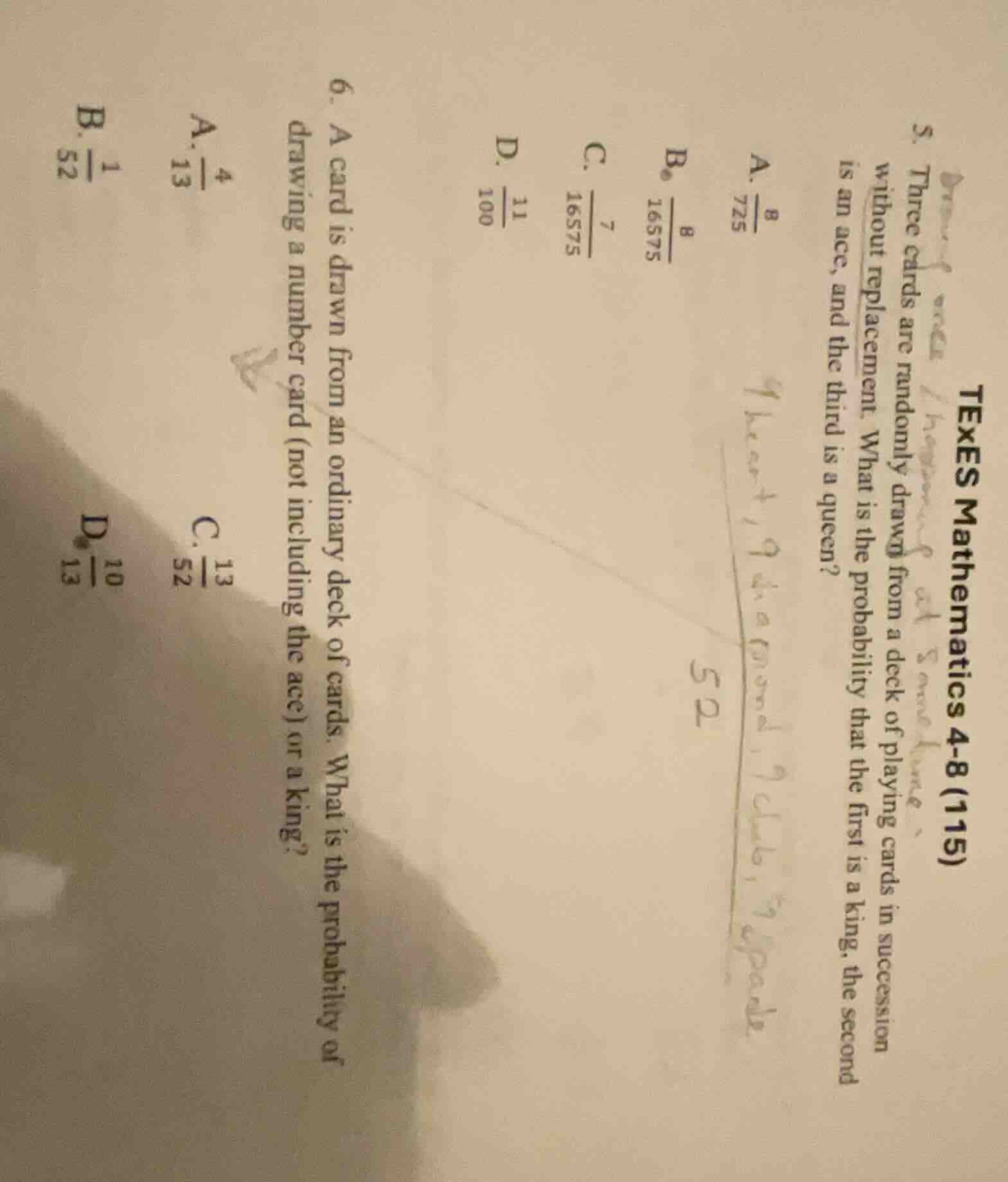
texes mathematics 4-8 (115)
- three cards are randomly drawn from a deck of playing cards in succession without replacement. what is the probability that the first is a king, the second is an ace, and the third is a queen?
a. \\(\frac{8}{725}\\)
b. \\(\frac{8}{16575}\\)
c. \\(\frac{7}{16575}\\)
d. \\(\frac{11}{100}\\)
- a card is drawn from an ordinary deck of cards. what is the probability of drawing a number card (not including the ace) or a king?
a. \\(\frac{4}{13}\\)
b. \\(\frac{1}{52}\\)
c. \\(\frac{13}{52}\\)
d. \\(\frac{10}{13}\\)
🆕 New Concept Discovered: Dependent Probability
Calculating likelihood when previous outcomes affect the next.
Step 1: Identify the card counts for each event
A standard deck has \( 52 \) cards in total.
- Number of Kings: \( 4 \)
- Number of Aces: \( 4 \)
- Number of Queens: \( 4 \)
Step 2: Calculate the probability of each sequential draw
Since the cards are drawn without replacement, the total number of cards decreases by \( 1 \) after each draw:
- First card is a King:
- Second card is an Ace (given the first was a King):
There are still \( 4 \) Aces left, but only \( 51 \) cards remaining in the deck.
- Third card is a Queen (given the first two were a King and an Ace):
There are still \( 4 \) Queens left, but only \( 50 \) cards remaining in the deck.
Step 3: Multiply the probabilities
Multiply the probabilities of these dependent events to find the joint probability:
Simplify the individual fractions before multiplying:
- \(\frac{4}{52} = \frac{1}{13}\)
- \(\frac{4}{50} = \frac{2}{25}\)
Now, multiply the simplified fractions:

Snap & solve any problem in the app
Get step-by-step solutions on Sovi AI
Photo-based solutions with guided steps
Explore more problems and detailed explanations
B. \(\frac{8}{16575}\)