QUESTION IMAGE
Question
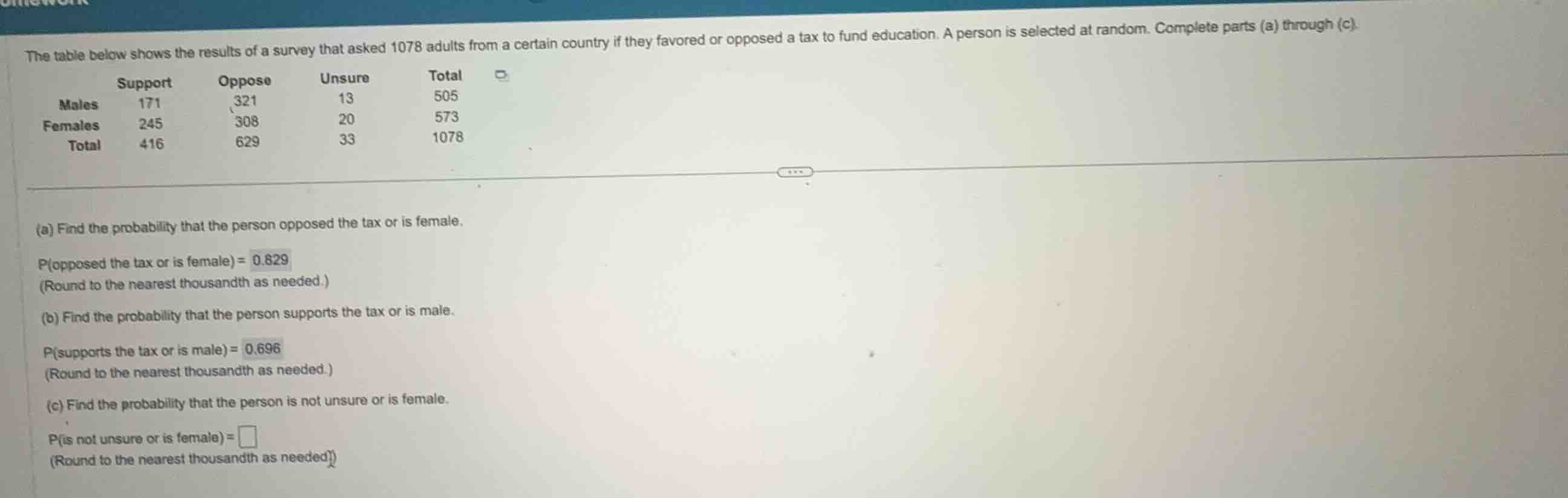
the table below shows the results of a survey that asked 1078 adults from a certain country if they favored or opposed a tax to fund education. a person is selected at random. complete parts (a) through (c).
\
(a) find the probability that the person opposed the tax or is female.
\\(p(\text{opposed the tax or is female}) = 0.829\\)
(round to the nearest thousandth as needed.)
(b) find the probability that the person supports the tax or is male.
\\(p(\text{supports the tax or is male}) = 0.696\\)
(round to the nearest thousandth as needed.)
(c) find the probability that the person is not unsure or is female.
\\(p(\text{is not unsure or is female}) = \\)
(round to the nearest thousandth as needed.)
Identify the given values and target
Using the Two-Way Contingency Table Probability knowledge point
We need to find \(P(\text{not unsure or is female})\).
Apply the addition rule for probability
Using the Addition Rule for Probability knowledge point
Calculate individual probabilities
Using the Two-Way Contingency Table Probability knowledge point
Compute the final probability
Using the Addition Rule for Probability knowledge point
Rounding to the nearest thousandth gives \(0.988\).

Snap & solve any problem in the app
Get step-by-step solutions on Sovi AI
Photo-based solutions with guided steps
Explore more problems and detailed explanations
(c) Find the probability that the person is not unsure or is female.
P(is not unsure or is female) = <blank>0.988</blank>
(Round to the nearest thousandth as needed.)