QUESTION IMAGE
Question
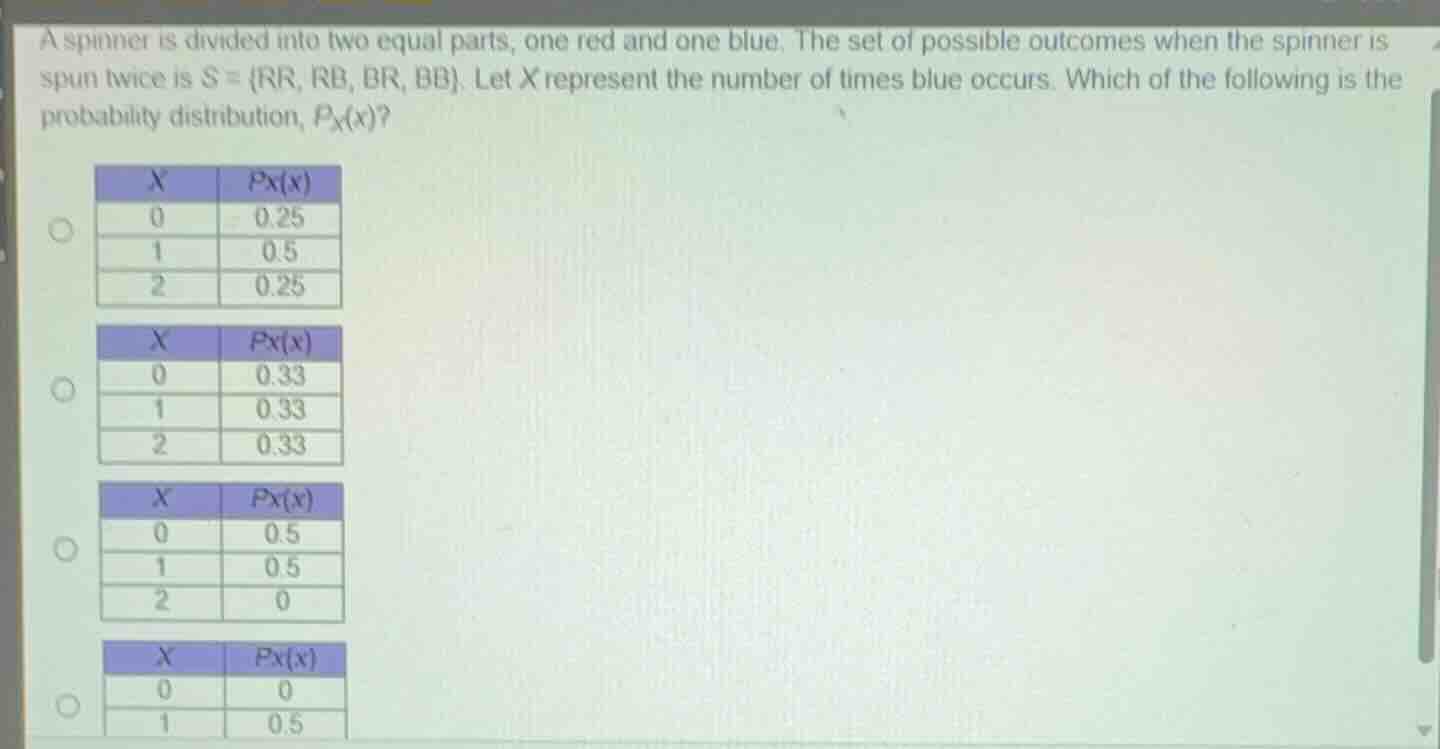
a spinner is divided into two equal parts, one red and one blue. the set of possible outcomes when the spinner is spun twice is \\(s = \\{\text{rr}, \text{rb}, \text{br}, \text{bb}\\}\\). let \\(x\\) represent the number of times blue occurs. which of the following is the probability distribution, \\(p_x(x)\\)?
Identify the sample space and outcomes
Using the Sample Space knowledge point
The spinner has two equal parts: Red (R) and Blue (B). Since the parts are equal, the probability of landing on Red is \(0.5\) and on Blue is \(0.5\).
When spun twice, the sample space of equally likely outcomes is:
Each of these 4 outcomes has a probability of:
Define the random variable X
The random variable \(X\) represents the number of times blue occurs in two spins. We evaluate \(X\) for each outcome in the sample space:
- For \(RR\): \(X = 0\) (no blue)
- For \(RB\): \(X = 1\) (one blue)
- For \(BR\): \(X = 1\) (one blue)
- For \(BB\): \(X = 2\) (two blues)
Calculate the probability distribution
Using the Probability Distribution knowledge point
We find the probability for each possible value of \(X\):
- For \(X = 0\):
- For \(X = 1\):
- For \(X = 2\):
Match with the given options
The calculated probability distribution is:
- \(X = 0 \implies P_X(0) = 0.25\)
- \(X = 1 \implies P_X(1) = 0.5\)
- \(X = 2 \implies P_X(2) = 0.25\)
This matches the first table option.

Snap & solve any problem in the app
Get step-by-step solutions on Sovi AI
Photo-based solutions with guided steps
Explore more problems and detailed explanations
- **(A)
(Correct answer)**
- (B)
- (C)
- (D)