QUESTION IMAGE
Question
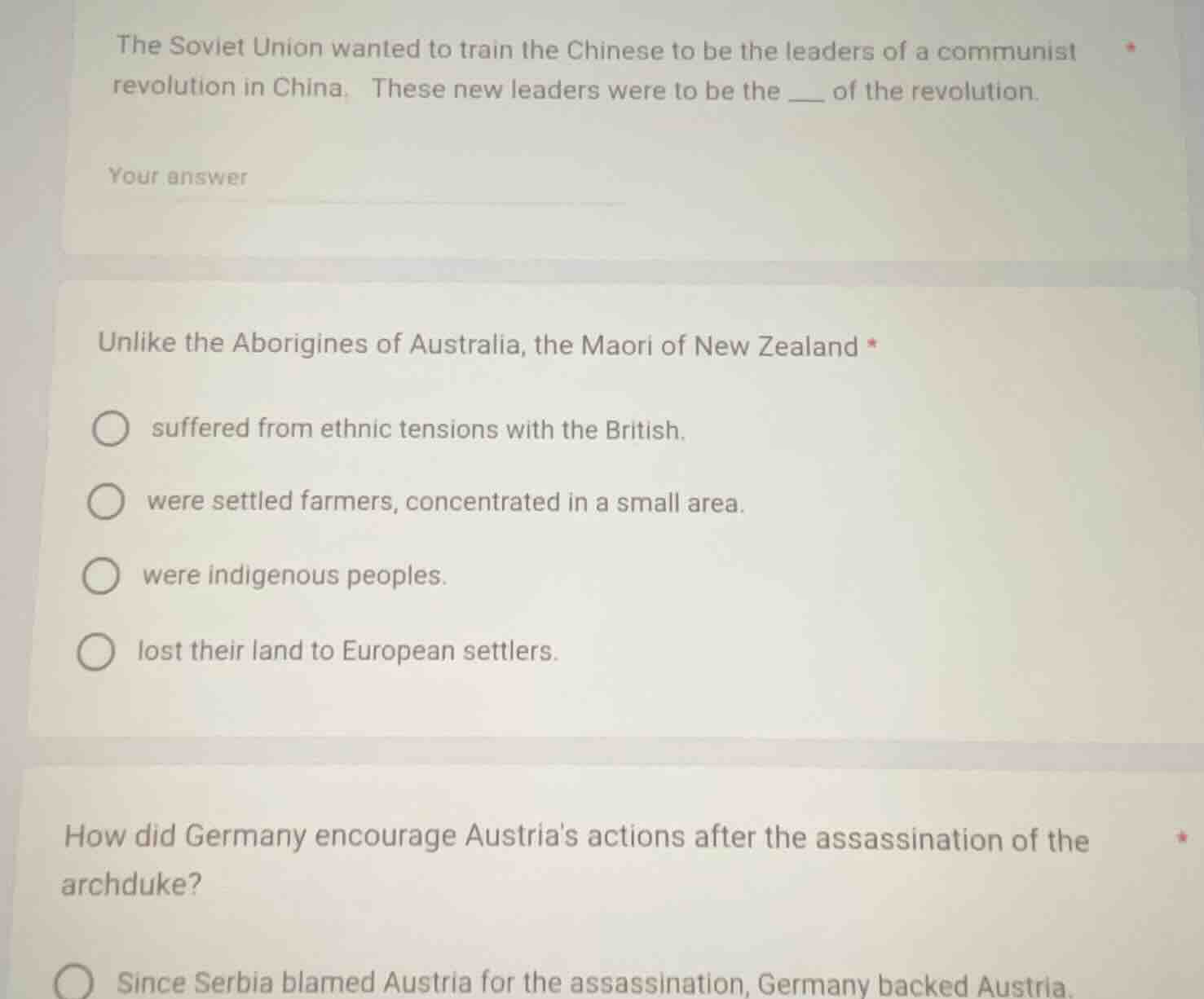
the soviet union wanted to train the chinese to be the leaders of a communist revolution in china. these new leaders were to be the ___ of the revolution.
your answer
unlike the aborigines of australia, the maori of new zealand *
suffered from ethnic tensions with the british.
were settled farmers, concentrated in a small area.
were indigenous peoples.
lost their land to european settlers.
how did germany encourage austrias actions after the assassination of the archduke?
Analyze the first question regarding Soviet-Chinese revolutionary training
The Soviet Union's strategy under Lenin and the Comintern was to train a dedicated group of professional revolutionaries to lead the movement in China, acting as the "vanguard" of the revolution.
Analyze the second question comparing Aborigines and Maori
Both Aborigines and Maori were indigenous peoples who suffered from ethnic tensions and lost land to British/European settlers. However, unlike the nomadic or semi-nomadic Aborigines of Australia, the Maori of New Zealand were settled farmers concentrated in relatively defined agricultural areas.
Analyze the third question regarding Germany's encouragement of Austria
Following the assassination of Archduke Franz Ferdinand, Germany encouraged Austria-Hungary's aggressive actions against Serbia by issuing the famous "blank check," promising unconditional military and diplomatic backing.

Snap & solve any problem in the app
Get step-by-step solutions on Sovi AI
Photo-based solutions with guided steps
Explore more problems and detailed explanations
Question 1
The Soviet Union wanted to train the Chinese to be the leaders of a communist revolution in China. These new leaders were to be the vanguard of the revolution.
Question 2
- suffered from ethnic tensions with the British.
- were settled farmers, concentrated in a small area. (Correct answer)
- were indigenous peoples.
- lost their land to European settlers.
Question 3
Germany backed Austria unconditionally by offering a "blank check" of military and diplomatic support, encouraging Austria-Hungary to take a harsh stance against Serbia.