QUESTION IMAGE
Question
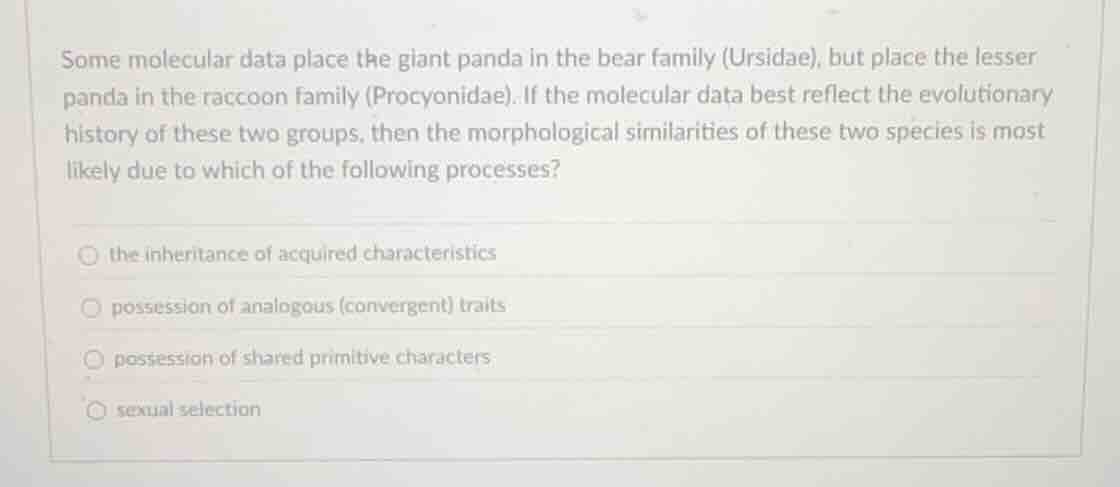
some molecular data place the giant panda in the bear family (ursidae), but place the lesser panda in the raccoon family (procyonidae). if the molecular data best reflect the evolutionary history of these two groups, then the morphological similarities of these two species is most likely due to which of the following processes?
the inheritance of acquired characteristics
possession of analogous (convergent) traits
possession of shared primitive characters
sexual selection
Analyze the evolutionary relationships
Using the Convergent Evolution and Homology vs Analogy knowledge points
The molecular data place the giant panda in the bear family (Ursidae) and the lesser panda (red panda) in the raccoon family (Procyonidae). This indicates that they belong to distinct lineages and do not share a recent common ancestor.
Determine the cause of morphological similarities
Using the Convergent Evolution and Homology vs Analogy knowledge points
Because they belong to different families, their shared morphological similarities (such as their diet, "thumbs," and markings) did not inherit from a close common ancestor. Instead, these similarities arose independently due to similar environmental pressures, which is the definition of convergent evolution leading to analogous traits.
Evaluate the given options
Using the Homology vs Analogy knowledge point
- "the inheritance of acquired characteristics" refers to Lamarckian evolution, which is scientifically incorrect.
- "possession of analogous (convergent) traits" correctly describes independent adaptation in separate lineages.
- "possession of shared primitive characters" (symplesiomorphies) would imply traits inherited from a distant common ancestor of all carnivorans, which does not explain their specific, unique similarities.
- "sexual selection" does not explain the shared ecological and morphological adaptations between these two distinct species.

Snap & solve any problem in the app
Get step-by-step solutions on Sovi AI
Photo-based solutions with guided steps
Explore more problems and detailed explanations
- the inheritance of acquired characteristics
- possession of analogous (convergent) traits (Correct answer)
- possession of shared primitive characters
- sexual selection