QUESTION IMAGE
Question
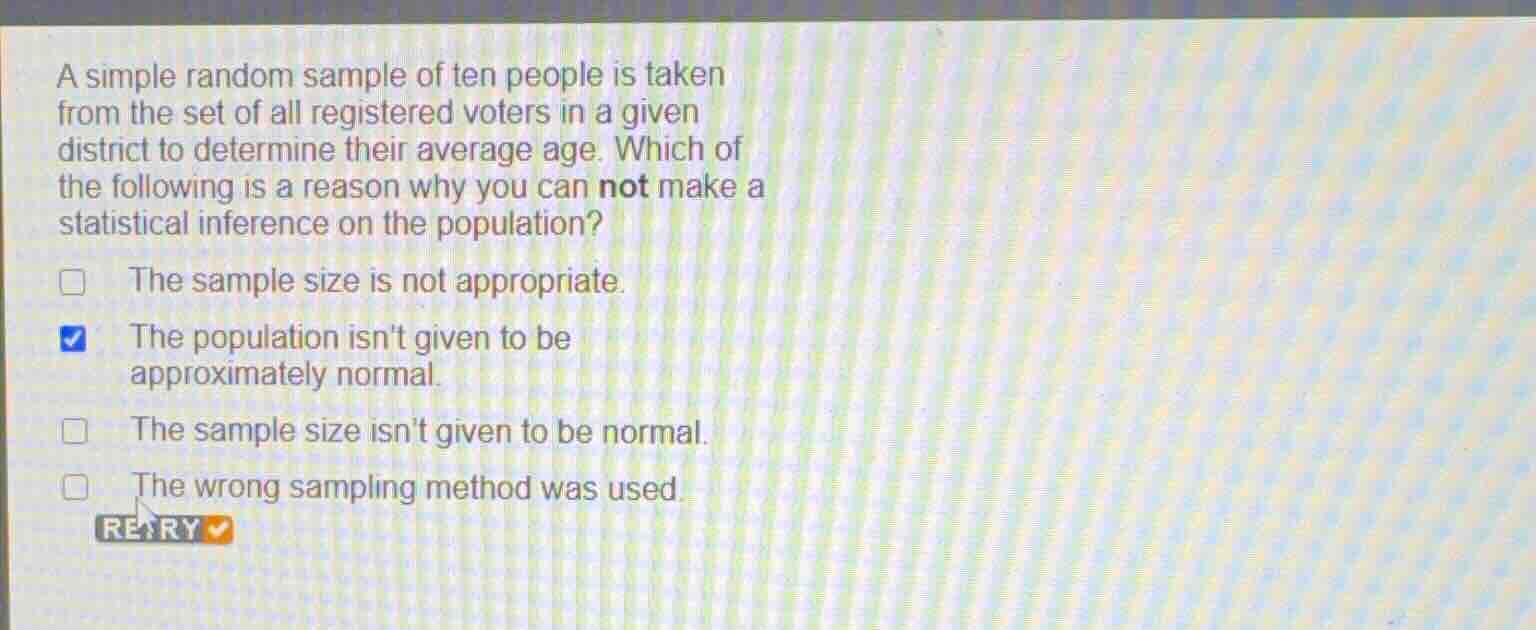
a simple random sample of ten people is taken from the set of all registered voters in a given district to determine their average age. which of the following is a reason why you can not make a statistical inference on the population?
the sample size is not appropriate.
x the population isnt given to be approximately normal.
the sample size isnt given to be normal.
the wrong sampling method was used.
Analyze the sampling scenario
The problem describes a simple random sample of size \(n = 10\) taken from a population of registered voters to estimate the average age. We want to determine why a statistical inference (such as constructing a t-interval or performing a t-test for the population mean) cannot be safely made.
Evaluate inference assumptions
Using the Statistical Inference Assumptions knowledge point:
For inference about a population mean \(\mu\) using a t-distribution, we require the sampling distribution of the sample mean \(\bar{x}\) to be approximately normal. This condition is met if:
- The underlying population distribution is approximately normal, OR
- The sample size is large enough (typically \(n \ge 30\)) to apply the Central Limit Theorem.
Check the given conditions
Using the Central Limit Theorem Conditions knowledge point:
- Here, the sample size is \(n = 10\), which is small (\(n < 30\)). Thus, we cannot rely on the Central Limit Theorem to guarantee the normality of the sampling distribution.
- Since the Central Limit Theorem does not apply, we must assume or be given that the underlying population distribution of ages is approximately normal.
- Because the population is not stated to be approximately normal, and the sample size is too small to overcome this, we cannot safely perform statistical inference.
Evaluate the given options
- "The sample size is not appropriate": While small, a sample size of 10 can be appropriate for inference if the underlying population is known to be normal.
- "The population isn't given to be approximately normal": This is the correct reason. Since \(n = 10 < 30\), we must have a normal population to proceed.
- "The sample size isn't given to be normal": A sample size is a single number, not a distribution, so it cannot "be normal."
- "The wrong sampling method was used": A simple random sample (SRS) is the ideal sampling method.

Snap & solve any problem in the app
Get step-by-step solutions on Sovi AI
Photo-based solutions with guided steps
Explore more problems and detailed explanations
- The sample size is not appropriate.
- The population isn't given to be approximately normal. (Correct answer)
- The sample size isn't given to be normal.
- The wrong sampling method was used.