Sovi.AI - AI Math Tutor

Scan to solve math questions

QUESTION IMAGE

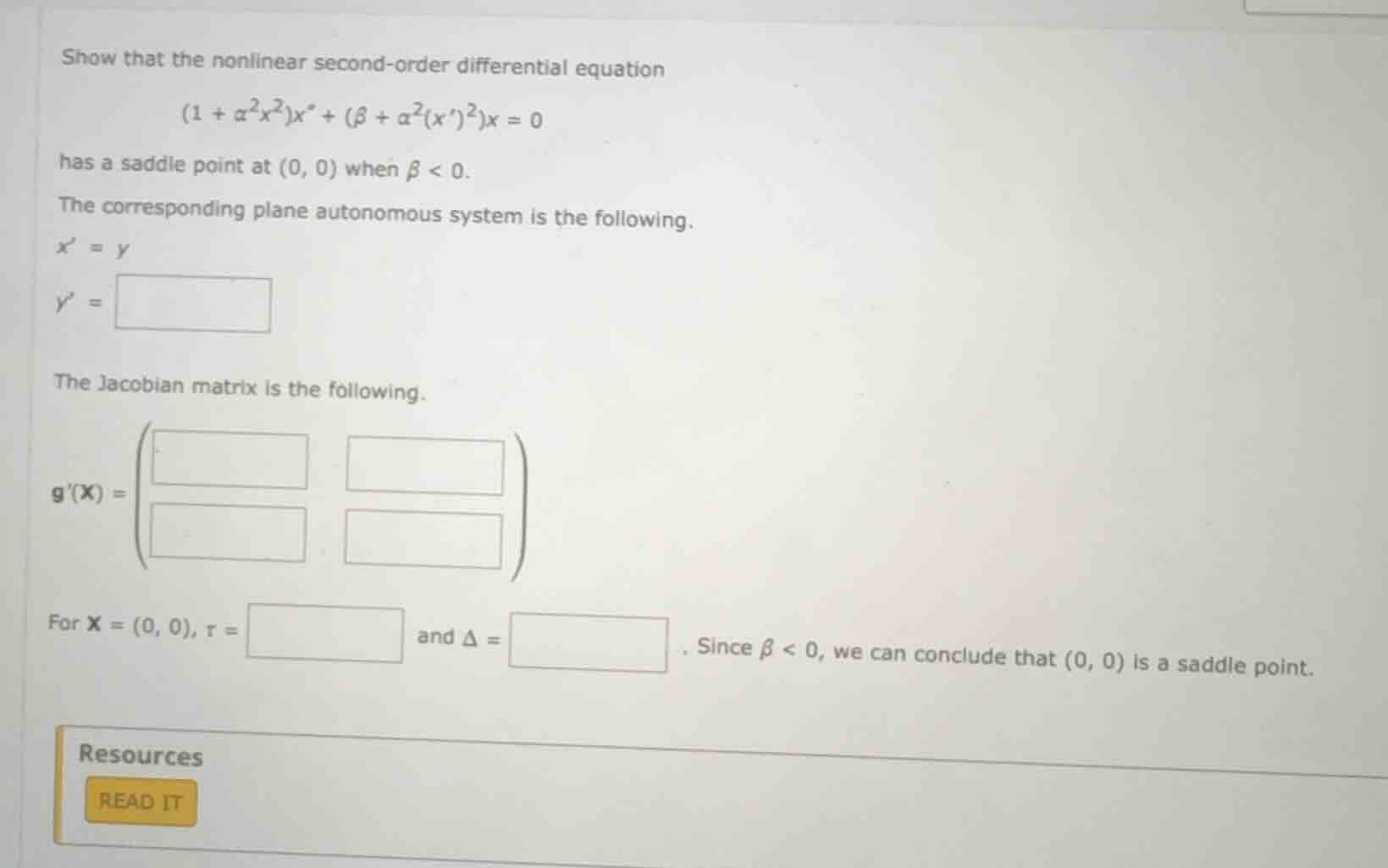
show that the nonlinear second-order differential equation \\(1 + \\alp…

Question

show that the nonlinear second-order differential equation

\\(1 + \alpha^2 x^2)x + (\beta + \alpha^2 (x)^2)x = 0\\

has a saddle point at \\((0, 0)\\) when \\(\beta < 0\\).

the corresponding plane autonomous system is the following.
\\x = y\\
\\y = \\

the jacobian matrix is the following.

\\g(x) = \

$$\begin{pmatrix} \\quad & \\quad \\\\ \\quad & \\quad \\end{pmatrix}$$

\\

for \\(x = (0, 0)\\), \\(\tau = \\) and \\(\delta = \\). since \\(\beta < 0\\), we can conclude that \\((0, 0)\\) is a saddle point.

Explanation:

Response

<pre_analysis>
{
"quality": "clear",
"question_count": 1,
"skills_matched": [
"step_cot",
"blank_filling_formatter",
"explain_then_answer",
"tutor",
"mastery_adaptive_brevity"
],
"needs_drawing": false,
"concepts_used": [
"Phase Portrait Analysis",
"Linear Systems of ODEs"
],
"new_concepts": [
"Nonlinear Systems of ODEs",
"Jacobian Matrix Linearization"
],
"current_concepts": [
"Phase Portrait Analysis",
"Linear Systems of ODEs",
"Nonlinear Systems of ODEs",
"Jacobian Matrix Linearization"
]
}
</pre_analysis>

<reasoning>

Convert to a plane autonomous system

Using the Linear Systems of ODEs knowledge point
\[

$$\begin{aligned} &x' = y \\ &y' = x'' = -\frac{(\beta + \alpha^2 (x')^2)x}{1 + \alpha^2 x^2} = -\frac{(\beta + \alpha^2 y^2)x}{1 + \alpha^2 x^2} \end{aligned}$$

\]

Compute the partial derivatives for the Jacobian matrix

Using the Linear Systems of ODEs knowledge point
\[

$$\begin{aligned} &f(x, y) = y \implies \frac{\partial f}{\partial x} = 0, \quad \frac{\partial f}{\partial y} = 1 \\ &g(x, y) = -\frac{(\beta + \alpha^2 y^2)x}{1 + \alpha^2 x^2} \\ &\frac{\partial g}{\partial x} = -\frac{(\beta + \alpha^2 y^2)(1 + \alpha^2 x^2) - (\beta + \alpha^2 y^2)x(2\alpha^2 x)}{(1 + \alpha^2 x^2)^2} = -\frac{(\beta + \alpha^2 y^2)(1 - \alpha^2 x^2)}{(1 + \alpha^2 x^2)^2} \\ &\frac{\partial g}{\partial y} = -\frac{2\alpha^2 y x}{1 + \alpha^2 x^2} \end{aligned}$$

\]

Evaluate the Jacobian matrix at the origin

Using the Phase Portrait Analysis knowledge point
\[

$$\begin{aligned} &\mathbf{g}'(0, 0) = \begin{pmatrix} \frac{\partial f}{\partial x}(0,0) & \frac{\partial f}{\partial y}(0,0) \\ \frac{\partial g}{\partial x}(0,0) & \frac{\partial g}{\partial y}(0,0) \end{pmatrix} \\ &\frac{\partial f}{\partial x}(0,0) = 0, \quad \frac{\partial f}{\partial y}(0,0) = 1 \\ &\frac{\partial g}{\partial x}(0,0) = -\beta, \quad \frac{\partial g}{\partial y}(0,0) = 0 \\ &\mathbf{g}'(\mathbf{X}) = \begin{pmatrix} 0 & 1 \\ -\beta & 0 \end{pmatrix} \end{aligned}$$

\]

Determine trace and determinant at the origin

Using the Phase Portrait Analysis knowledge point
\[

$$\begin{aligned} &\tau = \operatorname{tr}(\mathbf{g}'(0,0)) = 0 + 0 = 0 \\ &\Delta = \det(\mathbf{g}'(0,0)) = 0(0) - 1(-\beta) = \beta \end{aligned}$$

\]
</reasoning>

<answer>
Show that the nonlinear second-order differential equation
\[(1 + \alpha^2x^2)x'' + (\beta + \alpha^2(x')^2)x = 0\]
has a saddle point at \((0, 0)\) when \(\beta < 0\).

The corresponding plane autonomous system is the following.
\(x' = y\)
\(y' =\) <blank>\(-\frac{(\beta + \alpha^2 y^2)x}{1 + \alpha^2 x^2}\)</blank>

The Jacobian matrix is the following.
\[\mathbf{g}'(\mathbf{X}) =

$$\begin{pmatrix} \text{\(0\)} & \text{\(1\)} \\ \text{\(-\frac{(\beta + \alpha^2 y^2)(1 - \alpha^2 x^2)}{(1 + \alpha^2 x^2)^2}\)} & \text{\(-\frac{2\alpha^2 x y}{1 + \alpha^2 x^2}\)} \end{pmatrix}$$

\]

For \(\mathbf{X} = (0, 0)\), \(\tau =\) <blank>\(0\)</blank> and \(\Delta =\) <blank>\(\beta\)</blank>. Since \(\beta < 0\), we can conclude that \((0, 0)\) is a saddle point.
</answer>

<post_analysis>
{
"subject": "Mathematics",
"question_type": "Fill-in-the-blank",
"knowledge_point": [
"Mathematics",
"Calculus",
"Nonlinear Systems of ODEs"
]
}
</post_analysis>

Answer:

<pre_analysis>
{
"quality": "clear",
"question_count": 1,
"skills_matched": [
"step_cot",
"blank_filling_formatter",
"explain_then_answer",
"tutor",
"mastery_adaptive_brevity"
],
"needs_drawing": false,
"concepts_used": [
"Phase Portrait Analysis",
"Linear Systems of ODEs"
],
"new_concepts": [
"Nonlinear Systems of ODEs",
"Jacobian Matrix Linearization"
],
"current_concepts": [
"Phase Portrait Analysis",
"Linear Systems of ODEs",
"Nonlinear Systems of ODEs",
"Jacobian Matrix Linearization"
]
}
</pre_analysis>

<reasoning>

Convert to a plane autonomous system

Using the Linear Systems of ODEs knowledge point
\[

$$\begin{aligned} &x' = y \\ &y' = x'' = -\frac{(\beta + \alpha^2 (x')^2)x}{1 + \alpha^2 x^2} = -\frac{(\beta + \alpha^2 y^2)x}{1 + \alpha^2 x^2} \end{aligned}$$

\]

Compute the partial derivatives for the Jacobian matrix

Using the Linear Systems of ODEs knowledge point
\[

$$\begin{aligned} &f(x, y) = y \implies \frac{\partial f}{\partial x} = 0, \quad \frac{\partial f}{\partial y} = 1 \\ &g(x, y) = -\frac{(\beta + \alpha^2 y^2)x}{1 + \alpha^2 x^2} \\ &\frac{\partial g}{\partial x} = -\frac{(\beta + \alpha^2 y^2)(1 + \alpha^2 x^2) - (\beta + \alpha^2 y^2)x(2\alpha^2 x)}{(1 + \alpha^2 x^2)^2} = -\frac{(\beta + \alpha^2 y^2)(1 - \alpha^2 x^2)}{(1 + \alpha^2 x^2)^2} \\ &\frac{\partial g}{\partial y} = -\frac{2\alpha^2 y x}{1 + \alpha^2 x^2} \end{aligned}$$

\]

Evaluate the Jacobian matrix at the origin

Using the Phase Portrait Analysis knowledge point
\[

$$\begin{aligned} &\mathbf{g}'(0, 0) = \begin{pmatrix} \frac{\partial f}{\partial x}(0,0) & \frac{\partial f}{\partial y}(0,0) \\ \frac{\partial g}{\partial x}(0,0) & \frac{\partial g}{\partial y}(0,0) \end{pmatrix} \\ &\frac{\partial f}{\partial x}(0,0) = 0, \quad \frac{\partial f}{\partial y}(0,0) = 1 \\ &\frac{\partial g}{\partial x}(0,0) = -\beta, \quad \frac{\partial g}{\partial y}(0,0) = 0 \\ &\mathbf{g}'(\mathbf{X}) = \begin{pmatrix} 0 & 1 \\ -\beta & 0 \end{pmatrix} \end{aligned}$$

\]

Determine trace and determinant at the origin

Using the Phase Portrait Analysis knowledge point
\[

$$\begin{aligned} &\tau = \operatorname{tr}(\mathbf{g}'(0,0)) = 0 + 0 = 0 \\ &\Delta = \det(\mathbf{g}'(0,0)) = 0(0) - 1(-\beta) = \beta \end{aligned}$$

\]
</reasoning>

<answer>
Show that the nonlinear second-order differential equation
\[(1 + \alpha^2x^2)x'' + (\beta + \alpha^2(x')^2)x = 0\]
has a saddle point at \((0, 0)\) when \(\beta < 0\).

The corresponding plane autonomous system is the following.
\(x' = y\)
\(y' =\) <blank>\(-\frac{(\beta + \alpha^2 y^2)x}{1 + \alpha^2 x^2}\)</blank>

The Jacobian matrix is the following.
\[\mathbf{g}'(\mathbf{X}) =

$$\begin{pmatrix} \text{\(0\)} & \text{\(1\)} \\ \text{\(-\frac{(\beta + \alpha^2 y^2)(1 - \alpha^2 x^2)}{(1 + \alpha^2 x^2)^2}\)} & \text{\(-\frac{2\alpha^2 x y}{1 + \alpha^2 x^2}\)} \end{pmatrix}$$

\]

For \(\mathbf{X} = (0, 0)\), \(\tau =\) <blank>\(0\)</blank> and \(\Delta =\) <blank>\(\beta\)</blank>. Since \(\beta < 0\), we can conclude that \((0, 0)\) is a saddle point.
</answer>

<post_analysis>
{
"subject": "Mathematics",
"question_type": "Fill-in-the-blank",
"knowledge_point": [
"Mathematics",
"Calculus",
"Nonlinear Systems of ODEs"
]
}
</post_analysis>