QUESTION IMAGE
Question
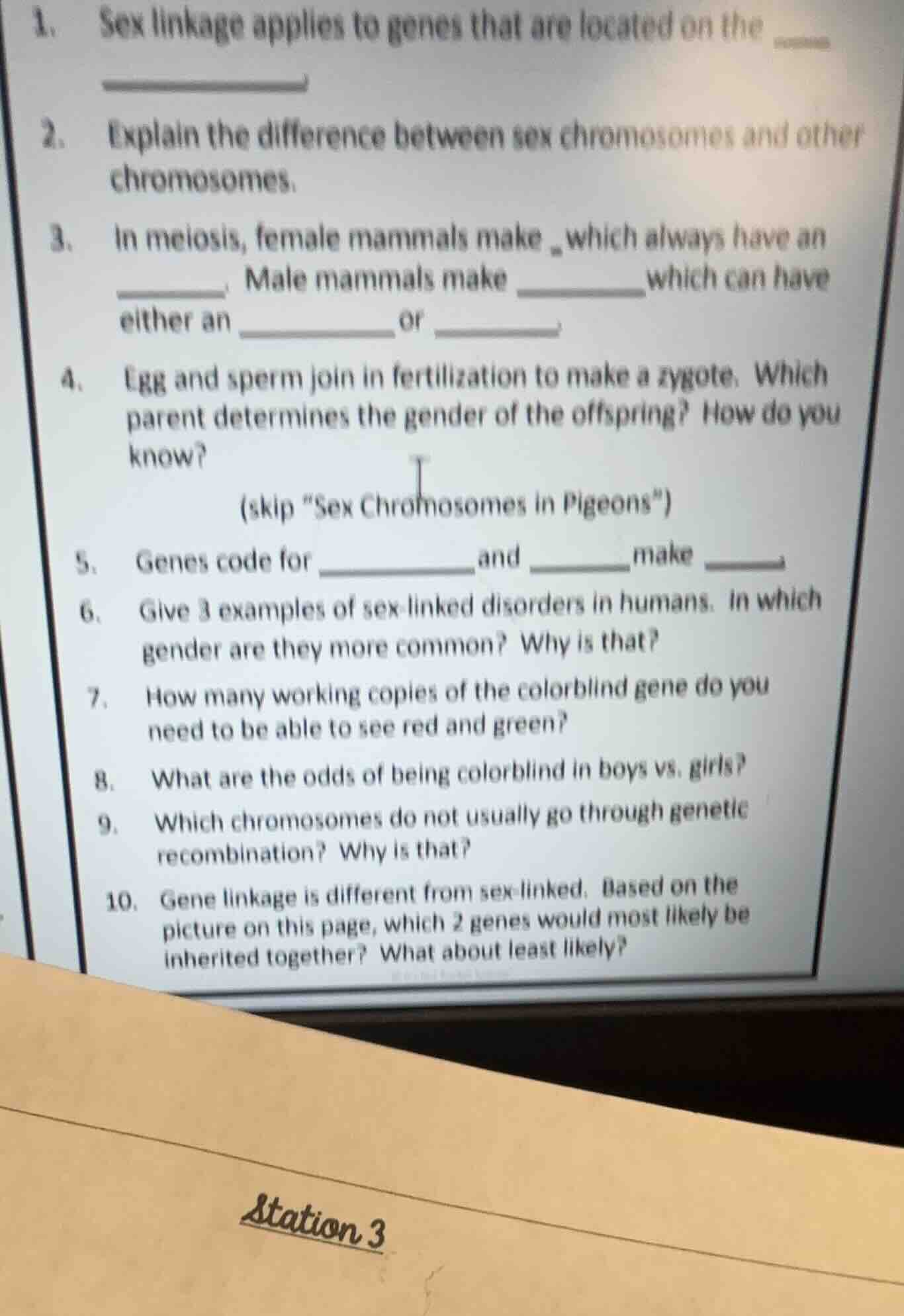
- sex linkage applies to genes that are located on the ____ ____.
- explain the difference between sex chromosomes and other chromosomes.
- in meiosis, female mammals make ____ which always have an __. male mammals make __ which can have either an __ or ____.
- egg and sperm join in fertilization to make a zygote. which parent determines the gender of the offspring? how do you know?
(skip \sex chromosomes in pigeons\)
- genes code for ____ and __ make ____.
- give 3 examples of sex-linked disorders in humans. in which gender are they more common? why is that?
- how many working copies of the colorblind gene do you need to be able to see red and green?
- what are the odds of being colorblind in boys vs. girls?
- which chromosomes do not usually go through genetic recombination? why is that?
- gene linkage is different from sex-linked. based on the picture on this page, which 2 genes would most likely be inherited together? what about least likely?
Identify sex linkage location
Sex linkage refers to genes located on sex chromosomes.
Using the Chromosomal Inheritance knowledge point, these are the \(X\) or \(Y\) chromosomes.
Compare chromosome types
Sex chromosomes determine biological sex (e.g., \(X\) and \(Y\)).
Autosomes are all other non-sex chromosomes.
Describe mammalian gametogenesis
Female mammals produce eggs containing only \(X\) chromosomes.
Male mammals produce sperm containing either \(X\) or \(Y\).
Determine offspring gender
The father's sperm determines biological sex.
Sperm carries either \(X\) or \(Y\), while eggs only carry \(X\).
Define gene coding
Genes code for proteins, which determine traits.
DNA is transcribed to RNA, then translated to proteins.
List sex-linked disorders
Hemophilia, colorblindness, and Duchenne muscular dystrophy are examples.
They are more common in males due to hemizygosity.
Count colorblind gene copies
One working copy of the gene is sufficient.
The normal allele is dominant over the colorblind allele.
Compare colorblindness odds
Males have a 1 in 12 chance (\(8\%\)).
Females have a 1 in 200 chance (\(0.5\%\)).
Identify recombination exceptions
Sex chromosomes (\(X\) and \(Y\)) do not recombine.
They lack homologous regions to pair during meiosis.
Analyze gene linkage
Genes closer together are inherited together.
Genes farther apart are least likely to co-inherit.

Snap & solve any problem in the app
Get step-by-step solutions on Sovi AI
Photo-based solutions with guided steps
Explore more problems and detailed explanations
Question 1
Sex linkage applies to genes that are located on the sex chromosomes (specifically the \(X\) or \(Y\) chromosome).
Question 2
Sex chromosomes (such as \(X\) and \(Y\) in mammals) determine an individual's biological sex and carry sex-linked traits. Other chromosomes, called autosomes, contain genes for general somatic characteristics and do not determine sex.
Question 3
In meiosis, female mammals make eggs, which always have an \(X\) chromosome. Male mammals make sperm, which can have either an \(X\) or \(Y\) chromosome.
Question 4
The father determines the gender of the offspring. This is because the mother's egg always contributes an \(X\) chromosome, while the father's sperm can contribute either an \(X\) chromosome (resulting in a female, \(XX\)) or a \(Y\) chromosome (resulting in a male, \(XY\)).
Question 5
Genes code for proteins, and proteins make traits (or cellular structures).
Question 6
- Examples: Red-green colorblindness, Hemophilia, and Duchenne muscular dystrophy.
- Gender prevalence: They are much more common in males.
- Reason: These are \(X\)-linked recessive disorders. Males have only one \(X\) chromosome (\(XY\)), so a single mutated allele causes the disorder. Females have two \(X\) chromosomes (\(XX\)) and need two mutated copies to express the condition.
Question 7
You need 1 working copy of the gene to have normal red-green color vision, because the normal vision allele is dominant.
Question 8
- Boys: Approximately \(1\text{ in }12\) (about \(8\%\)).
- Girls: Approximately \(1\text{ in }200\) (about \(0.5\%\)).
Question 9
The \(X\) and \(Y\) chromosomes in males do not undergo standard genetic recombination over most of their length. This is because they are not homologous chromosomes and lack matching sequences to cross over, except at small pseudoautosomal regions at their tips.
Question 10
- Most likely to be inherited together: The two genes that are located closest together on the same chromosome.
- Least likely to be inherited together: The two genes that are located farthest apart on the same chromosome (or on entirely different chromosomes).