QUESTION IMAGE
Question
select all the correct diagrams.
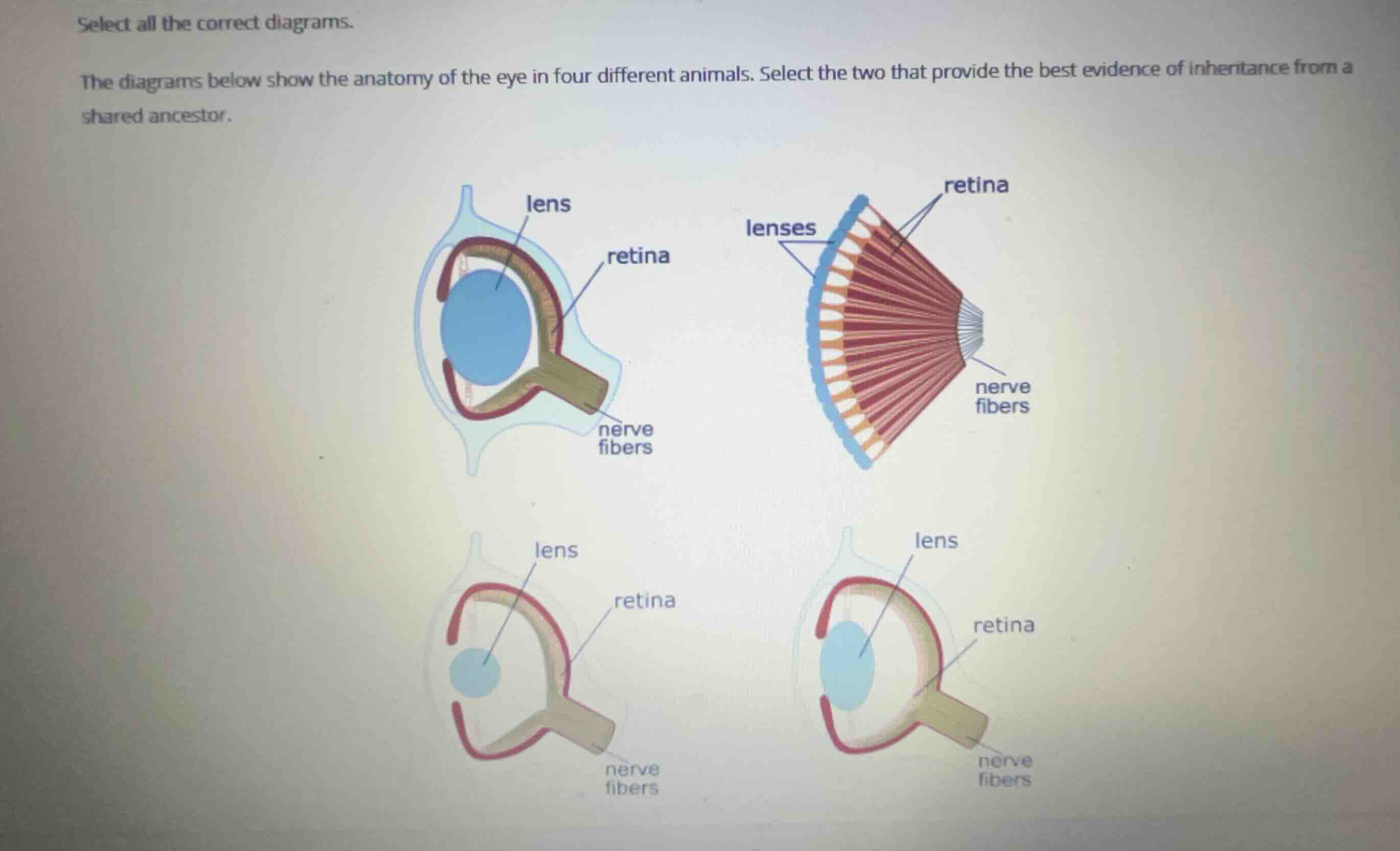
the diagrams below show the anatomy of the eye in four different animals. select the two that provide the best evidence of inheritance from a shared ancestor.
Identify homologous structures
To find evidence of inheritance from a shared ancestor, we look for homologous structures. Homologous structures share a similar basic anatomical plan, layout, and developmental origin, even if they serve slightly different functions or vary in size.
Analyze the four eye diagrams
- Top-left diagram: Shows a single-lens camera-type eye with a large lens, a surrounding retina layer, and nerve fibers exiting from the back. It has a distinct blue outer protective layer/cornea-like structure.
- Top-right diagram: Shows a compound eye consisting of multiple individual units (ommatidia), each with its own lens, retina, and nerve fiber. This is structurally completely different from the other three camera-type eyes.
- Bottom-left diagram: Shows a camera-type eye with a small lens, a retina, and nerve fibers exiting the back.
- Bottom-right diagram: Shows a camera-type eye with a medium-sized lens, a retina, and nerve fibers exiting the back.
Compare structural similarities
The top-left, bottom-left, and bottom-right diagrams all represent variations of a single-lens camera-type eye. However, we need to select the two that provide the best evidence of inheritance from a shared ancestor.
Looking closely at the anatomical details:
- The top-left and bottom-right diagrams share highly specific structural features: they both have the outer blue protective layer/cornea-like sheath surrounding the eyeball, a similarly shaped iris/ciliary body structure (the dark red/brown layer), a lens, a retina, and nerve fibers exiting through a similarly structured optic nerve canal.
- The bottom-left diagram lacks the outer blue protective layer/sheath and has a much simpler, smaller lens with a different relative proportion and layout.
- Therefore, the top-left and bottom-right diagrams share the most detailed, complex anatomical similarities (homologies), providing the strongest evidence of a close common evolutionary origin.

Snap & solve any problem in the app
Get step-by-step solutions on Sovi AI
Photo-based solutions with guided steps
Explore more problems and detailed explanations
- (A) Top-left diagram (large lens with blue outer sheath) (Correct answer)
- (B) Top-right diagram (compound eye with multiple lenses)
- (C) Bottom-left diagram (small lens without blue outer sheath)
- (D) Bottom-right diagram (medium lens with blue outer sheath) (Correct answer)