QUESTION IMAGE
Question
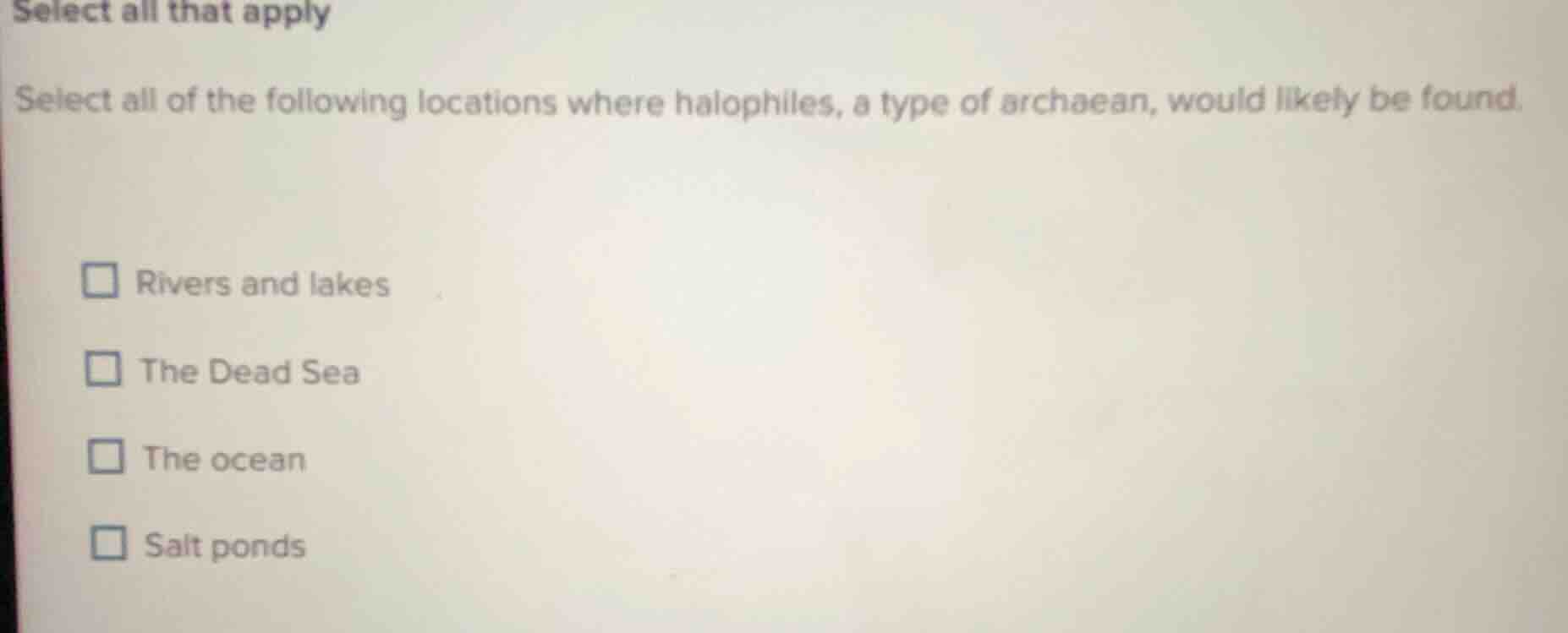
select all that apply
select all of the following locations where halophiles, a type of archaean, would likely be found.
rivers and lakes
the dead sea
the ocean
salt ponds
🆕 New Concept Discovered: Extremophiles and Halophilic Adaptations
Organisms adapted to survive in extreme environments.
Step 1: Define halophiles
"Halophile" literally translates to "salt-lover" (from the Greek words halo for salt and phile for loving). These are specialized microorganisms, mostly belonging to the domain Archaea, that require extremely high concentrations of salt (sodium chloride) to grow and survive.
Step 2: Evaluate the environmental options
We need to identify which of the given environments have the extremely high salinity levels required by halophiles:
- Rivers and lakes: These are typically freshwater environments with very low salt concentrations (usually less than \(0.1\%\)). Halophiles cannot survive here because their cellular machinery requires high salt concentrations to remain stable.
- The Dead Sea: This is a hypersaline lake with a salt concentration of around \(34\%\) (nearly 10 times saltier than ordinary seawater). This is a classic, prime habitat for extreme halophiles.
- The ocean: While the ocean is salty (average salinity of about \(3.5\%\)), this concentration is generally too low for extreme halophiles, which typically require salinity levels above \(9\%\) to \(10\%\) to thrive.
- Salt ponds: Also known as solar evaporation ponds, these man-made or natural shallow ponds are used to harvest salt from seawater. As water evaporates, the salt concentration becomes extremely high, making them ideal environments for halophiles (which often turn these ponds vibrant shades of pink or red due to their pigments).

Snap & solve any problem in the app
Get step-by-step solutions on Sovi AI
Photo-based solutions with guided steps
Explore more problems and detailed explanations
- The Dead Sea
- Salt ponds