QUESTION IMAGE
Question
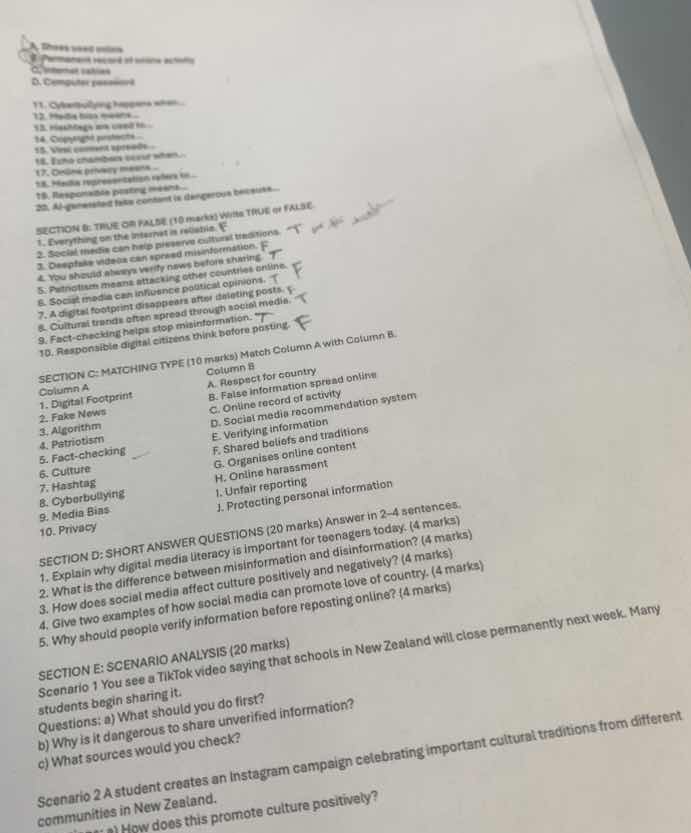
section b: true or false (10 marks) write true or false.
- everything on the internet is reliable.
- social media can help preserve cultural traditions.
- deepfake videos can spread misinformation.
- you should always verify news before sharing.
- patriotism means attacking other countries online.
- social media can influence political opinions.
- a digital footprint disappears after deleting posts.
- cultural trends often spread through social media.
- fact-checking helps stop misinformation.
- responsible digital citizens think before posting.
section c: matching type (10 marks) match column a with column b.
column a
- digital footprint
- fake news
- algorithm
- patriotism
- fact-checking
- culture
- hashtag
- cyberbullying
- media bias
- privacy
column b
a. respect for country
b. false information spread online
c. online record of activity
d. social media recommendation system
e. verifying information
f. shared beliefs and traditions
g. organises online content
h. online harassment
i. unfair reporting
j. protecting personal information
section d: short answer questions (20 marks) answer in 2-4 sentences.
- explain why digital media literacy is important for teenagers today. (4 marks)
- what is the difference between misinformation and disinformation? (4 marks)
- how does social media affect culture positively and negatively? (4 marks)
- give two examples of how social media can promote love of country. (4 marks)
- why should people verify information before reposting online? (4 marks)
section e: scenario analysis (20 marks)
scenario 1 you see a tiktok video saying that schools in new zealand will close permanently next week. many students begin sharing it.
questions: a) what should you do first?
b) why is it dangerous to share unverified information?
c) what sources would you check?
scenario 2 a student creates an instagram campaign celebrating important cultural traditions from different communities in new zealand.
questions: a) how does this promote culture positively?
Match Column A terms with Column B definitions
- Digital Footprint matches with C. Online record of activity because a digital footprint is the trail of data you leave behind on the internet.
- Fake News matches with B. False information spread online as it refers to fabricated news stories designed to mislead.
- Algorithm matches with D. Social media recommendation system because algorithms determine what content is shown to users on social platforms.
- Patriotism matches with A. Respect for country which is the standard definition of showing love and devotion to one's nation.
- Fact-checking matches with E. Verifying information which is the process of checking the accuracy of claims.
- Culture matches with F. Shared beliefs and traditions which represents the social behavior and norms found in human societies.
- Hashtag matches with G. Organises online content because hashtags are metadata tags used to group and find specific topics.
- Cyberbullying matches with H. Online harassment which is the use of electronic communication to bully or harass a person.
- Media Bias matches with I. Unfair reporting which occurs when journalists or news outlets present stories in a one-sided manner.
- Privacy matches with J. Protecting personal information which is the practice of keeping personal data secure from unauthorized access.

Snap & solve any problem in the app
Get step-by-step solutions on Sovi AI
Photo-based solutions with guided steps
Explore more problems and detailed explanations
| No. | Column A | Column B |
|---|---|---|
| 2 | Fake News | B. False information spread online |
| 3 | Algorithm | D. Social media recommendation system |
| 4 | Patriotism | A. Respect for country |
| 5 | Fact-checking | E. Verifying information |
| 6 | Culture | F. Shared beliefs and traditions |
| 7 | Hashtag | G. Organises online content |
| 8 | Cyberbullying | H. Online harassment |
| 9 | Media Bias | I. Unfair reporting |
| 10 | Privacy | J. Protecting personal information |