QUESTION IMAGE
Question
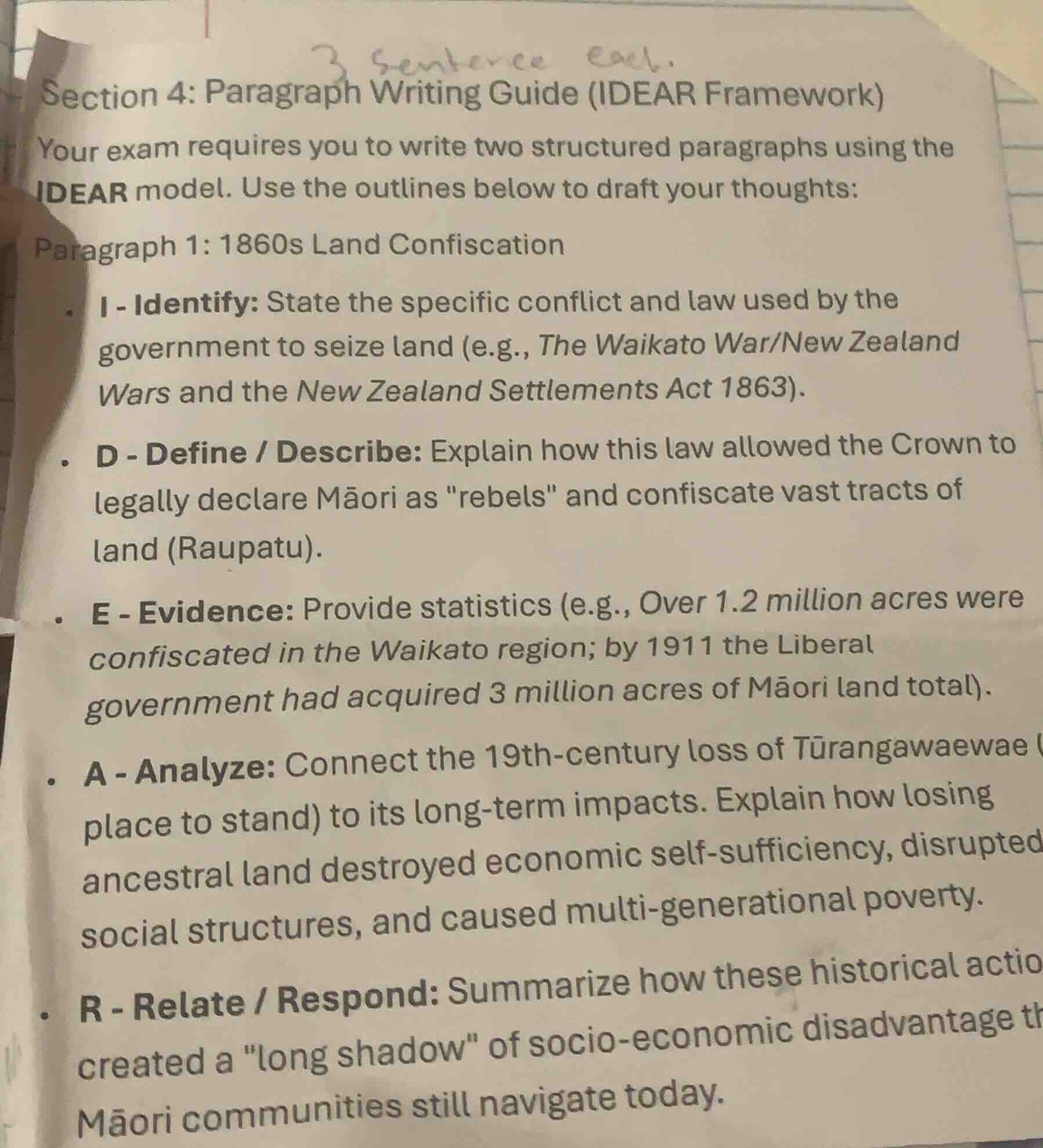
section 4: paragraph writing guide (idear framework)
your exam requires you to write two structured paragraphs using the idear model. use the outlines below to draft your thoughts:
paragraph 1: 1860s land confiscation
- i - identify: state the specific conflict and law used by the government to seize land (e.g., the waikato war/new zealand wars and the new zealand settlements act 1863).
- d - define / describe: explain how this law allowed the crown to legally declare māori as
ebels\ and confiscate vast tracts of land (raupatu).
- e - evidence: provide statistics (e.g., over 1.2 million acres were confiscated in the waikato region; by 1911 the liberal government had acquired 3 million acres of māori land total).
- a - analyze: connect the 19th-century loss of tūrangawaewae (place to stand) to its long-term impacts. explain how losing ancestral land destroyed economic self-sufficiency, disrupted social structures, and caused multi-generational poverty.
- r - relate / respond: summarize how these historical actions created a \long shadow\ of socio-economic disadvantage that māori communities still navigate today.
Analyze the IDEAR prompt requirements
The prompt asks to draft a structured paragraph about the 1860s Land Confiscation using the IDEAR Paragraph Structure. The handwritten note at the top says "3 sentence each" (which likely refers to the target length or depth, but we will construct a cohesive, high-quality paragraph that thoroughly addresses all five IDEAR components: Identify, Define/Describe, Evidence, Analyze, and Relate/Respond).
Draft the "Identify" and "Define/Describe" sections
Using the Raupatu Land Confiscations knowledge point:
- Identify (I): During the New Zealand Wars of the 1860s, specifically the Waikato War, the colonial government passed the New Zealand Settlements Act 1863 to seize Māori land.
- Define/Describe (D): This legislation allowed the Crown to legally designate Māori who fought for their sovereignty as "rebels," providing a legal pretext to confiscate vast tracts of ancestral land, a process known as Raupatu.
Draft the "Evidence" and "Analyze" sections
- Evidence (E): Consequently, over 1.2 million acres of land were confiscated in the Waikato region alone, contributing to a total of over 3 million acres acquired by the Liberal government by 1911.
- Analyze (A): This catastrophic loss of Tūrangawaewae (a place to stand) severed Māori connections to their ancestral lands, which dismantled their economic self-sufficiency, fractured traditional tribal social structures, and initiated a cycle of multi-generational poverty.
Draft the "Relate/Respond" section
- Relate/Respond (R): Ultimately, these systematic historical confiscations cast a long shadow of socio-economic disadvantage, resulting in disparities in health, education, and wealth that Māori communities continue to actively navigate and challenge today.
Review and refine the paragraph
Combine these elements into a single, cohesive, and powerful academic paragraph that flows logically from historical facts to modern-day impacts.

Snap & solve any problem in the app
Get step-by-step solutions on Sovi AI
Photo-based solutions with guided steps
Explore more problems and detailed explanations
Here is a structured paragraph drafted in accordance with the IDEAR framework guidelines:
During the New Zealand Wars of the 1860s, specifically the Waikato War, the colonial government enacted the New Zealand Settlements Act 1863 to systematically seize indigenous territory. This legislation empowered the Crown to legally declare Māori landholders defending their sovereignty as "rebels," establishing a legal mechanism to confiscate vast tracts of ancestral land under the policy of Raupatu. As a direct result of this Act, over 1.2 million acres were confiscated in the Waikato region alone, forming a major part of the millions of acres of Māori land acquired by the government by the early 20th century. This profound loss of Tūrangawaewae (a place to stand) devastated Māori economic self-sufficiency, severely disrupted traditional tribal social structures, and laid the foundation for multi-generational poverty. Ultimately, these historical injustices created a persistent shadow of socio-economic disadvantage, manifesting in systemic disparities that Māori communities still navigate and work to overcome today.