QUESTION IMAGE
Question
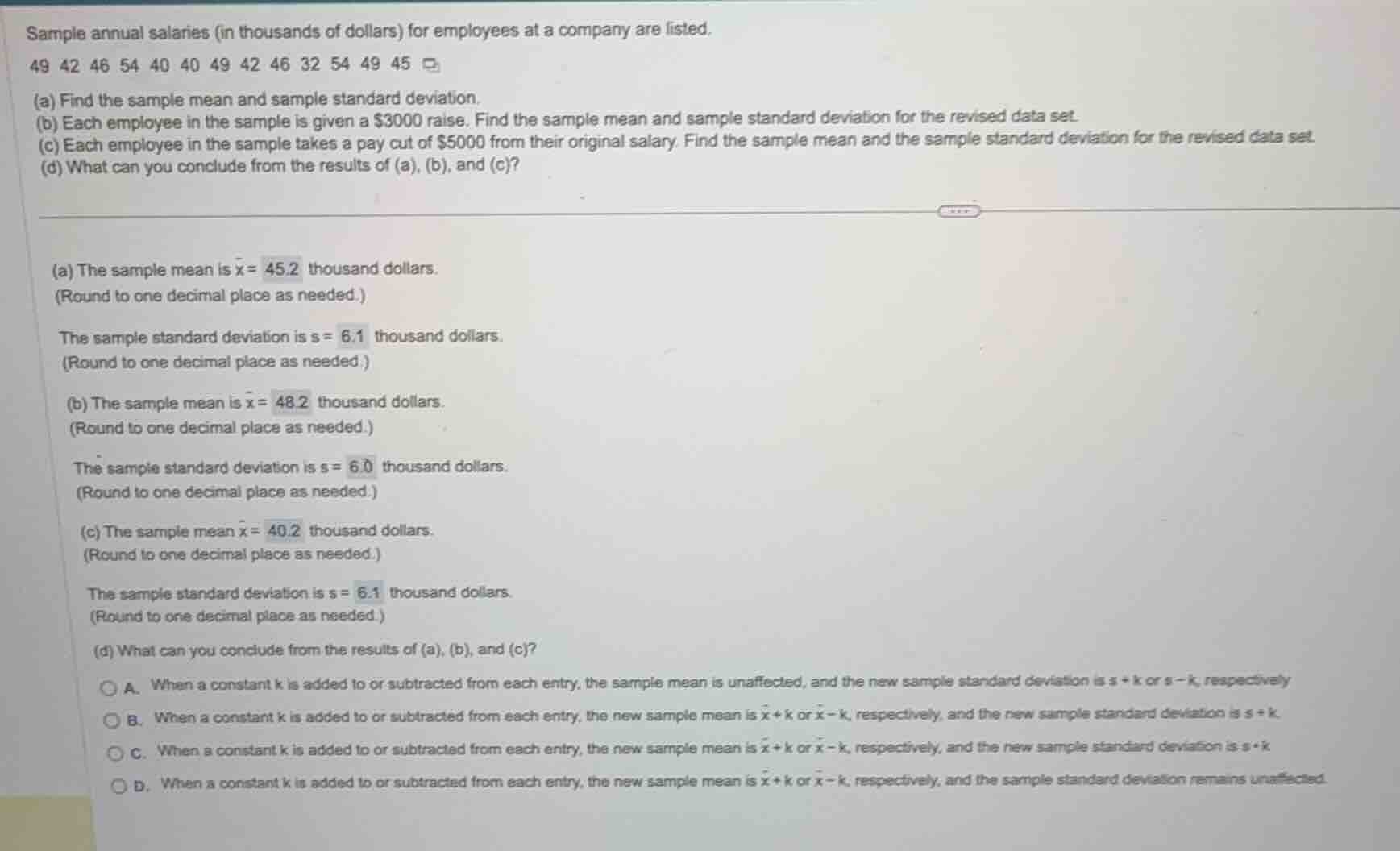
sample annual salaries (in thousands of dollars) for employees at a company are listed.
49 42 46 54 40 40 49 42 46 32 54 49 45
(a) find the sample mean and sample standard deviation.
(b) each employee in the sample is given a $3000 raise. find the sample mean and sample standard deviation for the revised data set.
(c) each employee in the sample takes a pay cut of $5000 from their original salary. find the sample mean and sample standard deviation for the revised data set.
(d) what can you conclude from the results of (a), (b), and (c)?
(a) the sample mean is \\(\bar{x} = 45.2\\) thousand dollars.
(round to one decimal place as needed.)
the sample standard deviation is \\(s = 6.1\\) thousand dollars.
(round to one decimal place as needed.)
(b) the sample mean is \\(\bar{x} = 48.2\\) thousand dollars.
(round to one decimal place as needed.)
the sample standard deviation is \\(s = 6.0\\) thousand dollars.
(round to one decimal place as needed.)
(c) the sample mean \\(\bar{x} = 40.2\\) thousand dollars.
(round to one decimal place as needed.)
the sample standard deviation is \\(s = 6.1\\) thousand dollars.
(round to one decimal place as needed.)
(d) what can you conclude from the results of (a), (b), and (c)?
a. when a constant \\(k\\) is added to or subtracted from each entry, the sample mean is unaffected, and the new sample standard deviation is \\(s + k\\) or \\(s - k\\), respectively.
b. when a constant \\(k\\) is added to or subtracted from each entry, the new sample mean is \\(\bar{x} + k\\) or \\(\bar{x} - k\\), respectively, and the new sample standard deviation is \\(s + k\\).
c. when a constant \\(k\\) is added to or subtracted from each entry, the new sample mean is \\(\bar{x} + k\\) or \\(\bar{x} - k\\), respectively, and the new sample standard deviation is \\(s \cdot k\\).
d. when a constant \\(k\\) is added to or subtracted from each entry, the new sample mean is \\(\bar{x} + k\\) or \\(\bar{x} - k\\), respectively, and the sample standard deviation remains unaffected.
Calculate original sample statistics
Using the Mean Calculation and Sample Standard Deviation knowledge points
The sample data is: \(49, 42, 46, 54, 40, 40, 49, 42, 46, 32, 54, 49, 45\)
Number of observations \(n = 13\)
Analyze effect of adding a constant
Using the Linear Transformation of Data knowledge point
Adding \(k = 3\) thousand dollars to each entry:
Analyze effect of subtracting a constant
Using the Linear Transformation of Data knowledge point
Subtracting \(k = 5\) thousand dollars from each entry:
Formulate general conclusion
Using the Linear Transformation of Data knowledge point
When a constant \(k\) is added to or subtracted from each entry:
- The new sample mean is \(\bar{x} + k\) or \(\bar{x} - k\), respectively.
- The sample standard deviation remains unaffected.
This matches option D.

Snap & solve any problem in the app
Get step-by-step solutions on Sovi AI
Photo-based solutions with guided steps
Explore more problems and detailed explanations
Question 1
(a) The sample mean is \(\bar{x} =\) <blank>45.2</blank> thousand dollars.
The sample standard deviation is \(s =\) <blank>6.1</blank> thousand dollars.
Question 2
(b) The sample mean is \(\bar{x} =\) <blank>48.2</blank> thousand dollars.
The sample standard deviation is \(s =\) <blank>6.1</blank> thousand dollars.
Question 3
(c) The sample mean is \(\bar{x} =\) <blank>40.2</blank> thousand dollars.
The sample standard deviation is \(s =\) <blank>6.1</blank> thousand dollars.
Question 4
- A. When a constant k is added to or subtracted from each entry, the sample mean is unaffected, and the new sample standard deviation is s + k or s - k, respectively.
- B. When a constant k is added to or subtracted from each entry, the new sample mean is \(\bar{x} + k\) or \(\bar{x} - k\), respectively, and the new sample standard deviation is s + k.
- C. When a constant k is added to or subtracted from each entry, the new sample mean is \(\bar{x} + k\) or \(\bar{x} - k\), respectively, and the new sample standard deviation is s - k.
- D. When a constant k is added to or subtracted from each entry, the new sample mean is \(\bar{x} + k\) or \(\bar{x} - k\), respectively, and the sample standard deviation remains unaffected. (Correct answer)