QUESTION IMAGE
Question
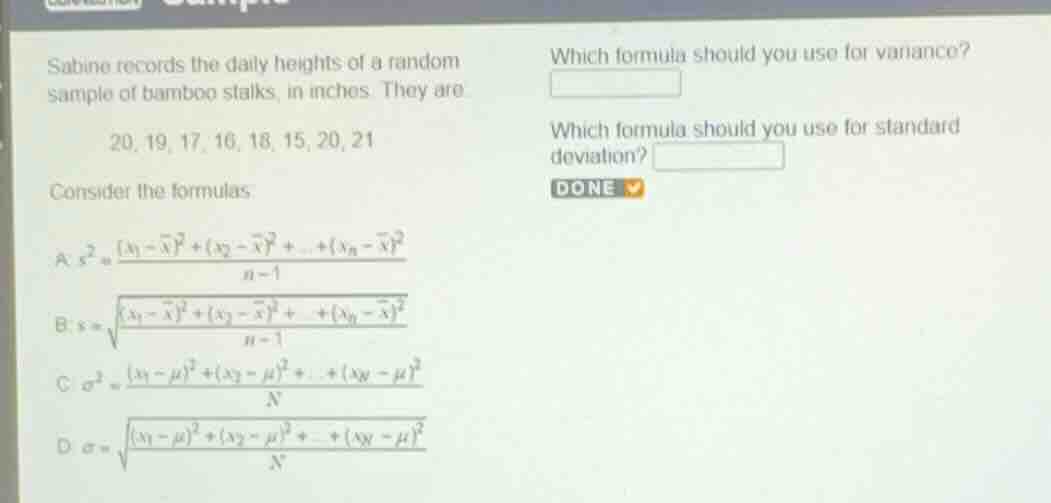
sabine records the daily heights of a random sample of bamboo stalks, in inches. they are:
20, 19, 17, 16, 18, 15, 20, 21
consider the formulas:
a. (s^2 = \frac{(x_1 - \bar{x})^2 + (x_2 - \bar{x})^2 + \dots + (x_n - \bar{x})^2}{n - 1})
b. (s = \sqrt{\frac{(x_1 - \bar{x})^2 + (x_2 - \bar{x})^2 + \dots + (x_n - \bar{x})^2}{n - 1}})
c. (\sigma^2 = \frac{(x_1 - \mu)^2 + (x_2 - \mu)^2 + \dots + (x_n - \mu)^2}{n})
d. (\sigma = \sqrt{\frac{(x_1 - \mu)^2 + (x_2 - \mu)^2 + \dots + (x_n - \mu)^2}{n}})
which formula should you use for variance?
which formula should you use for standard deviation?
Identify data type
Using the Population Variance Calculation and Population Standard Deviation knowledge points
The problem states that Sabine records the daily heights of a "random sample" of bamboo stalks. Since this dataset represents a sample rather than an entire population, we must use the sample formulas for variance and standard deviation.
Select variance formula
Using the Population Variance Calculation knowledge point
For a sample, the variance is denoted by \(s^2\) and uses a denominator of \(n-1\):
This corresponds to formula A.
Select standard deviation formula
Using the Population Standard Deviation knowledge point
For a sample, the standard deviation is denoted by \(s\) and is the square root of the sample variance:
This corresponds to formula B.

Snap & solve any problem in the app
Get step-by-step solutions on Sovi AI
Photo-based solutions with guided steps
Explore more problems and detailed explanations
Question 1
Which formula should you use for variance? <blank>A</blank>
Question 2
Which formula should you use for standard deviation? <blank>B</blank>