QUESTION IMAGE
Question
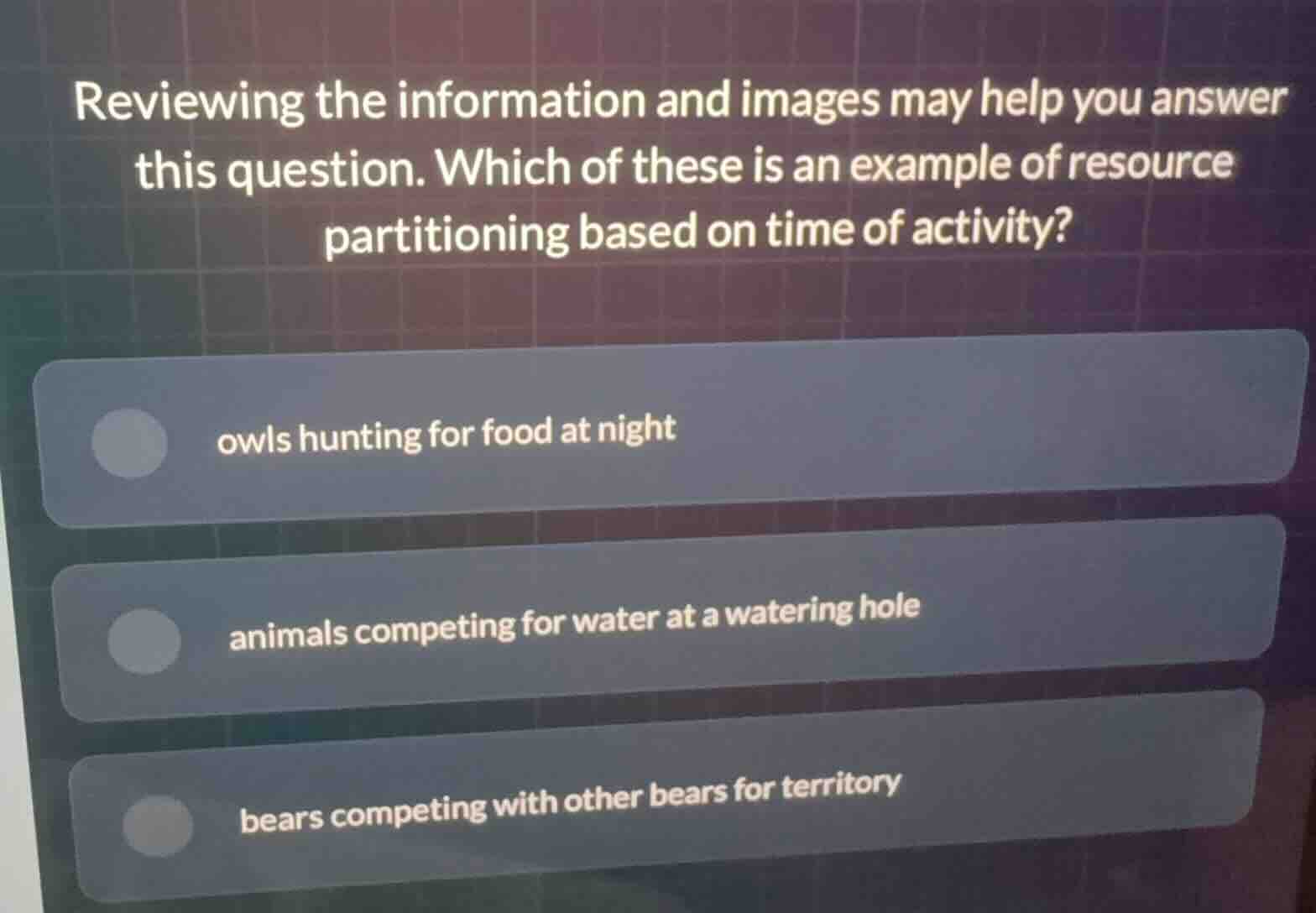
reviewing the information and images may help you answer this question. which of these is an example of resource partitioning based on time of activity?
owls hunting for food at night
animals competing for water at a watering hole
bears competing with other bears for territory
🆕 New Concept Discovered: Resource Partitioning
Sharing resources by using them at different times or places.
Step 1: Understand Resource Partitioning
Resource partitioning is an evolutionary process where species with similar requirements use shared resources in different ways, at different times, or in different places. This division of resources helps reduce direct competition, allowing multiple species to coexist in the same habitat.
Step 2: Analyze the Specific Requirement
The question asks for an example of resource partitioning based specifically on the time of activity (temporal partitioning). This means we are looking for a scenario where organisms avoid direct competition by being active or hunting at different times of the day or night.
Step 3: Evaluate the Options
- owls hunting for food at night: Owls hunt at night (nocturnal), while other birds of prey (like hawks) hunt for similar food during the day (diurnal). This is a classic example of temporal resource partitioning because they share the same food resource but hunt at different times.
- animals competing for water at a watering hole: This describes active competition for a resource rather than partitioning it to avoid competition.
- bears competing with other bears for territory: This is an example of direct intraspecific competition (competition within the same species) rather than resource partitioning.

Snap & solve any problem in the app
Get step-by-step solutions on Sovi AI
Photo-based solutions with guided steps
Explore more problems and detailed explanations
owls hunting for food at night