QUESTION IMAGE
Question
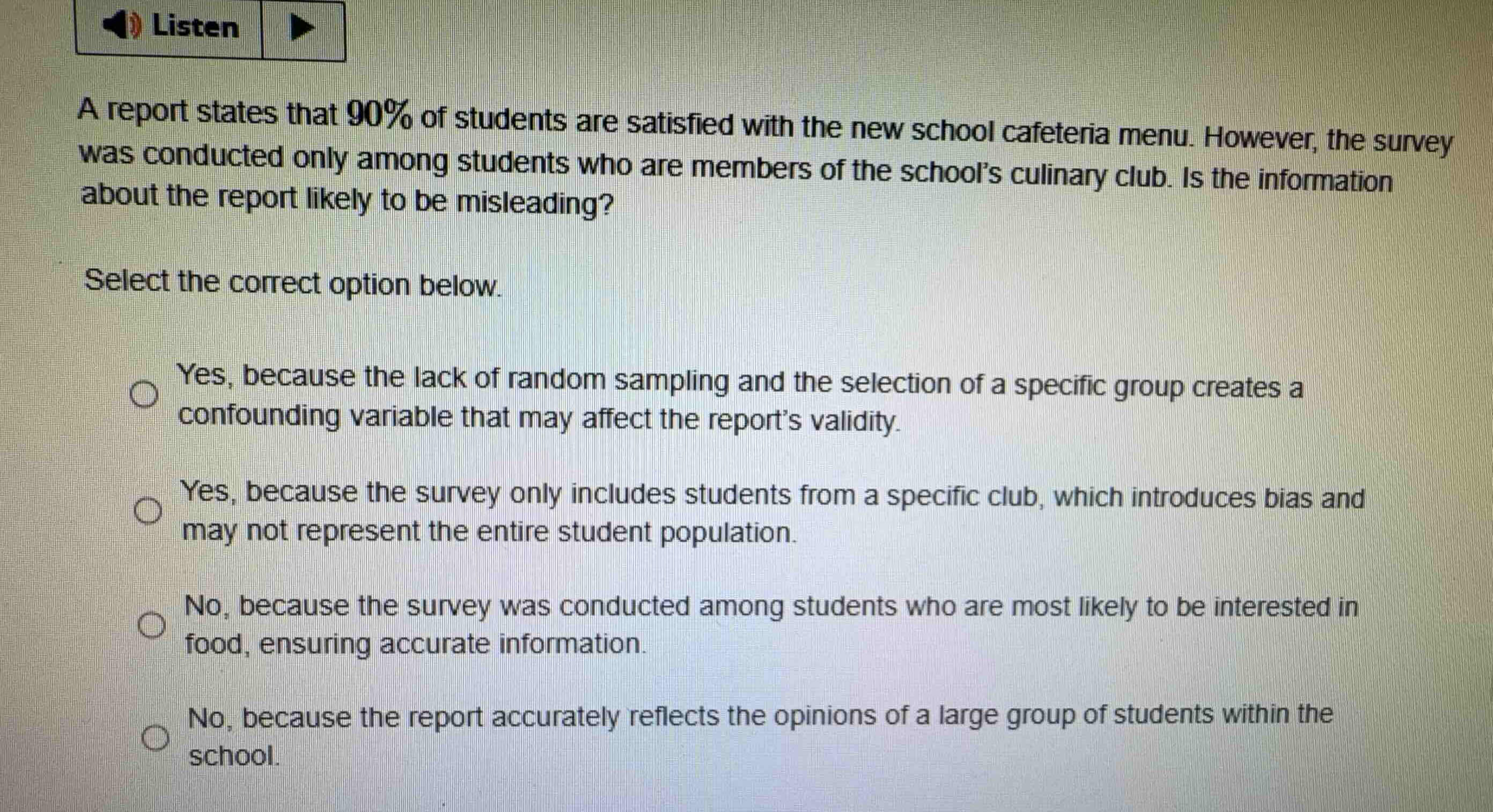
a report states that 90% of students are satisfied with the new school cafeteria menu. however, the survey was conducted only among students who are members of the schools culinary club. is the information about the report likely to be misleading?
select the correct option below.
- yes, because the lack of random sampling and the selection of a specific group creates a confounding variable that may affect the reports validity.
- yes, because the survey only includes students from a specific club, which introduces bias and may not represent the entire student population.
- no, because the survey was conducted among students who are most likely to be interested in food, ensuring accurate information.
- no, because the report accurately reflects the opinions of a large group of students within the school.
Analyze the survey population
The report claims that \(90\%\) of all students are satisfied with the new cafeteria menu. However, the survey was conducted exclusively among members of the school's culinary club.
Evaluate representativeness
A culinary club consists of students with a specific interest in food and cooking. Their opinions on cafeteria food may systematically differ from those of the general student body, meaning this sample is not representative of the entire school population.
Identify the source of error
Limiting a survey to a specific, non-random subgroup introduces sampling bias. Because the sample does not represent the entire student population, the generalized claim about "all students" is likely to be misleading.
Compare the given options
- Option 1 suggests a confounding variable, but the primary issue is selection bias/undercoverage rather than an uncontrolled confounding variable in an experiment.
- Option 2 correctly identifies that surveying only a specific club introduces bias and fails to represent the entire student population.
- Options 3 and 4 incorrectly claim the report is not misleading.

Snap & solve any problem in the app
Get step-by-step solutions on Sovi AI
Photo-based solutions with guided steps
Explore more problems and detailed explanations
- Yes, because the lack of random sampling and the selection of a specific group creates a confounding variable that may affect the report's validity.
- Yes, because the survey only includes students from a specific club, which introduces bias and may not represent the entire student population. (Correct answer)
- No, because the survey was conducted among students who are most likely to be interested in food, ensuring accurate information.
- No, because the report accurately reflects the opinions of a large group of students within the school.