QUESTION IMAGE
Question
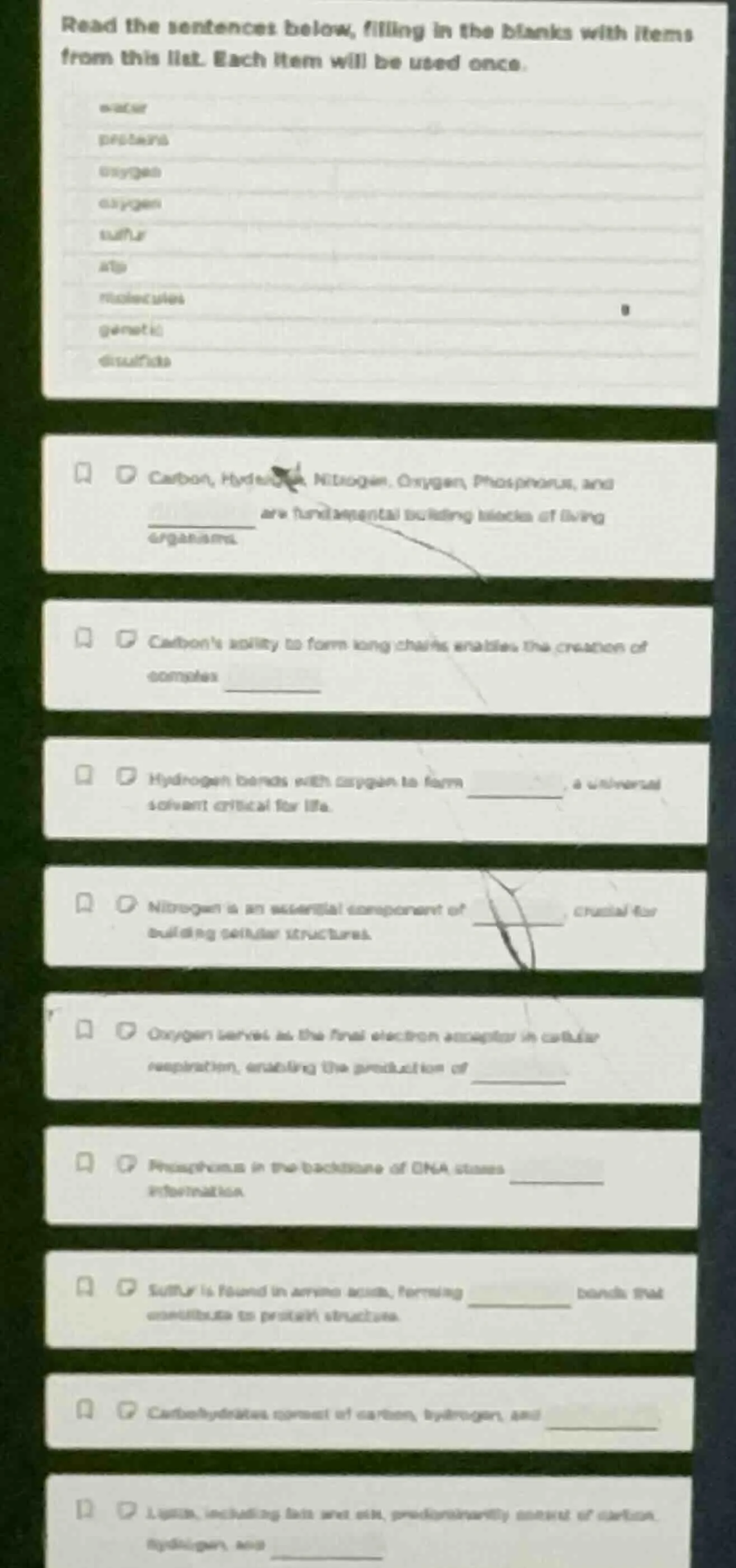
read the sentences below, filling in the blanks with items from this list. each item will be used once.
water
proteins
oxygen
oxygen
sulfur
atp
molecules
genetic
disulfide
carbon, hydrogen, nitrogen, oxygen, phosphorus, and ______ are fundamental building blocks of living organisms.
carbons ability to form long chains enables the creation of complex ______
hydrogen bonds with oxygen to form ______, a universal solvent critical for life.
nitrogen is an essential component of ______, crucial for building cellular structures.
oxygen serves as the final electron acceptor in cellular respiration, enabling the production of ______.
phosphorus in the backbone of dna stores ______ information.
sulfur is found in amino acids, forming ______ bonds that contribute to protein structure.
carbohydrates consist of carbon, hydrogen, and ______.
lipids, including fats and oils, predominantly consist of carbon, hydrogen, and ______
- The main elements of life (CHNOPS) include Sulfur as the final listed element.
- Carbon's bonding forms complex biological molecules.
- Hydrogen + Oxygen = water, the universal solvent.
- Nitrogen is a key part of proteins for cell structure.
- Cellular respiration with oxygen produces ATP for energy.
- DNA (with phosphorus in its backbone) stores genetic information.
- Sulfur in amino acids creates disulfide bonds for protein shape.
- Carbohydrates have the formula (CH₂O)ₙ, so oxygen is a core element.
- Lipids (fats/oils) are primarily made of carbon, hydrogen, and oxygen.

Snap & solve any problem in the app
Get step-by-step solutions on Sovi AI
Photo-based solutions with guided steps
Explore more problems and detailed explanations
- Sulfur
- molecules
- water
- proteins
- atp
- genetic
- disulfide
- oxygen
- oxygen