QUESTION IMAGE
Question
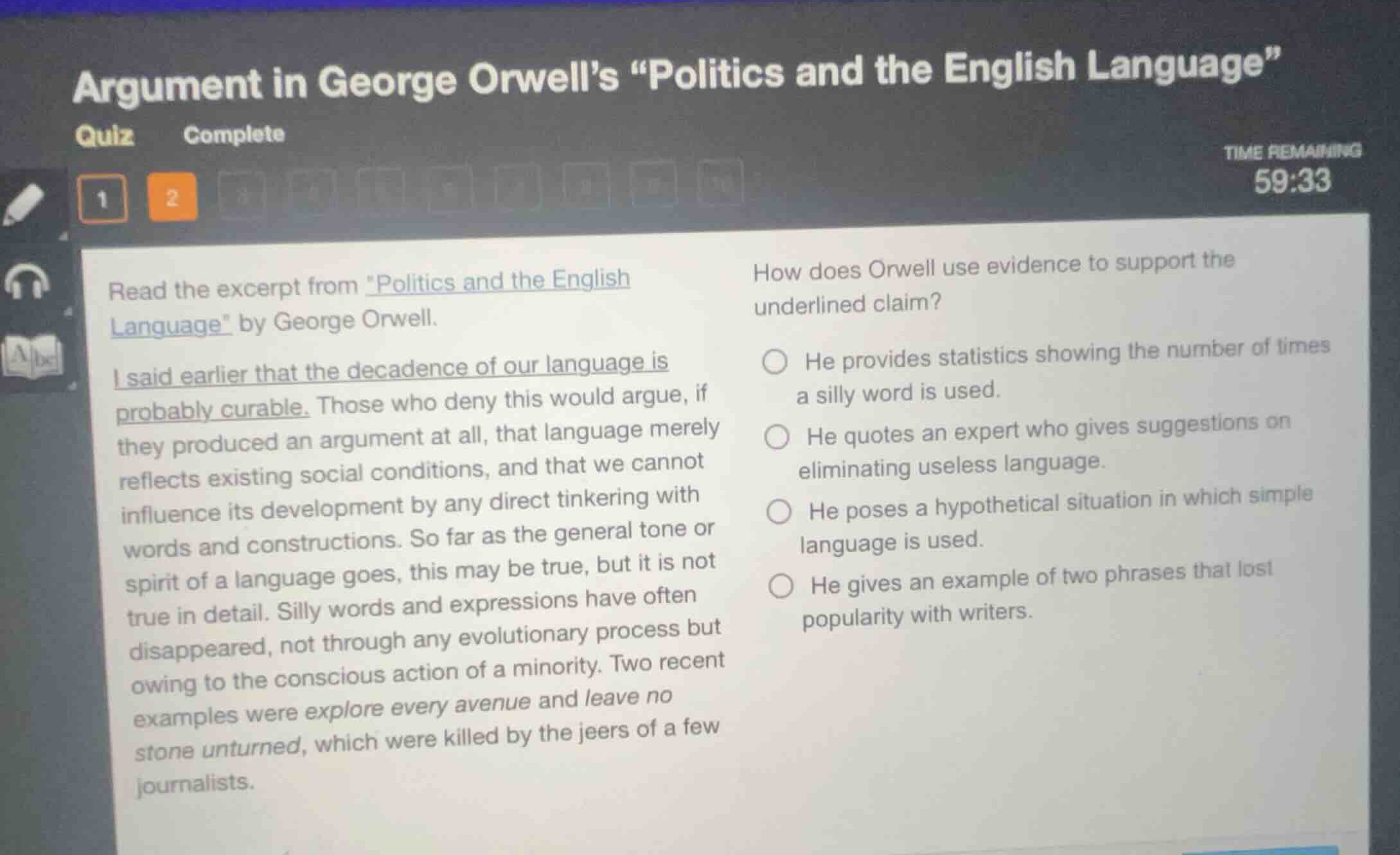
read the excerpt from \politics and the english language\ by george orwell.
i said earlier that the decadence of our language is probably curable. those who deny this would argue, if they produced an argument at all, that language merely reflects existing social conditions, and that we cannot influence its development by any direct tinkering with words and constructions. so far as the general tone or spirit of a language goes, this may be true, but it is not true in detail. silly words and expressions have often disappeared, not through any evolutionary process but owing to the conscious action of a minority. two recent examples were explore every avenue and leave no stone unturned, which were killed by the jeers of a few journalists.
how does orwell use evidence to support the underlined claim?
he provides statistics showing the number of times a silly word is used.
he quotes an expert who gives suggestions on eliminating useless language.
he poses a hypothetical situation in which simple language is used.
he gives an example of two phrases that lost popularity with writers.
Identify the underlined claim
The underlined claim is: "I said earlier that the decadence of our language is probably curable."
Analyze the supporting evidence
Orwell argues that language development can be influenced by direct tinkering. He states that silly words and expressions disappear "owing to the conscious action of a minority."
Evaluate the specific examples
To support this, Orwell provides two specific examples of phrases: "explore every avenue" and "leave no stone unturned." He explains that these clichés "were killed by the jeers of a few journalists."
Connect to the options
Using Evidence Evaluation and Textual Support, we analyze how these examples function. The phrases "explore every avenue" and "leave no stone unturned" are examples of clichés (silly expressions) that lost popularity ("were killed") due to conscious action (the "jeers of a few journalists"). This matches the fourth option.

Snap & solve any problem in the app
Get step-by-step solutions on Sovi AI
Photo-based solutions with guided steps
Explore more problems and detailed explanations
- (A) He provides statistics showing the number of times a silly word is used.
- (B) He quotes an expert who gives suggestions on eliminating useless language.
<mcq-option>(C) He poses a hypothetical situation in which simple language is used.</mcq-correct>
- (D) He gives an example of two phrases that lost popularity with writers. (Correct answer)