QUESTION IMAGE
Question
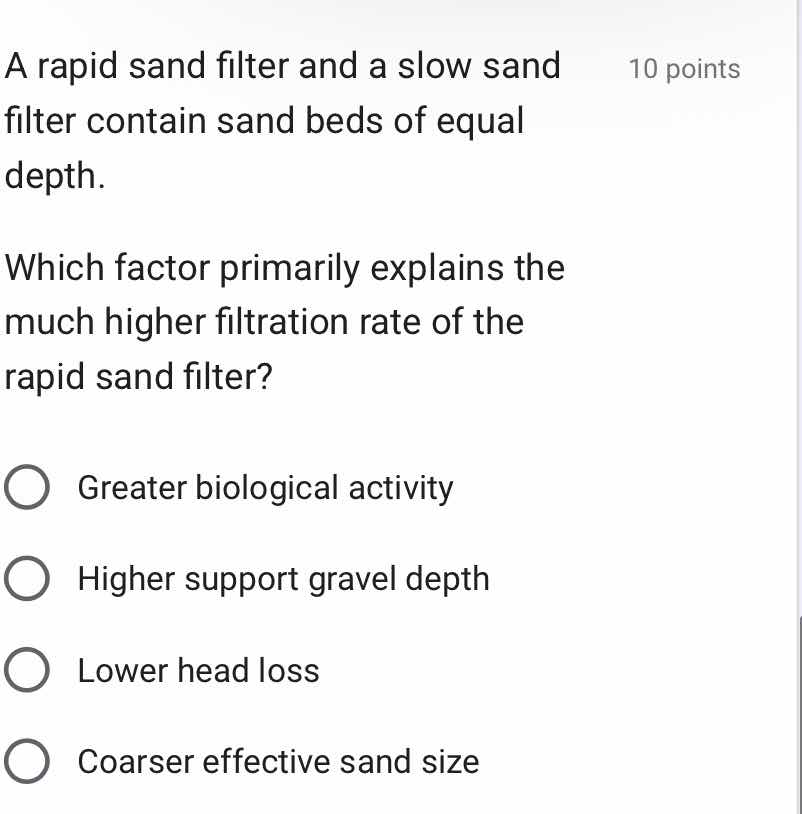
a rapid sand filter and a slow sand filter contain sand beds of equal depth.
which factor primarily explains the much higher filtration rate of the rapid sand filter?
greater biological activity
higher support gravel depth
lower head loss
coarser effective sand size
🆕 New Concept Discovered: Sand Filter Hydraulics
How grain size controls water flow rate.
Step 1: Analyze the physics of porous media flow
The rate of water flow through a porous medium (like a sand bed) is governed by Darcy's Law:
where \( K \) is the hydraulic conductivity of the media. According to the Hazen formula, hydraulic conductivity is directly proportional to the square of the effective size of the sand grains (\( d_{10} \)):
Step 2: Compare rapid and slow sand filters
- Effective Sand Size (\( d_{10} \)): Rapid sand filters use much coarser sand (typically \( 0.45\text{ to }0.55\text{ mm} \)) compared to slow sand filters (typically \( 0.15\text{ to }0.35\text{ mm} \)). Larger sand grains create larger pore spaces, significantly increasing hydraulic conductivity and allowing water to pass through much faster.
- Biological Activity: Slow sand filters rely heavily on a biological layer (schmutzdecke) to treat water, which actually restricts flow and slows down filtration. Rapid sand filters rely primarily on physical straining and chemical coagulation, having minimal biological activity.
- Support Gravel Depth: The depth of the supporting gravel layer does not dictate the primary filtration rate of the sand bed itself.
- Head Loss: Rapid sand filters operate under higher head loss limits before backwashing is required, not lower.
Therefore, the coarser effective sand size is the primary physical factor that enables the much higher filtration rate.

Snap & solve any problem in the app
Get step-by-step solutions on Sovi AI
Photo-based solutions with guided steps
Explore more problems and detailed explanations
Coarser effective sand size